Local government faces challenge implementing generative AI ethically whilst maintaining public trust and data security as new EU AI Act regulations require basic AI literacy training for staff.
Khizer Ahmed Biyabani, researcher with ADAPT at Trinity College Dublin and 2025 Digital
Transformation Rising IT Star winner, alongside Richie Shakespeare, assistant staff officer Dublin City Council, explain Ireland's first local government generative AI Lab translating academic research into practical ethical AI tools, how retrieval model analysing council meeting minutes avoids hallucinations by training only on specific datasets preventing New South Wales Australia confusion, why four pillars covering governance, education, proof of concepts and enterprise scaling create systematic approach, and how smart gully life buoy monitoring sensors demonstrate broader Smart Cities innovation culture.
Khizer Ahmed Biyabani is researcher with ADAPT at Trinity College Dublin recently winning Rising IT Star in Public Sector Award at 2025 Digital Transformation and AI Awards. Co-leading Ireland's first local government generative AI Lab translating academic research into ethical practical AI tools for public services, he runs Explain IT workshops with colleague Claudia Bailey from Smart Documents under Academy Near Future programme at Connect Resource Centre providing basic AI literacy training required by EU AI Act Article Four.
Richie Shakespeare is assistant staff officer in Dublin City Council working within Smart Cities tech innovation section examining new emerging technologies, innovative processes and collaboration models making city operate smarter. Co-leading local government generative AI Lab partnership with ADAPT Centre at Trinity College Dublin, he focuses on internal process improvements identifying pain points staff experience whilst maintaining ethical considerations around data sensitivity and personal information protection.
Connect with the Gen AI Lab:
Website: www.adaptcentre.ie
ADAPT Centre at Trinity College Dublin
Dublin City Council Smart Cities Division
MORE INFORMATION
You can learn more about the Sea-Scan project and other cutting-edge research at Trinity College Dublin's ADAPT Centre here: www.adaptcentre.ie/
Adapt Radio is produced by DustPod.io for the ADAPT Centre
For more information about ADAPT's groundbreaking AI and data analytics research visit www.adaptcentre.ie/
All content for ADAPT Radio is the property of The ADAPT Centre and is served directly from their servers
with no modification, redirects, or rehosting. The podcast is not affiliated with or endorsed by Podjoint in any way.
Local government faces challenge implementing generative AI ethically whilst maintaining public trust and data security as new EU AI Act regulations require basic AI literacy training for staff.
Khizer Ahmed Biyabani, researcher with ADAPT at Trinity College Dublin and 2025 Digital
Transformation Rising IT Star winner, alongside Richie Shakespeare, assistant staff officer Dublin City Council, explain Ireland's first local government generative AI Lab translating academic research into practical ethical AI tools, how retrieval model analysing council meeting minutes avoids hallucinations by training only on specific datasets preventing New South Wales Australia confusion, why four pillars covering governance, education, proof of concepts and enterprise scaling create systematic approach, and how smart gully life buoy monitoring sensors demonstrate broader Smart Cities innovation culture.
Khizer Ahmed Biyabani is researcher with ADAPT at Trinity College Dublin recently winning Rising IT Star in Public Sector Award at 2025 Digital Transformation and AI Awards. Co-leading Ireland's first local government generative AI Lab translating academic research into ethical practical AI tools for public services, he runs Explain IT workshops with colleague Claudia Bailey from Smart Documents under Academy Near Future programme at Connect Resource Centre providing basic AI literacy training required by EU AI Act Article Four.
Richie Shakespeare is assistant staff officer in Dublin City Council working within Smart Cities tech innovation section examining new emerging technologies, innovative processes and collaboration models making city operate smarter. Co-leading local government generative AI Lab partnership with ADAPT Centre at Trinity College Dublin, he focuses on internal process improvements identifying pain points staff experience whilst maintaining ethical considerations around data sensitivity and personal information protection.
Connect with the Gen AI Lab:
Website: www.adaptcentre.ie
ADAPT Centre at Trinity College Dublin
Dublin City Council Smart Cities Division
MORE INFORMATION
You can learn more about the Sea-Scan project and other cutting-edge research at Trinity College Dublin's ADAPT Centre here: www.adaptcentre.ie/
Adapt Radio is produced by DustPod.io for the ADAPT Centre
For more information about ADAPT's groundbreaking AI and data analytics research visit www.adaptcentre.ie/
AI is developing at such a rapid pace that we can get caught up in its potential capabilities and role in our future. However, there are still a lot of issues to rule out.
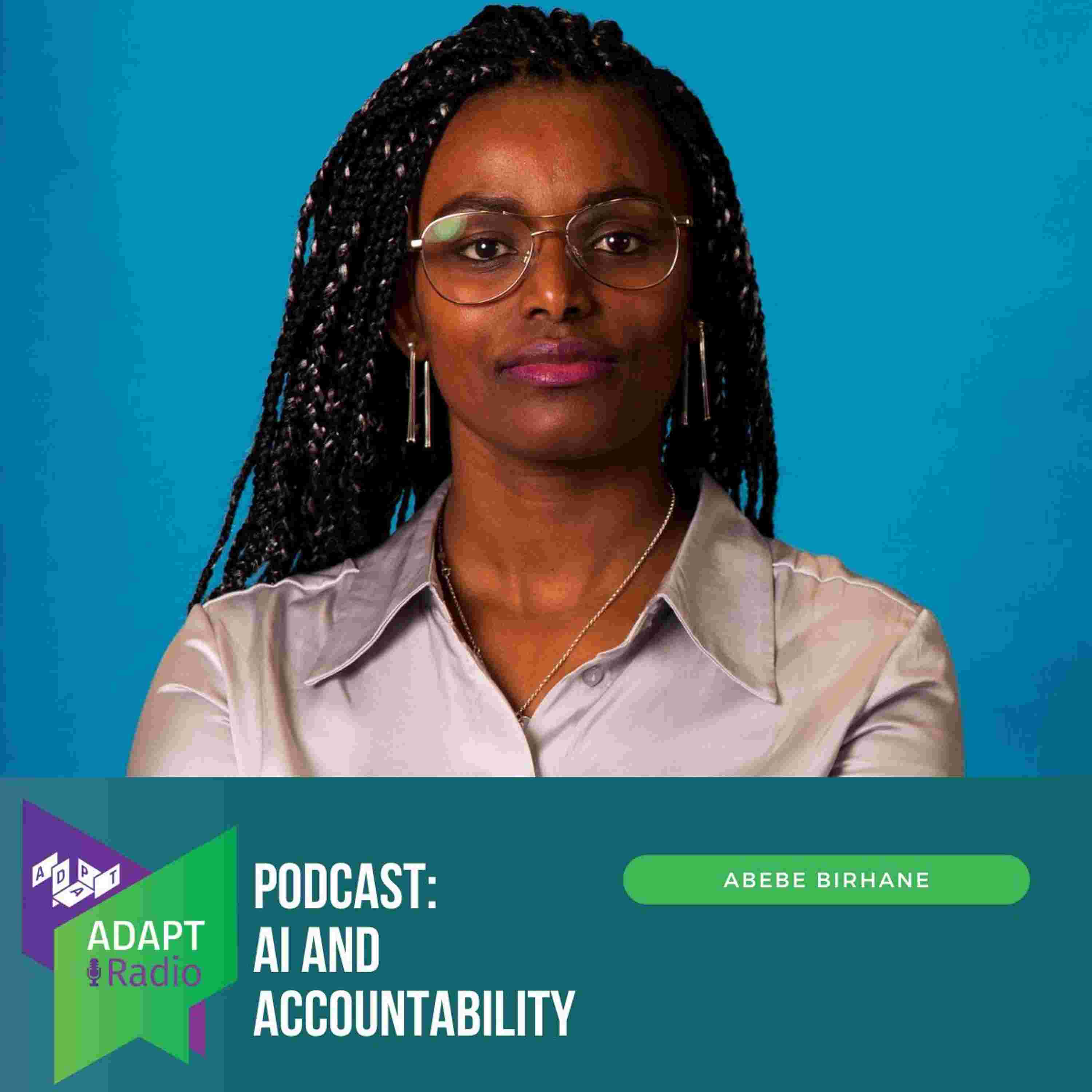
ADAPT recently hosted the Annual Scientific Conference 2024 in Dublin and today we’re hearing one of the keynote speakers, Abeba Birhane. We learn about the potential dangers of large-scale datasets, such as AI hallucinations and the reinforcement of societal biases and negative stereotypes. She also explored strategies for both incremental improvements and guiding broader structural changes in AI.
Our expert guest has been exploring strategies for both incremental improvements and guiding broader structural changes in AI. She is Senior Advisor for AI Accountability at Mozilla, Adjunct Professor at Trinity College Dublin and new ADAPT member, Abebe Birhane.
THINGS WE SPOKE ABOUT
● How rumours of autonomous AI distract from real issues
● Hallucinations creating factually incorrect information
● AI ownership giving power to the hands of the few
● Data issues with collection, copyright and biases
● Creating standards for the safe use and development of AI
GUEST DETAILS
Abeba Birhane is a cognitive scientist, currently a Senior Advisor in AI Accountability at the Mozilla Foundation and an Adjunct Assistant Professor in the School of Computer Science and Statistics at Trinity College Dublin (working with Trinity’s Complex Software Lab).
She researches human behaviour, social systems, and responsible and ethical artificial intelligence and was recently appointed to the UN’s Advisory Body on AI. Abeba works at the intersection of complex adaptive systems, machine learning, algorithmic bias, and critical race studies. In her present work, Abeba examines the challenges and pitfalls of computational models and datasets from a conceptual, empirical, and critical perspective.
Abeba Birhane has a PhD in cognitive science at the School of Computer Science, UCD, and Lero, The Irish Software Research Centre. Her interdisciplinary research focused on the dynamic and reciprocal relationship between ubiquitous technologies, personhood, and society. Specifically, she explored how ubiquitous technologies constitute and shape what it means to be a person through the lenses of embodied cognitive science, complexity science, and critical data studies.
Her work with Vinay Prabhu uncovered that large-scale image datasets commonly used to develop AI systems, including ImageNet and 80 Million Tiny Images, carried racist and misogynistic labels and offensive images. She has been recognised by VentureBeat as a top innovator in computer vision.
MORE INFORMATION
Adapt Radio is produced by DustPod.io for the Adapt Centre
For more information about ADAPT visit www.adaptcentre.ie/
QUOTES
Generative AI has been around for quite some time, but the introduction of DALL-E back in April 2022 can be noted as one of the landmarks where generative AI really exploded into the public space. - Abeba Birhane
These hypothetical AI concerns, existential concerns, about the very idea of this attempt to build AGI has neither scientific nor engineering principles. Again, a lot of it is just hype, marketing, and PR, that is just really dominating the entire field. - Abeba Birhane
The results are really worrying, over 50% of the output from these models was inaccurate, 40%, harmful, and incomplete - Abeba Birhane
There is no such thing as fully autonomous AI, we will always need people, humans, in the loop. - Abeba Birhane
KEYWORDS
#ai #data #audit #research #chatgpt #ethicalai
ADAPT Radio
Local government faces challenge implementing generative AI ethically whilst maintaining public trust and data security as new EU AI Act regulations require basic AI literacy training for staff.
Khizer Ahmed Biyabani, researcher with ADAPT at Trinity College Dublin and 2025 Digital
Transformation Rising IT Star winner, alongside Richie Shakespeare, assistant staff officer Dublin City Council, explain Ireland's first local government generative AI Lab translating academic research into practical ethical AI tools, how retrieval model analysing council meeting minutes avoids hallucinations by training only on specific datasets preventing New South Wales Australia confusion, why four pillars covering governance, education, proof of concepts and enterprise scaling create systematic approach, and how smart gully life buoy monitoring sensors demonstrate broader Smart Cities innovation culture.
Khizer Ahmed Biyabani is researcher with ADAPT at Trinity College Dublin recently winning Rising IT Star in Public Sector Award at 2025 Digital Transformation and AI Awards. Co-leading Ireland's first local government generative AI Lab translating academic research into ethical practical AI tools for public services, he runs Explain IT workshops with colleague Claudia Bailey from Smart Documents under Academy Near Future programme at Connect Resource Centre providing basic AI literacy training required by EU AI Act Article Four.
Richie Shakespeare is assistant staff officer in Dublin City Council working within Smart Cities tech innovation section examining new emerging technologies, innovative processes and collaboration models making city operate smarter. Co-leading local government generative AI Lab partnership with ADAPT Centre at Trinity College Dublin, he focuses on internal process improvements identifying pain points staff experience whilst maintaining ethical considerations around data sensitivity and personal information protection.
Connect with the Gen AI Lab:
Website: www.adaptcentre.ie
ADAPT Centre at Trinity College Dublin
Dublin City Council Smart Cities Division
MORE INFORMATION
You can learn more about the Sea-Scan project and other cutting-edge research at Trinity College Dublin's ADAPT Centre here: www.adaptcentre.ie/
Adapt Radio is produced by DustPod.io for the ADAPT Centre
For more information about ADAPT's groundbreaking AI and data analytics research visit www.adaptcentre.ie/