Local government faces challenge implementing generative AI ethically whilst maintaining public trust and data security as new EU AI Act regulations require basic AI literacy training for staff.
Khizer Ahmed Biyabani, researcher with ADAPT at Trinity College Dublin and 2025 Digital
Transformation Rising IT Star winner, alongside Richie Shakespeare, assistant staff officer Dublin City Council, explain Ireland's first local government generative AI Lab translating academic research into practical ethical AI tools, how retrieval model analysing council meeting minutes avoids hallucinations by training only on specific datasets preventing New South Wales Australia confusion, why four pillars covering governance, education, proof of concepts and enterprise scaling create systematic approach, and how smart gully life buoy monitoring sensors demonstrate broader Smart Cities innovation culture.
Khizer Ahmed Biyabani is researcher with ADAPT at Trinity College Dublin recently winning Rising IT Star in Public Sector Award at 2025 Digital Transformation and AI Awards. Co-leading Ireland's first local government generative AI Lab translating academic research into ethical practical AI tools for public services, he runs Explain IT workshops with colleague Claudia Bailey from Smart Documents under Academy Near Future programme at Connect Resource Centre providing basic AI literacy training required by EU AI Act Article Four.
Richie Shakespeare is assistant staff officer in Dublin City Council working within Smart Cities tech innovation section examining new emerging technologies, innovative processes and collaboration models making city operate smarter. Co-leading local government generative AI Lab partnership with ADAPT Centre at Trinity College Dublin, he focuses on internal process improvements identifying pain points staff experience whilst maintaining ethical considerations around data sensitivity and personal information protection.
Connect with the Gen AI Lab:
Website: www.adaptcentre.ie
ADAPT Centre at Trinity College Dublin
Dublin City Council Smart Cities Division
MORE INFORMATION
You can learn more about the Sea-Scan project and other cutting-edge research at Trinity College Dublin's ADAPT Centre here: www.adaptcentre.ie/
Adapt Radio is produced by DustPod.io for the ADAPT Centre
For more information about ADAPT's groundbreaking AI and data analytics research visit www.adaptcentre.ie/
All content for ADAPT Radio is the property of The ADAPT Centre and is served directly from their servers
with no modification, redirects, or rehosting. The podcast is not affiliated with or endorsed by Podjoint in any way.
Local government faces challenge implementing generative AI ethically whilst maintaining public trust and data security as new EU AI Act regulations require basic AI literacy training for staff.
Khizer Ahmed Biyabani, researcher with ADAPT at Trinity College Dublin and 2025 Digital
Transformation Rising IT Star winner, alongside Richie Shakespeare, assistant staff officer Dublin City Council, explain Ireland's first local government generative AI Lab translating academic research into practical ethical AI tools, how retrieval model analysing council meeting minutes avoids hallucinations by training only on specific datasets preventing New South Wales Australia confusion, why four pillars covering governance, education, proof of concepts and enterprise scaling create systematic approach, and how smart gully life buoy monitoring sensors demonstrate broader Smart Cities innovation culture.
Khizer Ahmed Biyabani is researcher with ADAPT at Trinity College Dublin recently winning Rising IT Star in Public Sector Award at 2025 Digital Transformation and AI Awards. Co-leading Ireland's first local government generative AI Lab translating academic research into ethical practical AI tools for public services, he runs Explain IT workshops with colleague Claudia Bailey from Smart Documents under Academy Near Future programme at Connect Resource Centre providing basic AI literacy training required by EU AI Act Article Four.
Richie Shakespeare is assistant staff officer in Dublin City Council working within Smart Cities tech innovation section examining new emerging technologies, innovative processes and collaboration models making city operate smarter. Co-leading local government generative AI Lab partnership with ADAPT Centre at Trinity College Dublin, he focuses on internal process improvements identifying pain points staff experience whilst maintaining ethical considerations around data sensitivity and personal information protection.
Connect with the Gen AI Lab:
Website: www.adaptcentre.ie
ADAPT Centre at Trinity College Dublin
Dublin City Council Smart Cities Division
MORE INFORMATION
You can learn more about the Sea-Scan project and other cutting-edge research at Trinity College Dublin's ADAPT Centre here: www.adaptcentre.ie/
Adapt Radio is produced by DustPod.io for the ADAPT Centre
For more information about ADAPT's groundbreaking AI and data analytics research visit www.adaptcentre.ie/
This podcast is also available with international sign language and closed captions on YouTube. https://youtu.be/vrvoiYNRpts
We live in an Uber digital world, and being able to access online information is an important part of life. Unfortunately, this isn’t always accessible for minority communities, such as the deaf and hard of hearing.
Today we learn about the challenges this community faces in the digital world and barriers that exist in sign language translation.
We hear from experts who have been in the SignON Project, which is a European project aimed at overcoming these issues and creating a more accessible online experience.
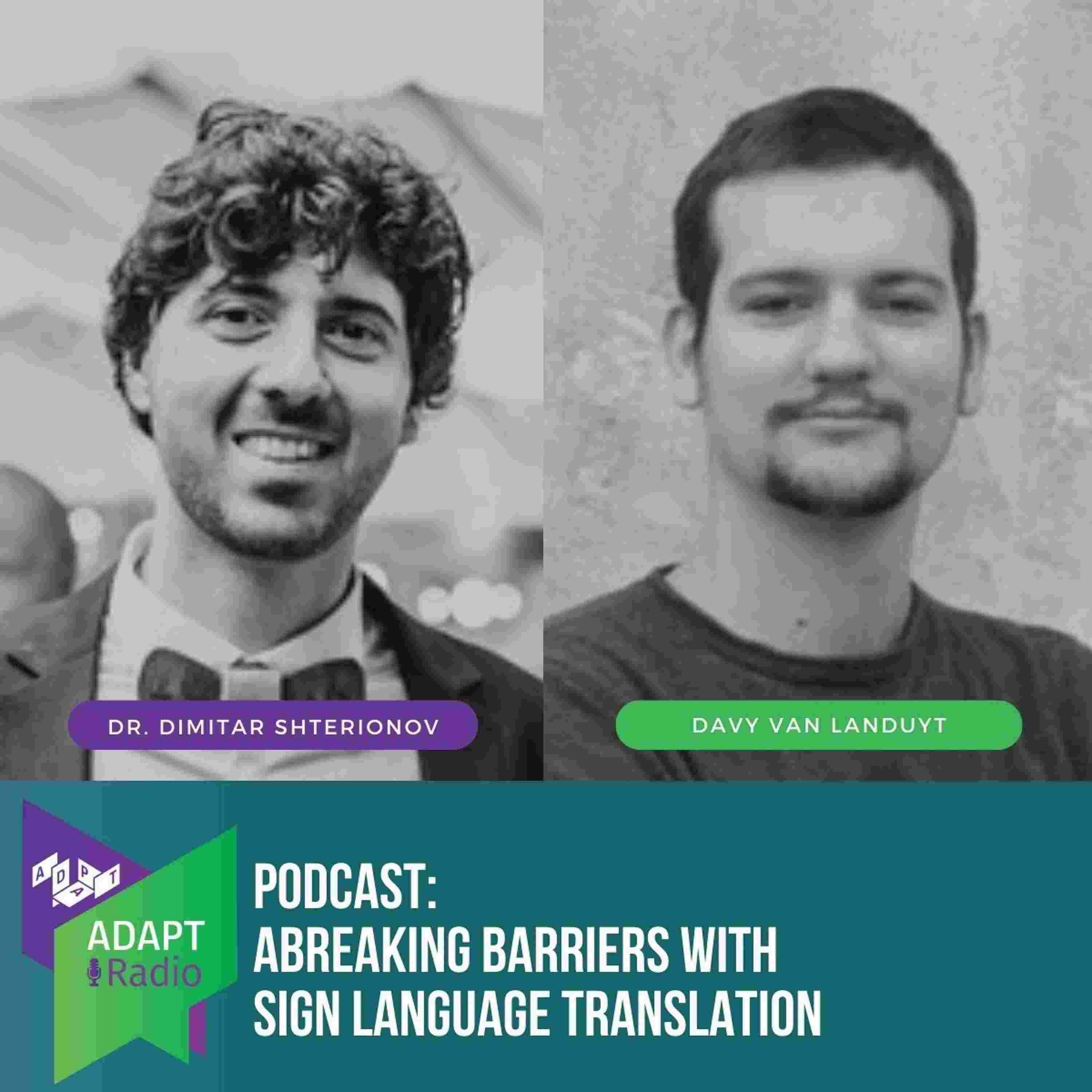
Our guests today are Dr. Dimitar Shterionov, Assistant Professor in Cognitive Science and Artificial Intelligence at Tilburg University, who was scientific lead on the project, and Davy Van Landuyt, Project Officer with the European Union of the Deaf and an end user of the project as a deaf person. We are also delighted to be joined by interpreter Romy O’Callaghan.
This podcast has been published in both audio and video format. For video format with sign language please click here.
THINGS WE SPOKE ABOUT
● The unique task of developing AI-powered technology for sign language translation
● Challenges faced by the deaf community in accessing online information
● How the SignON project is tackling these issues with new technology
● Importance of co-creation and involving the deaf and hard of hearing community
● Addressing data availability and quality before launching to the public
GUEST DETAILS
Dr. Dimitar Shterionov is Assistant Professor in Cognitive Science and Artificial Intelligence at Tilburg University, The Netherlands (scientific lead). Between January and July 2020 he worked as an assistant professor in Computing the School of Computing, DCU. Prior to that (2017 - 2019) he worked as a post-doctoral researcher in the ADAPT centre, DCU. He holds a PhD in computer science engineering from KULeuven, Belgium. He was the scientific lead of the EU-funded project on translation of sign and oral languages: SignON with Professor Andy Way of the ADAPT Centre.
Davy Van Landuyt is Project Officer with the European Union of the Deaf. Davy is a deaf Belgian with roots in the social-cultural movement and association work in the deaf community, going through all possible layers from the local level to the European level. Since 2021, he has worked as Project Officer for the European Union of the Deaf. Outside of his commitments in the deaf community, Davy is also active in the area of localization, specifically videogame and software localization in the Dutch language.
MORE INFORMATION
SignON is a European funded Horizon 2020 project that started in January 2021 and ran until December 2023, with the objective of addressing the communication gap between users of spoken languages and Deaf sign language users.
https://signon-project.eu/about-signon/the-signon-project/
Adapt Radio is produced by DustPod.io for the Adapt Centre
For more information about ADAPT visit www.adaptcentre.ie/
ADAPT Radio
Local government faces challenge implementing generative AI ethically whilst maintaining public trust and data security as new EU AI Act regulations require basic AI literacy training for staff.
Khizer Ahmed Biyabani, researcher with ADAPT at Trinity College Dublin and 2025 Digital
Transformation Rising IT Star winner, alongside Richie Shakespeare, assistant staff officer Dublin City Council, explain Ireland's first local government generative AI Lab translating academic research into practical ethical AI tools, how retrieval model analysing council meeting minutes avoids hallucinations by training only on specific datasets preventing New South Wales Australia confusion, why four pillars covering governance, education, proof of concepts and enterprise scaling create systematic approach, and how smart gully life buoy monitoring sensors demonstrate broader Smart Cities innovation culture.
Khizer Ahmed Biyabani is researcher with ADAPT at Trinity College Dublin recently winning Rising IT Star in Public Sector Award at 2025 Digital Transformation and AI Awards. Co-leading Ireland's first local government generative AI Lab translating academic research into ethical practical AI tools for public services, he runs Explain IT workshops with colleague Claudia Bailey from Smart Documents under Academy Near Future programme at Connect Resource Centre providing basic AI literacy training required by EU AI Act Article Four.
Richie Shakespeare is assistant staff officer in Dublin City Council working within Smart Cities tech innovation section examining new emerging technologies, innovative processes and collaboration models making city operate smarter. Co-leading local government generative AI Lab partnership with ADAPT Centre at Trinity College Dublin, he focuses on internal process improvements identifying pain points staff experience whilst maintaining ethical considerations around data sensitivity and personal information protection.
Connect with the Gen AI Lab:
Website: www.adaptcentre.ie
ADAPT Centre at Trinity College Dublin
Dublin City Council Smart Cities Division
MORE INFORMATION
You can learn more about the Sea-Scan project and other cutting-edge research at Trinity College Dublin's ADAPT Centre here: www.adaptcentre.ie/
Adapt Radio is produced by DustPod.io for the ADAPT Centre
For more information about ADAPT's groundbreaking AI and data analytics research visit www.adaptcentre.ie/