BUFFALO, NY — January 5, 2026 — A new #research paper featured as the #cover of Volume 17, Issue 12 of Aging-US was #published on December 22, 2025, titled “A combination of differential expression and network connectivity analyses identifies a common set of RNA splicing and processing genes altered with age across human tissues.”
In this study by Caio M.P.F. Batalha from the University of São Paulo, André Fujita from the University of São Paulo and Kyushu University, and Nadja C. de Souza-Pinto also from the University of São Paulo, researchers investigated how gene activity changes with age across multiple human tissues. They found that many tissues share common aging-related alterations in genes involved in RNA splicing and RNA processing. These findings are important because RNA processing is essential for accurate protein production, and disruptions in this process are linked to aging and disease.
Aging affects all tissues, yet identifying molecular changes that are shared across the body has remained challenging. To address this, researchers moved beyond traditional approaches that focus exclusively on changes in gene expression levels. They also analyzed how genes alter their patterns of interaction within regulatory networks, capturing age-related changes that are not evident from expression data alone.
“Gene expression data (in TPM – transcripts per million) were obtained from the Genotype-Tissue Expression (GTEx) project.”
Using RNA sequencing data from nearly one thousand human donors aged 20 to 70, the research team analyzed eight tissues, including blood, brain, heart, skin, and muscle. The results showed that many aging-related changes become evident only when gene network behavior is considered. When gene expression and network connectivity were analyzed together, a consistent group of genes emerged across tissues, most of which were linked to RNA splicing and RNA processing, key steps in the production of functional proteins.
The study also revealed that these RNA-related genes are highly interconnected at the protein level. Many of them form known protein complexes, including components of the spliceosome, which plays a central role in RNA maturation. With age, the interactions among these genes tend to reorganize in similar ways across tissues, pointing to a shared biological response rather than independent, tissue-specific effects.
In addition to RNA processing, the researchers observed age-related changes in pathways involved in managing damaged RNAs and proteins, including protein degradation, autophagy, and DNA damage response mechanisms. These pathways support cellular quality control and help limit the accumulation of molecular errors that increase with age.
Overall, this study identifies RNA splicing and RNA processing as central, conserved features of human aging across tissues. It also demonstrates that network-based approaches provide a more complete view of the aging transcriptome, offering new insights into age-related biological changes and potential directions for aging research.
DOI - https://doi.org/10.18632/aging.206347
Corresponding author - Nadja C. de Souza-Pinto - nadja@iq.usp.br
Abstract video - https://www.youtube.com/watch?v=A1slKwaSd6g
Subscribe for free publication alerts from Aging - https://www.aging-us.com/subscribe-to-toc-alerts
To learn more about the journal, please visit https://www.Aging-US.com and connect with us on social media at:
Bluesky - https://bsky.app/profile/aging-us.bsky.social
ResearchGate - https://www.researchgate.net/journal/Aging-1945-4589
Facebook - https://www.facebook.com/AgingUS/
X - https://twitter.com/AgingJrnl
Instagram - https://www.instagram.com/agingjrnl/
YouTube - https://www.youtube.com/@Aging-US
LinkedIn - https://www.linkedin.com/company/aging/
Pinterest - https://www.pinterest.com/AgingUS/
Spotify - https://open.spotify.com/show/1X4HQQgegjReaf6Mozn6Mc
MEDIA@IMPACTJOURNALS.COM
All content for Aging-US is the property of Aging-US Podcast and is served directly from their servers
with no modification, redirects, or rehosting. The podcast is not affiliated with or endorsed by Podjoint in any way.
BUFFALO, NY — January 5, 2026 — A new #research paper featured as the #cover of Volume 17, Issue 12 of Aging-US was #published on December 22, 2025, titled “A combination of differential expression and network connectivity analyses identifies a common set of RNA splicing and processing genes altered with age across human tissues.”
In this study by Caio M.P.F. Batalha from the University of São Paulo, André Fujita from the University of São Paulo and Kyushu University, and Nadja C. de Souza-Pinto also from the University of São Paulo, researchers investigated how gene activity changes with age across multiple human tissues. They found that many tissues share common aging-related alterations in genes involved in RNA splicing and RNA processing. These findings are important because RNA processing is essential for accurate protein production, and disruptions in this process are linked to aging and disease.
Aging affects all tissues, yet identifying molecular changes that are shared across the body has remained challenging. To address this, researchers moved beyond traditional approaches that focus exclusively on changes in gene expression levels. They also analyzed how genes alter their patterns of interaction within regulatory networks, capturing age-related changes that are not evident from expression data alone.
“Gene expression data (in TPM – transcripts per million) were obtained from the Genotype-Tissue Expression (GTEx) project.”
Using RNA sequencing data from nearly one thousand human donors aged 20 to 70, the research team analyzed eight tissues, including blood, brain, heart, skin, and muscle. The results showed that many aging-related changes become evident only when gene network behavior is considered. When gene expression and network connectivity were analyzed together, a consistent group of genes emerged across tissues, most of which were linked to RNA splicing and RNA processing, key steps in the production of functional proteins.
The study also revealed that these RNA-related genes are highly interconnected at the protein level. Many of them form known protein complexes, including components of the spliceosome, which plays a central role in RNA maturation. With age, the interactions among these genes tend to reorganize in similar ways across tissues, pointing to a shared biological response rather than independent, tissue-specific effects.
In addition to RNA processing, the researchers observed age-related changes in pathways involved in managing damaged RNAs and proteins, including protein degradation, autophagy, and DNA damage response mechanisms. These pathways support cellular quality control and help limit the accumulation of molecular errors that increase with age.
Overall, this study identifies RNA splicing and RNA processing as central, conserved features of human aging across tissues. It also demonstrates that network-based approaches provide a more complete view of the aging transcriptome, offering new insights into age-related biological changes and potential directions for aging research.
DOI - https://doi.org/10.18632/aging.206347
Corresponding author - Nadja C. de Souza-Pinto - nadja@iq.usp.br
Abstract video - https://www.youtube.com/watch?v=A1slKwaSd6g
Subscribe for free publication alerts from Aging - https://www.aging-us.com/subscribe-to-toc-alerts
To learn more about the journal, please visit https://www.Aging-US.com and connect with us on social media at:
Bluesky - https://bsky.app/profile/aging-us.bsky.social
ResearchGate - https://www.researchgate.net/journal/Aging-1945-4589
Facebook - https://www.facebook.com/AgingUS/
X - https://twitter.com/AgingJrnl
Instagram - https://www.instagram.com/agingjrnl/
YouTube - https://www.youtube.com/@Aging-US
LinkedIn - https://www.linkedin.com/company/aging/
Pinterest - https://www.pinterest.com/AgingUS/
Spotify - https://open.spotify.com/show/1X4HQQgegjReaf6Mozn6Mc
MEDIA@IMPACTJOURNALS.COM
Machine Learning Identifies Senescence-Inducing Compound for p16-Positive Cancer Cells
Aging-US
3 minutes 58 seconds
1 month ago
Machine Learning Identifies Senescence-Inducing Compound for p16-Positive Cancer Cells
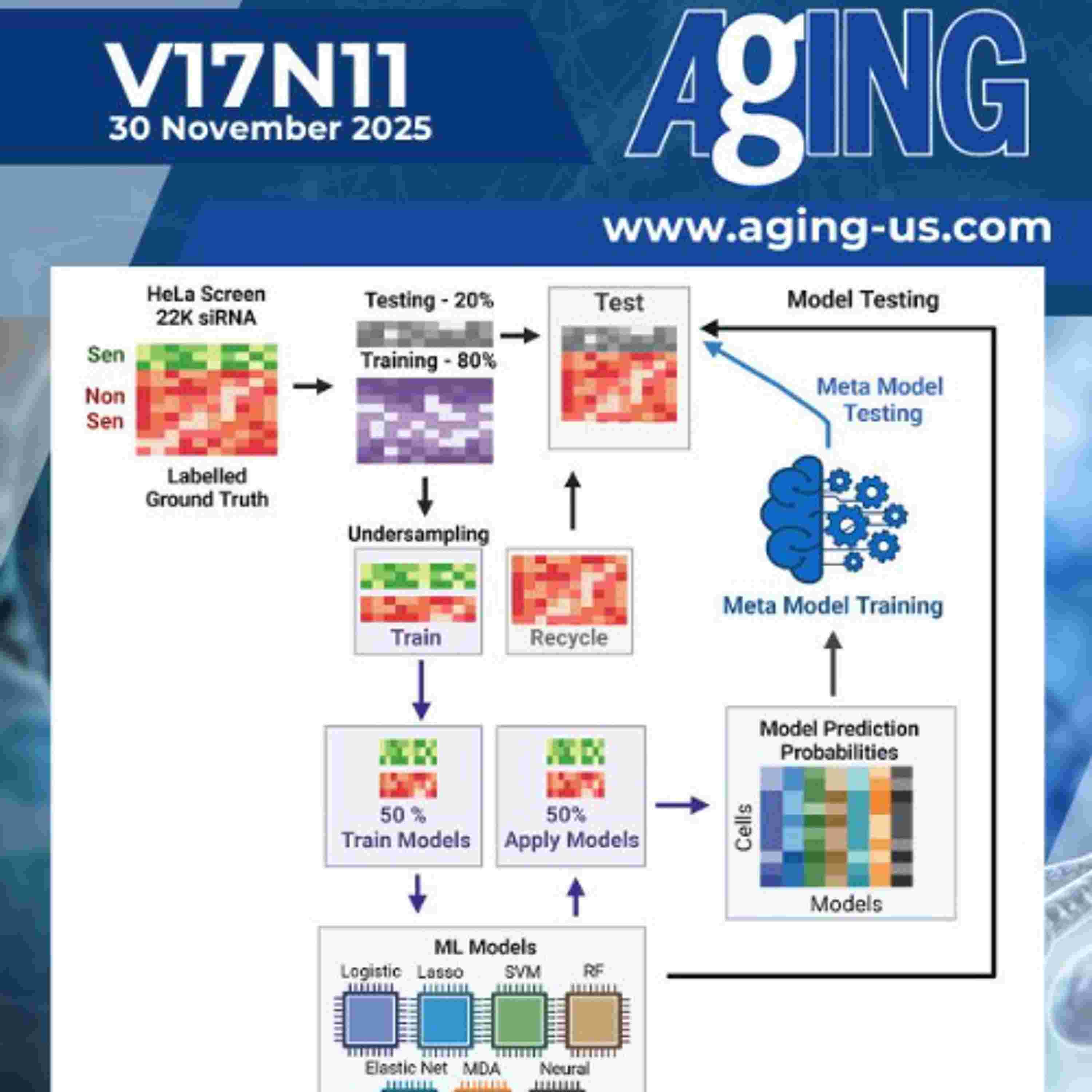
BUFFALO, NY — December 1, 2025 — A new #research paper featured on the #cover of Volume 17, Issue 11 of Aging-US was #published on October 30, 2025, titled “SAMP-Score: a morphology-based machine learning classification method for screening pro-senescence compounds in p16 positive cancer cells.”
In this study led by first author Ryan Wallis along with corresponding author Cleo L. Bishop, from Queen Mary University of London, researchers developed a machine learning tool to identify compounds that induce cancer cells into senescence. The tool, called SAMP-Score, offers a new strategy for drug discovery in cancers with poor treatment options like basal-like breast cancer.
Senescence is a process where damaged or aged cells stop dividing. In cancer therapy, inducing senescence is an approach to control tumor growth. However, it is difficult to detect true senescence in cancer cells that already appear aged. These cancers, often called Sen-Mark+ cancers, include basal-like breast cancer and typically lack reliable markers to confirm senescence. SAMP-Score was designed to address this problem.
Instead of relying on traditional markers, the researchers built a machine learning model trained to recognize patterns based on senescent cells’ shape and structure under a microscope. These visual patterns, known as senescence-associated morphological profiles (SAMPs), allowed the model to distinguish real signs of aging from other effects such as toxicity or normal variation. By analyzing thousands of cell images, the model learned to classify whether a cell had truly entered senescence.
“To demonstrate the potential application of SAMP-Score in p16 positive cancer therapeutic discovery, we assessed a diversity screen of 10,000 novel chemical entities in MB-468 cells (p16 positive BLBC).”
The team used SAMP-Score to screen more than 10,000 experimental compounds. One compound, QM5928, consistently triggered senescence in several cancer cell types without killing them, making it a promising candidate for further study. Importantly, it worked in cancers resistant to known drugs like palbociclib, which are often ineffective in cancers with high p16 expression like basal-like breast cancer.
Further analysis revealed that QM5928 caused the p16 protein to move into the nucleus of cancer cells, a possible sign that the protein is helping stop cell division. This subtle effect was only detectable using the detailed imaging and analysis made possible by SAMP-Score, highlighting the tool’s ability to distinguish true senescence from toxic responses and making it a powerful resource in cancer drug discovery.
By combining machine learning with high-resolution imaging, this study introduces a new way to find and evaluate cancer therapies. SAMP-Score could accelerate efforts to develop treatments that exploit the body’s natural aging processes to fight cancer, especially for patients with resistant tumors. The tool is openly available at GitHub, making it accessible for other researchers exploring senescence-based cancer therapies.
DOI - https://doi.org/10.18632/aging.206333
Corresponding author - Cleo L. Bishop - c.l.bishop@qmul.ac.uk
Abstract video - https://www.youtube.com/watch?v=qXI_KI3EgHE
Subscribe for free publication alerts from Aging - https://www.aging-us.com/subscribe-to-toc-alerts
To learn more about the journal, please visit https://www.Aging-US.com and connect with us on social media at:
Facebook - https://www.facebook.com/AgingUS/
X - https://twitter.com/AgingJrnl
Instagram - https://www.instagram.com/agingjrnl/
YouTube - https://www.youtube.com/@Aging-US
LinkedIn - https://www.linkedin.com/company/aging/
Bluesky - https://bsky.app/profile/aging-us.bsky.social
Pinterest - https://www.pinterest.com/AgingUS/
Spotify - https://open.spotify.com/show/1X4HQQgegjReaf6Mozn6Mc
MEDIA@IMPACTJOURNALS.COM
Aging-US
BUFFALO, NY — January 5, 2026 — A new #research paper featured as the #cover of Volume 17, Issue 12 of Aging-US was #published on December 22, 2025, titled “A combination of differential expression and network connectivity analyses identifies a common set of RNA splicing and processing genes altered with age across human tissues.”
In this study by Caio M.P.F. Batalha from the University of São Paulo, André Fujita from the University of São Paulo and Kyushu University, and Nadja C. de Souza-Pinto also from the University of São Paulo, researchers investigated how gene activity changes with age across multiple human tissues. They found that many tissues share common aging-related alterations in genes involved in RNA splicing and RNA processing. These findings are important because RNA processing is essential for accurate protein production, and disruptions in this process are linked to aging and disease.
Aging affects all tissues, yet identifying molecular changes that are shared across the body has remained challenging. To address this, researchers moved beyond traditional approaches that focus exclusively on changes in gene expression levels. They also analyzed how genes alter their patterns of interaction within regulatory networks, capturing age-related changes that are not evident from expression data alone.
“Gene expression data (in TPM – transcripts per million) were obtained from the Genotype-Tissue Expression (GTEx) project.”
Using RNA sequencing data from nearly one thousand human donors aged 20 to 70, the research team analyzed eight tissues, including blood, brain, heart, skin, and muscle. The results showed that many aging-related changes become evident only when gene network behavior is considered. When gene expression and network connectivity were analyzed together, a consistent group of genes emerged across tissues, most of which were linked to RNA splicing and RNA processing, key steps in the production of functional proteins.
The study also revealed that these RNA-related genes are highly interconnected at the protein level. Many of them form known protein complexes, including components of the spliceosome, which plays a central role in RNA maturation. With age, the interactions among these genes tend to reorganize in similar ways across tissues, pointing to a shared biological response rather than independent, tissue-specific effects.
In addition to RNA processing, the researchers observed age-related changes in pathways involved in managing damaged RNAs and proteins, including protein degradation, autophagy, and DNA damage response mechanisms. These pathways support cellular quality control and help limit the accumulation of molecular errors that increase with age.
Overall, this study identifies RNA splicing and RNA processing as central, conserved features of human aging across tissues. It also demonstrates that network-based approaches provide a more complete view of the aging transcriptome, offering new insights into age-related biological changes and potential directions for aging research.
DOI - https://doi.org/10.18632/aging.206347
Corresponding author - Nadja C. de Souza-Pinto - nadja@iq.usp.br
Abstract video - https://www.youtube.com/watch?v=A1slKwaSd6g
Subscribe for free publication alerts from Aging - https://www.aging-us.com/subscribe-to-toc-alerts
To learn more about the journal, please visit https://www.Aging-US.com and connect with us on social media at:
Bluesky - https://bsky.app/profile/aging-us.bsky.social
ResearchGate - https://www.researchgate.net/journal/Aging-1945-4589
Facebook - https://www.facebook.com/AgingUS/
X - https://twitter.com/AgingJrnl
Instagram - https://www.instagram.com/agingjrnl/
YouTube - https://www.youtube.com/@Aging-US
LinkedIn - https://www.linkedin.com/company/aging/
Pinterest - https://www.pinterest.com/AgingUS/
Spotify - https://open.spotify.com/show/1X4HQQgegjReaf6Mozn6Mc
MEDIA@IMPACTJOURNALS.COM