All content for AI Deep Dive is the property of Pete Larkin and is served directly from their servers
with no modification, redirects, or rehosting. The podcast is not affiliated with or endorsed by Podjoint in any way.
Curated AI news and stories from all the top sources, influencers, and thought leaders.
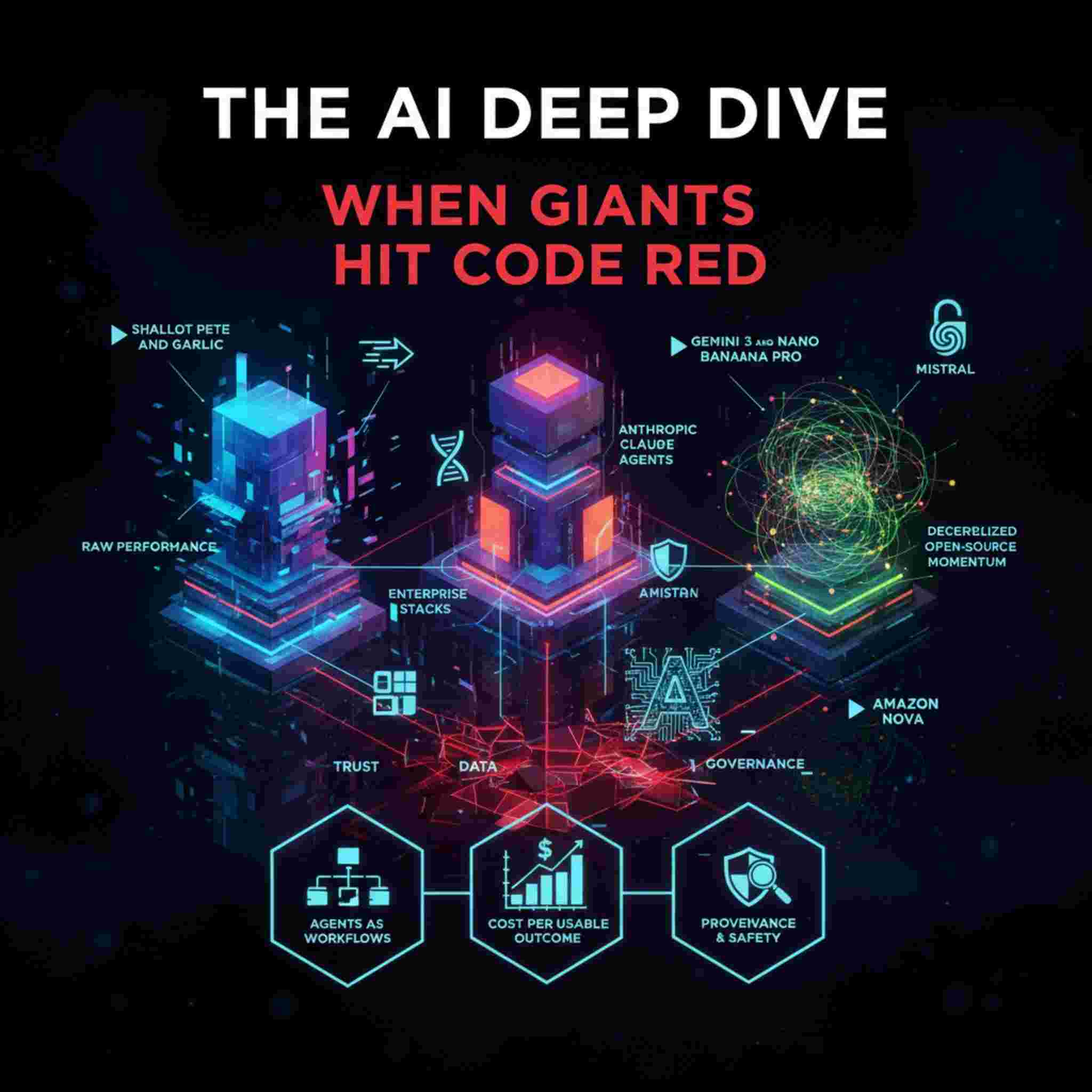
OpenAI’s internal “Code Red” memo was just the loudest signal in a week that made one thing clear: leadership in AI is no longer a given. The competitive landscape has fractured into three simultaneous battlegrounds — raw performance (new short‑cycle models and benchmarks), enterprise stacks (cost‑efficient, vertically integrated full‑stack offers), and decentralized open‑source momentum (small, fast models running locally). Key developments to watch: OpenAI fast‑tracking tactical and long‑term model upgrades (Shallot Pete and Garlic) and reprioritizing the consumer experience; Google’s Gemini 3 and Nano Banana Pro pushing multimodal reasoning and pro‑grade visuals; Anthropic proving rapid commercial traction with domain‑specific Claude agents; Amazon quietly building a full enterprise stack (Nova, Novaforge, Trainium); and Mistral’s Apache‑2.0 family expanding the open‑weight threat. At the same time agent autonomy, Browse Safe and Raptor‑style security tooling, and troubling signals about knowledge erosion and public anxiety mean the race is as much about trust, data, and governance as it is about raw capability.
Why it matters to marketers and AI practitioners: the market is moving from “who has the biggest model” to “who can deliver predictable, auditable business outcomes.” That changes how you pick partners, budget for scale, and design experiences.
Fast tactical moves:
- Treat agents as workflows, not widgets: build modular skill packs (brand guidelines, compliance templates) that agents can load on demand and audit at checkpoints.
- Measure cost per usable outcome, not token throughput: run comparative pilots (performance × token cost × latency) before committing to a provider.
- Harden provenance and safety: require source attribution, expandable verification (image/video provenance, citation trails), and human‑in‑the‑loop signoffs for any customer‑facing automation.
Big strategic questions to ask your team: Are you betting on raw model performance, lowest‑cost inference, or control of proprietary data and connectors? And as convenience grows, how will you ensure it doesn’t hollow out the human expertise you need to supervise it?
AI Deep Dive
Curated AI news and stories from all the top sources, influencers, and thought leaders.