All content for AI Deep Dive is the property of Pete Larkin and is served directly from their servers
with no modification, redirects, or rehosting. The podcast is not affiliated with or endorsed by Podjoint in any way.
Curated AI news and stories from all the top sources, influencers, and thought leaders.
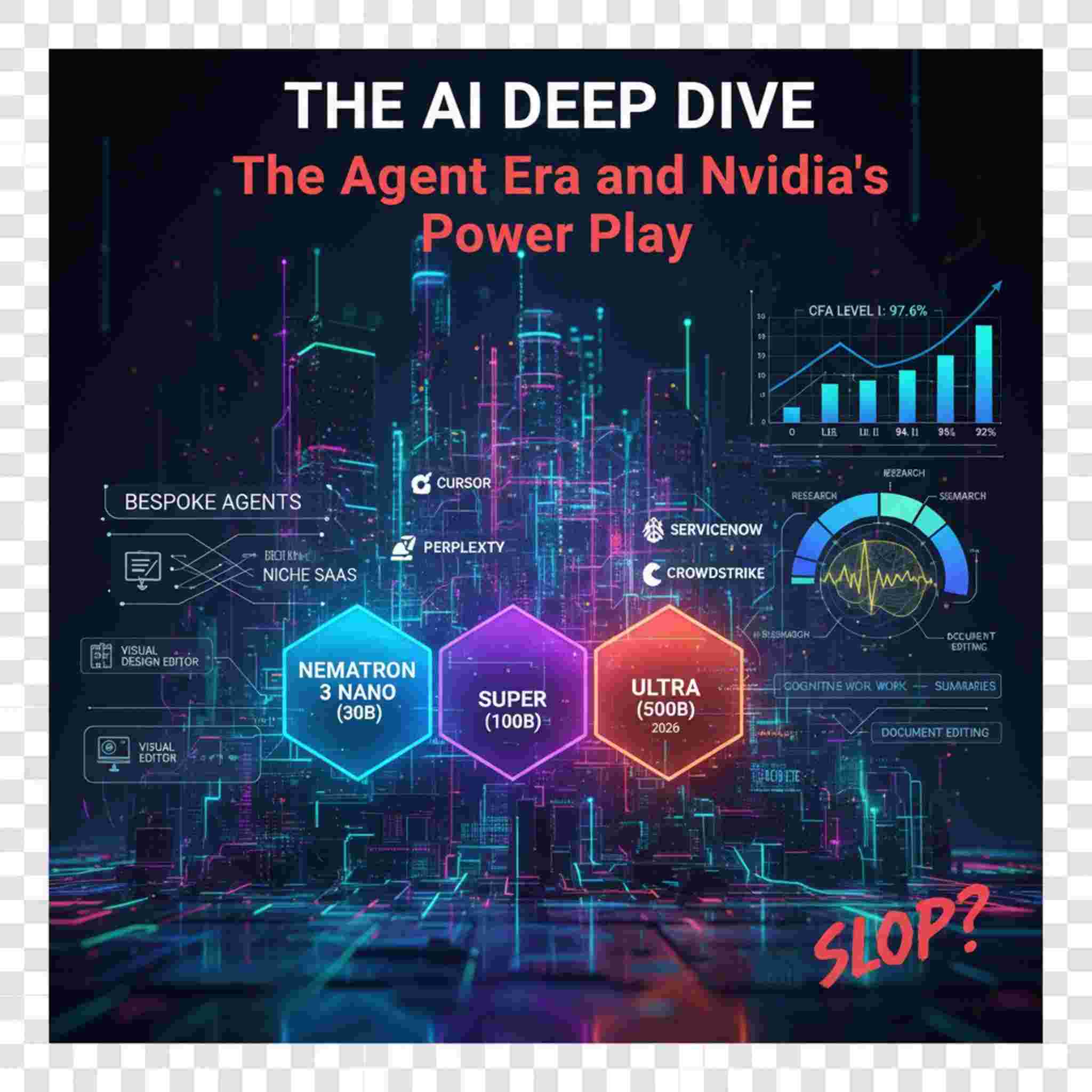
The chatbot era is over—welcome to agents: autonomous, multi-step project managers that plan, execute and monitor complex work. This episode unpacks three seismic shifts reshaping marketing and enterprise AI: Nvidia’s strategic open-model push, lightning-fast leaps in professional reasoning, and how real users are deploying agents for high-value work.
We break down Nvidia’s Nematron 3 lineup—Nano (30B parameters, available now), Super (100B) and Ultra (500B, arriving 2026)—and why releasing high-performance open models is a deliberate move to lock developers into Nvidia’s hardware stack. Early adopters like Cursor, Perplexity, ServiceNow and CrowdStrike are already integrating the models into everything from coding acceleration to cybersecurity.
Then we dig into capability: leading models now pass the three-tier CFA exams with near-perfect scores—Gemini 3.0 Pro hit 97.6% on Level I, GPT‑5 topped Level II at 94.3%, and Gemini led Level III at 92%—a two-year leap from models that once failed basic questions. That speed of mastery forces a reframe: if machines own core technical knowledge, human roles must pivot toward judgment, client relationships and political/ethical intuition.
Real-world usage confirms the pivot. Perplexity/Harvard analysis of Comet browser queries shows most agent activity centers on deep cognitive work—summaries, document editing, research—driven by tech, finance and marketing pros in high-GDP, high-education user bases. The result: basic single-function SaaS is under threat as engineers spin up bespoke agents that replace niche subscriptions. New tools like Cursor’s Visual Design Editor and Manus 1.6’s visual mobile editor show how small teams can do the work of large ones. Technical best practices matter too—models like Claude Opus 4.5 can process ~200,000 tokens, but the best outcomes come from surgical, short-context threads, not noisy infinite memory.
All this volume and velocity also creates a quality problem—Merriam‑Webster’s 2025 Word of the Year is “slop,” signaling an era of high-volume, low-quality AI content. Mathematician Terence Tao’s frame of “artificial general cleverness” helps: these agents solve broad, hard problems with pragmatic methods rather than human-like unified intelligence. The takeaway for marketing professionals and AI practitioners is practical and urgent: identify the uniquely human judgment in your workflow—client strategy, ethical navigation, high-stakes negotiation—that AI will take longest to replicate, and double down there.
AI Deep Dive
Curated AI news and stories from all the top sources, influencers, and thought leaders.