All content for AI Deep Dive is the property of Pete Larkin and is served directly from their servers
with no modification, redirects, or rehosting. The podcast is not affiliated with or endorsed by Podjoint in any way.
Curated AI news and stories from all the top sources, influencers, and thought leaders.
87: Image Arms Race and the New Rules of AI Optimization
AI Deep Dive
14 minutes
3 weeks ago
87: Image Arms Race and the New Rules of AI Optimization
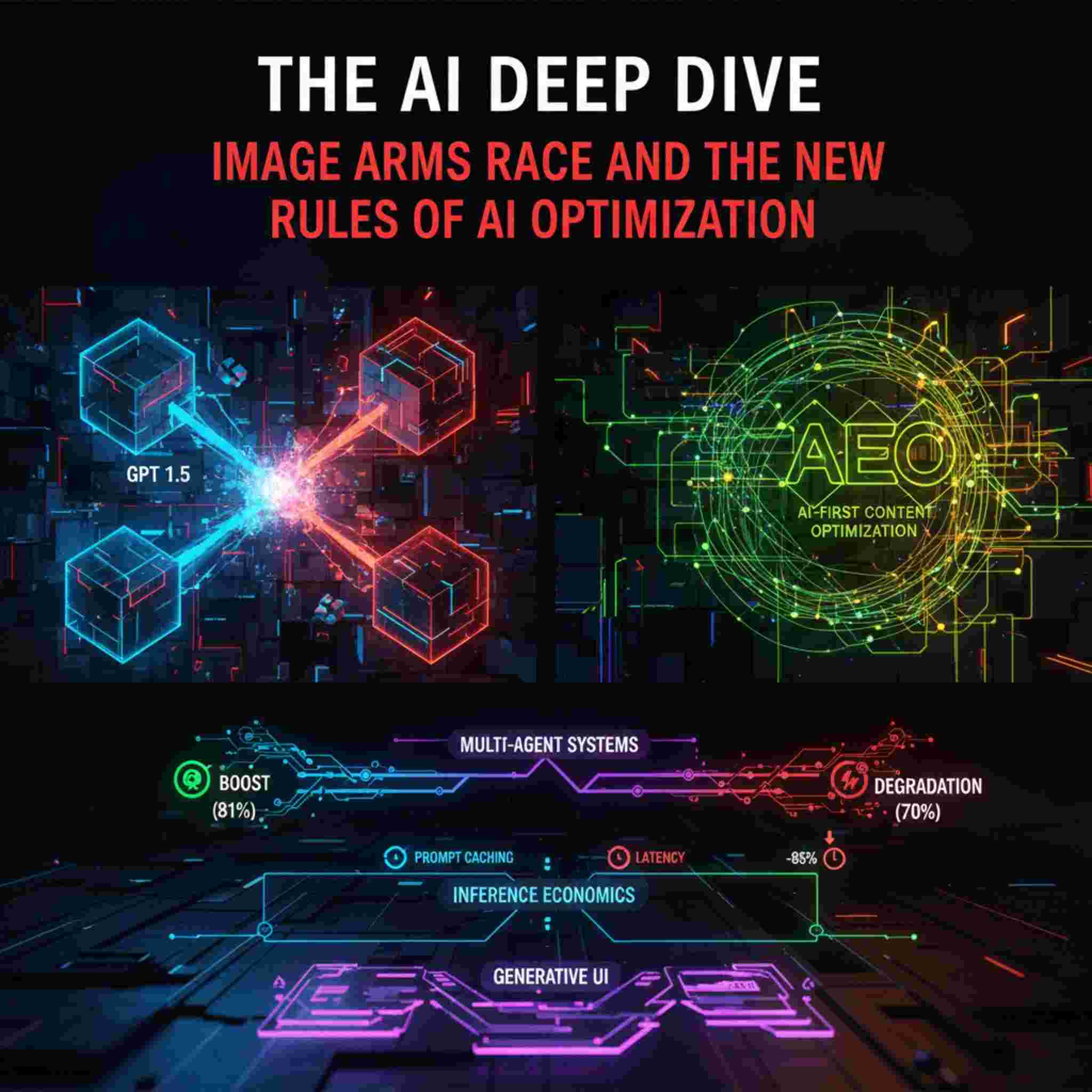
This episode cuts through the flood of AI headlines to give marketing leaders and AI practitioners the practical picture: an intense image-generation arms race, a mandatory shift from SEO to AI-first content (AEO), and a wake-up call about the hidden costs of multi-agent systems and inference economics. We unpack OpenAI’s GPT Image 1.5 — a major counterpunch to Google that claims up to 4x faster generation, far better handling of long-form text and infographics, and consistent edits that preserve faces, lighting and composition — and why that moves image models from novelty toys to professional design assistants. We also flag Meta’s SAM Audio and Alibaba’s multimodal 1.2.6 as proof the frontier is moving beyond static images into holistic audio and video creation.
Next, we explain why content teams must stop optimizing for search engines and start optimizing for LLM consumption. HubSpot’s AEO argument matters: low-quality, SEO-gamed content can create a negative reputation in an AI knowledge graph that’s brutally expensive to fix. The practical takeaway — restructure content into high-quality, machine-consumable formats so agents can reliably summarize and reuse your expertise.
Then we dig into the Google–MIT multi-agent study that upends a core assumption: more agents aren’t always better. Across 180 controlled experiments, multi-agent setups delivered an 81% boost on highly parallel, divisible tasks but degraded performance by up to 70% on sequential, stepwise problems — largely because agents “chatter” through a shared token budget, filling context windows with overhead instead of meaningful reasoning. For many complex workflows a single well-designed agent will be cheaper and more accurate. Treat agents like teammates: require training, testing, least privilege and continuous evaluation.
We close with inference economics and UX lessons: the infrastructure market is splitting between reserved compute (predictability for large buyers) and inference APIs (on-demand scale but higher per-query cost). Techniques like prompt caching can make cached tokens ~10x cheaper and cut latency by up to 85%, and product teams are ruthlessly prioritizing speed — the OpenAI router rollback showed users prefer instant replies over marginally better answers if latency spikes 10–20 seconds. Finally, we sketch the future of a fully generative UI — proactive, contextual screens that dissolve app boundaries and surface the right tools instantly — and what that means for product, content and cost strategy.
For marketers and AI practitioners this episode gives three actions: adopt AEO and restructure content for LLMs, be surgical and measured when deploying multi-agent systems, and architect for inference costs and latency from day one.
AI Deep Dive
Curated AI news and stories from all the top sources, influencers, and thought leaders.