Angus McEntrye is a Chiropractor, Athletics coach and Strength & Conditioning Coach. He works out of his practice AM Health & Performance in Sydney and specialises in injury diagnosis, management, and rehabilitation. Angus has worked with several different athletes and teams and has coached athletes competing at World Championships, Commonwealth Games, and the Olympic Games in athletics. Angus is also an accredited Level 4 Athletics Coach and ASCA Elite L3 Strength & Conditioning Coach.
QUOTES
"So what is VBT to me? It's all about speed output. So moving the bar or the body as fast as we can."
"The most important part about the competitive season is that they're competing. We're not trying to be Olympic lifters. We're not trying to be power lifters. We want to make sure that their transfer to the sport is as high as possible. That's submaximal loading, accelerative strengthening, power on the force velocity curve. 60-70 % 1RM comes in as the heavy and then we muck around with 50-30 %; lighter, faster, ballistic tosses, jumping, loud noises, trying to get things moving as fast as we can..."
"How many sports generate force up and down like a squat? There aren't too many. In track and field, it's the hammer throw, skiing, rowing, a couple of examples there, but most of what we do is we're generating force in a split based position"
"So then, you know, going into those lighter loads, and doing it with a snatch, Cameron can lift up to four meters per second with 30% 1RM on the bar"
“I've always been somebody that likes to be creative and just think outside of the box and how might this work? How might this better the output that we're trying to achieve? And then in the gym, it just bolsters that as well. So, you know, as long as you're not being stupid, think being creative in your environment … especially with VBT”
SHOWNOTES
1) Angus’ journey in strength and conditioning, athletics coaching and chiropractic influences
2) Velocity based training (VBT) basics and split snatches in Tokyo
3) Periodizing VBT across general prep, specific prep and competition phases
4) Different exercises, including Olympic lifting variations, that Angus will use in his coaching
5) How VBT metrics and speeds can be adapted for power development, including lifts above 3-4 meters per second
6) The benefits of different coaching cues combined with VBT feedback
7) Being creative in your environment as a coach and the use of different exercises to influence technique
PEOPLE MENTIONED
Cam McEntrye
John Mitchell
Nick Winkelman
John Manenti
All content for ASCA Podcast is the property of Joseph Coyne and is served directly from their servers
with no modification, redirects, or rehosting. The podcast is not affiliated with or endorsed by Podjoint in any way.
Angus McEntrye is a Chiropractor, Athletics coach and Strength & Conditioning Coach. He works out of his practice AM Health & Performance in Sydney and specialises in injury diagnosis, management, and rehabilitation. Angus has worked with several different athletes and teams and has coached athletes competing at World Championships, Commonwealth Games, and the Olympic Games in athletics. Angus is also an accredited Level 4 Athletics Coach and ASCA Elite L3 Strength & Conditioning Coach.
QUOTES
"So what is VBT to me? It's all about speed output. So moving the bar or the body as fast as we can."
"The most important part about the competitive season is that they're competing. We're not trying to be Olympic lifters. We're not trying to be power lifters. We want to make sure that their transfer to the sport is as high as possible. That's submaximal loading, accelerative strengthening, power on the force velocity curve. 60-70 % 1RM comes in as the heavy and then we muck around with 50-30 %; lighter, faster, ballistic tosses, jumping, loud noises, trying to get things moving as fast as we can..."
"How many sports generate force up and down like a squat? There aren't too many. In track and field, it's the hammer throw, skiing, rowing, a couple of examples there, but most of what we do is we're generating force in a split based position"
"So then, you know, going into those lighter loads, and doing it with a snatch, Cameron can lift up to four meters per second with 30% 1RM on the bar"
“I've always been somebody that likes to be creative and just think outside of the box and how might this work? How might this better the output that we're trying to achieve? And then in the gym, it just bolsters that as well. So, you know, as long as you're not being stupid, think being creative in your environment … especially with VBT”
SHOWNOTES
1) Angus’ journey in strength and conditioning, athletics coaching and chiropractic influences
2) Velocity based training (VBT) basics and split snatches in Tokyo
3) Periodizing VBT across general prep, specific prep and competition phases
4) Different exercises, including Olympic lifting variations, that Angus will use in his coaching
5) How VBT metrics and speeds can be adapted for power development, including lifts above 3-4 meters per second
6) The benefits of different coaching cues combined with VBT feedback
7) Being creative in your environment as a coach and the use of different exercises to influence technique
PEOPLE MENTIONED
Cam McEntrye
John Mitchell
Nick Winkelman
John Manenti
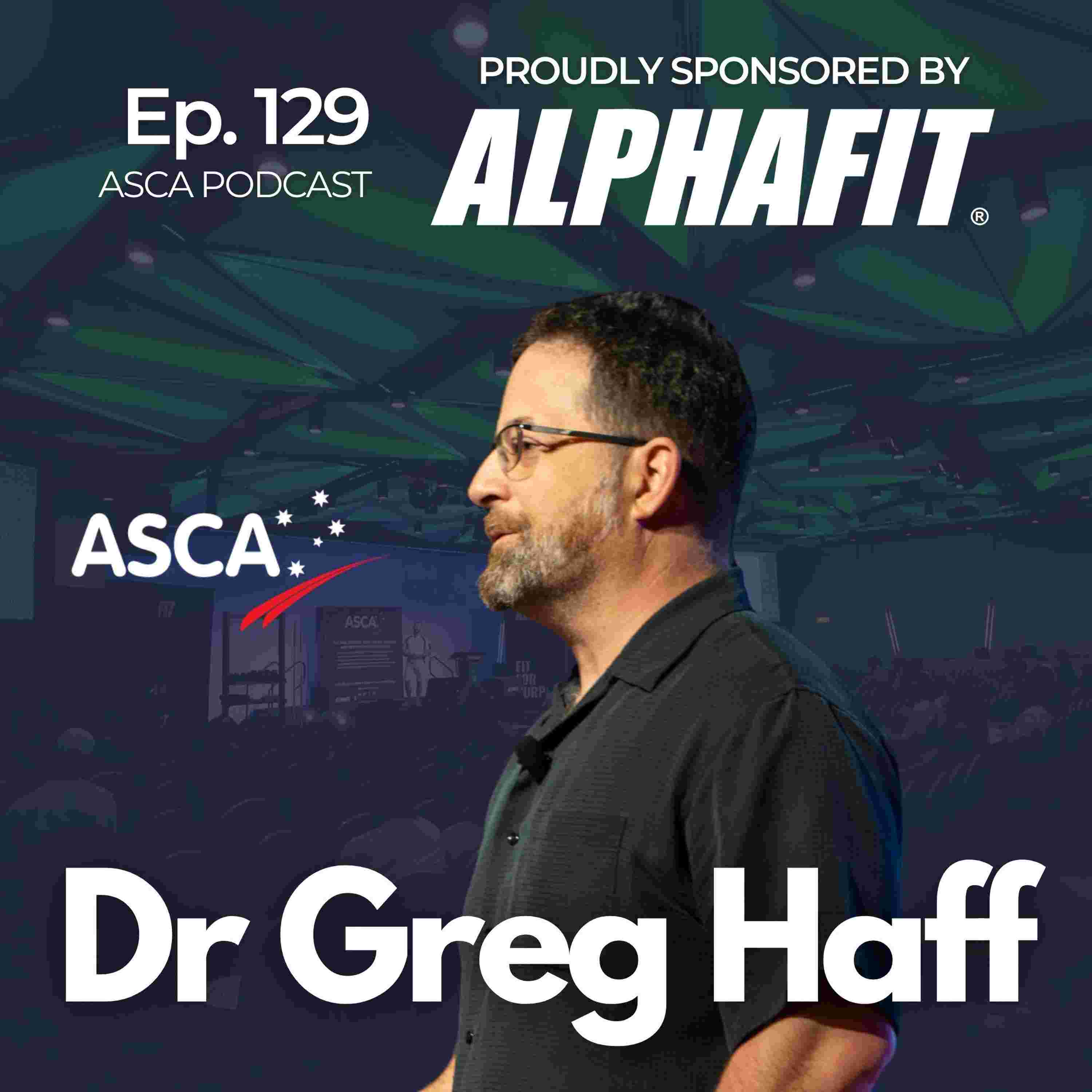
Dr. Gregory Haff is the Professor of S&C and the Director of the Strength and Power Research Group at ECU. He is the author of the ‘Scientific Foundations and Practical Applications of Periodisation’ & the co-editor of the NSCA’s Essentials of S&C textbooks. A central goal of his research is to bridge the gap between scientific inquiry & practical applications, with a research focus on the periodisation of training, resistance training programming strategies, and methods of testing and monitoring of the training process. His research focuses on methodologies for testing, monitoring, and programming resistance training interventions, as well as concepts related to periodization and training theory.
QUOTES
"So they created linear position transducers, much like a gym aware, and they used it with weightlifters in particular, because obviously weightlifting, it has a speed component to it e.g., you've got to be able to move the barbell quickly and you've got to be able to move heavy loads very quickly."
"If we guided training solely by velocity, we couldn't get high end strength development. Could we improve power? Yes. Could we improve the speed of movement? Yes. Could we regulate training load? Yes. But we often missed that stimulus to actually increase maximal strength."
"So when we looked at our data, what we found is the slope of the load velocity profile changes from day to day with fatigue more dramatically than maximal strength capacity. So this is where it gets a little interesting. If I'm programming off the load velocity profile, am I actually programming off the maximal capacity or am I being hyper reactive to fatigue?"
"Velocity based training is no better than the percentage based. There's no more variability or less variability. They're about the same. So is it really adding to my training other than more expense because I've got to buy them, more technology because I need it, and more training for my staff? Potentially not."
"You might want to occasionally use a load-velocity profile to look at where the athlete's weaknesses are. It might inform you, but then you've got to contextualize it. Where am I in my training program? And what is my goal right now? So if I'm in a strength power phase and the velocity end is low, then I have got a problem. But if I'm in a hypertrophy phase and it's low… you know, I don't really care right now."
"I wouldn't use it with weightlifting exercises, especially when what I've what I found with people that use it with weightlifting exercises, they change their technique to chase speed. And what happens is they create an inefficient movement pattern."
SHOWNOTES
1) Greg’s story, from growing up in the US as a son of a Marine to becoming a leading researcher in strength science
2) The history of velocity-based training and its German / Russian origins
3) Why we might have to be careful using VBT to estimate maximal strength considering the stability of maximal strength
4) Greg’s suggested strategies around using VBT to autoregulate load plus his preference for linear position transducers over accelerometers
5) Strength stability across different exercises and the stages of over-reaching/over-training
6) How and when to apply VBT during strength training periodization and using load-velocity profiles / critical minimum velocity thresholds across different exercises
7) The cognitive load of always using VBT and its effect on motivation as well as the effect of different athlete phenotypes on VBT
8) Which exercises to use VBT with and potential applications for other populations besides athletes
9) Using VBT to monitor readiness with a set load
10) The biggest thing Greg has changed his mind on in recent times and the importance of mobility
PEOPLE MENTIONED
Mike Stone
Boyd Epley
Andrew Fry
William Kraemer
Carl Miller
Stuart Guppy
Dietmar Schmidbleiter
Nick Poulos
Dan Baker
Jonathon Weakley
Bryan Mann
Duncan French
ASCA Podcast
Angus McEntrye is a Chiropractor, Athletics coach and Strength & Conditioning Coach. He works out of his practice AM Health & Performance in Sydney and specialises in injury diagnosis, management, and rehabilitation. Angus has worked with several different athletes and teams and has coached athletes competing at World Championships, Commonwealth Games, and the Olympic Games in athletics. Angus is also an accredited Level 4 Athletics Coach and ASCA Elite L3 Strength & Conditioning Coach.
QUOTES
"So what is VBT to me? It's all about speed output. So moving the bar or the body as fast as we can."
"The most important part about the competitive season is that they're competing. We're not trying to be Olympic lifters. We're not trying to be power lifters. We want to make sure that their transfer to the sport is as high as possible. That's submaximal loading, accelerative strengthening, power on the force velocity curve. 60-70 % 1RM comes in as the heavy and then we muck around with 50-30 %; lighter, faster, ballistic tosses, jumping, loud noises, trying to get things moving as fast as we can..."
"How many sports generate force up and down like a squat? There aren't too many. In track and field, it's the hammer throw, skiing, rowing, a couple of examples there, but most of what we do is we're generating force in a split based position"
"So then, you know, going into those lighter loads, and doing it with a snatch, Cameron can lift up to four meters per second with 30% 1RM on the bar"
“I've always been somebody that likes to be creative and just think outside of the box and how might this work? How might this better the output that we're trying to achieve? And then in the gym, it just bolsters that as well. So, you know, as long as you're not being stupid, think being creative in your environment … especially with VBT”
SHOWNOTES
1) Angus’ journey in strength and conditioning, athletics coaching and chiropractic influences
2) Velocity based training (VBT) basics and split snatches in Tokyo
3) Periodizing VBT across general prep, specific prep and competition phases
4) Different exercises, including Olympic lifting variations, that Angus will use in his coaching
5) How VBT metrics and speeds can be adapted for power development, including lifts above 3-4 meters per second
6) The benefits of different coaching cues combined with VBT feedback
7) Being creative in your environment as a coach and the use of different exercises to influence technique
PEOPLE MENTIONED
Cam McEntrye
John Mitchell
Nick Winkelman
John Manenti