Angus McEntrye is a Chiropractor, Athletics coach and Strength & Conditioning Coach. He works out of his practice AM Health & Performance in Sydney and specialises in injury diagnosis, management, and rehabilitation. Angus has worked with several different athletes and teams and has coached athletes competing at World Championships, Commonwealth Games, and the Olympic Games in athletics. Angus is also an accredited Level 4 Athletics Coach and ASCA Elite L3 Strength & Conditioning Coach.
QUOTES
"So what is VBT to me? It's all about speed output. So moving the bar or the body as fast as we can."
"The most important part about the competitive season is that they're competing. We're not trying to be Olympic lifters. We're not trying to be power lifters. We want to make sure that their transfer to the sport is as high as possible. That's submaximal loading, accelerative strengthening, power on the force velocity curve. 60-70 % 1RM comes in as the heavy and then we muck around with 50-30 %; lighter, faster, ballistic tosses, jumping, loud noises, trying to get things moving as fast as we can..."
"How many sports generate force up and down like a squat? There aren't too many. In track and field, it's the hammer throw, skiing, rowing, a couple of examples there, but most of what we do is we're generating force in a split based position"
"So then, you know, going into those lighter loads, and doing it with a snatch, Cameron can lift up to four meters per second with 30% 1RM on the bar"
“I've always been somebody that likes to be creative and just think outside of the box and how might this work? How might this better the output that we're trying to achieve? And then in the gym, it just bolsters that as well. So, you know, as long as you're not being stupid, think being creative in your environment … especially with VBT”
SHOWNOTES
1) Angus’ journey in strength and conditioning, athletics coaching and chiropractic influences
2) Velocity based training (VBT) basics and split snatches in Tokyo
3) Periodizing VBT across general prep, specific prep and competition phases
4) Different exercises, including Olympic lifting variations, that Angus will use in his coaching
5) How VBT metrics and speeds can be adapted for power development, including lifts above 3-4 meters per second
6) The benefits of different coaching cues combined with VBT feedback
7) Being creative in your environment as a coach and the use of different exercises to influence technique
PEOPLE MENTIONED
Cam McEntrye
John Mitchell
Nick Winkelman
John Manenti
All content for ASCA Podcast is the property of Joseph Coyne and is served directly from their servers
with no modification, redirects, or rehosting. The podcast is not affiliated with or endorsed by Podjoint in any way.
Angus McEntrye is a Chiropractor, Athletics coach and Strength & Conditioning Coach. He works out of his practice AM Health & Performance in Sydney and specialises in injury diagnosis, management, and rehabilitation. Angus has worked with several different athletes and teams and has coached athletes competing at World Championships, Commonwealth Games, and the Olympic Games in athletics. Angus is also an accredited Level 4 Athletics Coach and ASCA Elite L3 Strength & Conditioning Coach.
QUOTES
"So what is VBT to me? It's all about speed output. So moving the bar or the body as fast as we can."
"The most important part about the competitive season is that they're competing. We're not trying to be Olympic lifters. We're not trying to be power lifters. We want to make sure that their transfer to the sport is as high as possible. That's submaximal loading, accelerative strengthening, power on the force velocity curve. 60-70 % 1RM comes in as the heavy and then we muck around with 50-30 %; lighter, faster, ballistic tosses, jumping, loud noises, trying to get things moving as fast as we can..."
"How many sports generate force up and down like a squat? There aren't too many. In track and field, it's the hammer throw, skiing, rowing, a couple of examples there, but most of what we do is we're generating force in a split based position"
"So then, you know, going into those lighter loads, and doing it with a snatch, Cameron can lift up to four meters per second with 30% 1RM on the bar"
“I've always been somebody that likes to be creative and just think outside of the box and how might this work? How might this better the output that we're trying to achieve? And then in the gym, it just bolsters that as well. So, you know, as long as you're not being stupid, think being creative in your environment … especially with VBT”
SHOWNOTES
1) Angus’ journey in strength and conditioning, athletics coaching and chiropractic influences
2) Velocity based training (VBT) basics and split snatches in Tokyo
3) Periodizing VBT across general prep, specific prep and competition phases
4) Different exercises, including Olympic lifting variations, that Angus will use in his coaching
5) How VBT metrics and speeds can be adapted for power development, including lifts above 3-4 meters per second
6) The benefits of different coaching cues combined with VBT feedback
7) Being creative in your environment as a coach and the use of different exercises to influence technique
PEOPLE MENTIONED
Cam McEntrye
John Mitchell
Nick Winkelman
John Manenti
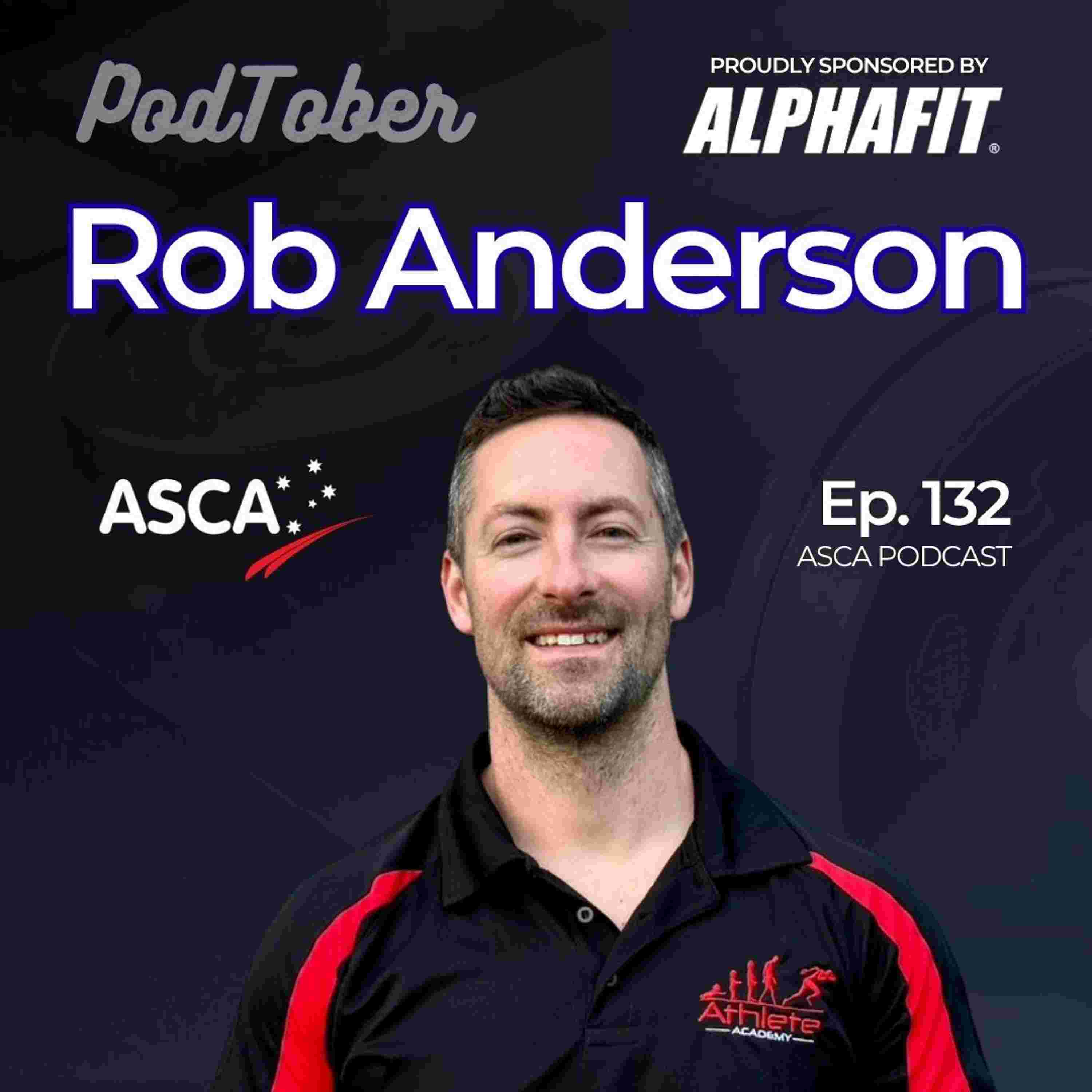
Rob Anderson is an award-winning youth strength and conditioning coach with over 15 years of experience developing young athletes across schools, academies, and national governing bodies. He spent five years with Scottish Rugby as the Lead Strength & Conditioning Coach for the Under 16, 17 and 18 National Teams as well as coaching emerging youth talent at the Borders & East Lothian and Caledonia Regional Academies. Rob then founded The Athlete Academy with the mission to provide world-class athletic development and coaching for young athletes. His dedication to improving youth athletic development is reflected in his recognition as the 2024 UKSCA Strength & Conditioning Coach of the Year for Youth Sport. A leading voice in LTAD, Rob also mentors practitioners through Collaborate Sports, helping coaches implement best practices in clubs, schools, and private sectors.
QUOTES
“It's not uncommon for guys and girls to be growing seven to 12 centimeters in a year. That's a huge physiological change. It's not uncommon during peak weight velocity for guys to be stacking on 10 kilos in a year. That's a huge physiological change. So in some ways, the training programs that we are putting on adult athletes, we know there's a level of adaptation that's going to change physiologically but we're probably getting the greatest physiological change during that period of adolescence, both for male and female athletes, with training”.
“If it works with kids, it works with adults but not the other way around”
"And sometimes it's going to be a bit deceptive for youth athletes because you might think, well, actually we've not changed training load. Like they're doing exactly what they were doing last year. But actually, last year they weren't in their peak high velocity and now they are. And so maybe their sensitivity has increased and that workload that was previously okay is actually now too much. And we just need to be smart about how we decrease that"
“So we need enough calories for the usual resting metabolic rate plus growth. Then what fuelling do we need for athletic endeavors? You know, it tends to be a lot more than parents think in terms of what the requirement actually is. And that's why, you know, it's not uncommon for athletes to be tired and under fueled because they don't realize that how much their calorie requirements are going through that period of training and growing.”
“I actually really love martial arts for an LTAD environment, because I think it's actually way more organic. You go into a Jiu-Jitsu class, for example, it's not all the white belts in one room or the brown belts in another room or the blue. It's like combined different ages, different experience levels. And it's actually a really quality LTAD experience and I've kind of borrowed from that.”
SHOWNOTES
1) Rob’s progression in youth strength and conditioning, from his own experience to Scotland national youth rugby teams to opening Athlete Academy
2) Fundamentals of youth strength & conditioning and dispelling old youth training myths
3) The impact of peak height velocity on different growth related conditions like Osgood Schlatters
4) The difference between peak height velocity and peak weight velocity
5) Organizing training and adaptation aims (e.g., neural vs hypertrophy) around pre, circa, and post pre height velocity
6) The parent as the head of performance for the youth athlete
7) The intake process at the Athlete Academy and putting youth athletes into the right level of a curriculum
8) Micro-dosing different tests across different weeks
9) Addressing parent questions about what their kid needs and the value of unilateral work
PEOPLE MENTIONED
Avery Faigenbaum
Kelvin Giles
Dan Baker
Rhodri Lloyd
John Oliver
Shane Fitzgibbon
James Baker
Angela Jackson
Mike Boyle
Frans Bosch
ASCA Podcast
Angus McEntrye is a Chiropractor, Athletics coach and Strength & Conditioning Coach. He works out of his practice AM Health & Performance in Sydney and specialises in injury diagnosis, management, and rehabilitation. Angus has worked with several different athletes and teams and has coached athletes competing at World Championships, Commonwealth Games, and the Olympic Games in athletics. Angus is also an accredited Level 4 Athletics Coach and ASCA Elite L3 Strength & Conditioning Coach.
QUOTES
"So what is VBT to me? It's all about speed output. So moving the bar or the body as fast as we can."
"The most important part about the competitive season is that they're competing. We're not trying to be Olympic lifters. We're not trying to be power lifters. We want to make sure that their transfer to the sport is as high as possible. That's submaximal loading, accelerative strengthening, power on the force velocity curve. 60-70 % 1RM comes in as the heavy and then we muck around with 50-30 %; lighter, faster, ballistic tosses, jumping, loud noises, trying to get things moving as fast as we can..."
"How many sports generate force up and down like a squat? There aren't too many. In track and field, it's the hammer throw, skiing, rowing, a couple of examples there, but most of what we do is we're generating force in a split based position"
"So then, you know, going into those lighter loads, and doing it with a snatch, Cameron can lift up to four meters per second with 30% 1RM on the bar"
“I've always been somebody that likes to be creative and just think outside of the box and how might this work? How might this better the output that we're trying to achieve? And then in the gym, it just bolsters that as well. So, you know, as long as you're not being stupid, think being creative in your environment … especially with VBT”
SHOWNOTES
1) Angus’ journey in strength and conditioning, athletics coaching and chiropractic influences
2) Velocity based training (VBT) basics and split snatches in Tokyo
3) Periodizing VBT across general prep, specific prep and competition phases
4) Different exercises, including Olympic lifting variations, that Angus will use in his coaching
5) How VBT metrics and speeds can be adapted for power development, including lifts above 3-4 meters per second
6) The benefits of different coaching cues combined with VBT feedback
7) Being creative in your environment as a coach and the use of different exercises to influence technique
PEOPLE MENTIONED
Cam McEntrye
John Mitchell
Nick Winkelman
John Manenti