Angus McEntrye is a Chiropractor, Athletics coach and Strength & Conditioning Coach. He works out of his practice AM Health & Performance in Sydney and specialises in injury diagnosis, management, and rehabilitation. Angus has worked with several different athletes and teams and has coached athletes competing at World Championships, Commonwealth Games, and the Olympic Games in athletics. Angus is also an accredited Level 4 Athletics Coach and ASCA Elite L3 Strength & Conditioning Coach.
QUOTES
"So what is VBT to me? It's all about speed output. So moving the bar or the body as fast as we can."
"The most important part about the competitive season is that they're competing. We're not trying to be Olympic lifters. We're not trying to be power lifters. We want to make sure that their transfer to the sport is as high as possible. That's submaximal loading, accelerative strengthening, power on the force velocity curve. 60-70 % 1RM comes in as the heavy and then we muck around with 50-30 %; lighter, faster, ballistic tosses, jumping, loud noises, trying to get things moving as fast as we can..."
"How many sports generate force up and down like a squat? There aren't too many. In track and field, it's the hammer throw, skiing, rowing, a couple of examples there, but most of what we do is we're generating force in a split based position"
"So then, you know, going into those lighter loads, and doing it with a snatch, Cameron can lift up to four meters per second with 30% 1RM on the bar"
“I've always been somebody that likes to be creative and just think outside of the box and how might this work? How might this better the output that we're trying to achieve? And then in the gym, it just bolsters that as well. So, you know, as long as you're not being stupid, think being creative in your environment … especially with VBT”
SHOWNOTES
1) Angus’ journey in strength and conditioning, athletics coaching and chiropractic influences
2) Velocity based training (VBT) basics and split snatches in Tokyo
3) Periodizing VBT across general prep, specific prep and competition phases
4) Different exercises, including Olympic lifting variations, that Angus will use in his coaching
5) How VBT metrics and speeds can be adapted for power development, including lifts above 3-4 meters per second
6) The benefits of different coaching cues combined with VBT feedback
7) Being creative in your environment as a coach and the use of different exercises to influence technique
PEOPLE MENTIONED
Cam McEntrye
John Mitchell
Nick Winkelman
John Manenti
All content for ASCA Podcast is the property of Joseph Coyne and is served directly from their servers
with no modification, redirects, or rehosting. The podcast is not affiliated with or endorsed by Podjoint in any way.
Angus McEntrye is a Chiropractor, Athletics coach and Strength & Conditioning Coach. He works out of his practice AM Health & Performance in Sydney and specialises in injury diagnosis, management, and rehabilitation. Angus has worked with several different athletes and teams and has coached athletes competing at World Championships, Commonwealth Games, and the Olympic Games in athletics. Angus is also an accredited Level 4 Athletics Coach and ASCA Elite L3 Strength & Conditioning Coach.
QUOTES
"So what is VBT to me? It's all about speed output. So moving the bar or the body as fast as we can."
"The most important part about the competitive season is that they're competing. We're not trying to be Olympic lifters. We're not trying to be power lifters. We want to make sure that their transfer to the sport is as high as possible. That's submaximal loading, accelerative strengthening, power on the force velocity curve. 60-70 % 1RM comes in as the heavy and then we muck around with 50-30 %; lighter, faster, ballistic tosses, jumping, loud noises, trying to get things moving as fast as we can..."
"How many sports generate force up and down like a squat? There aren't too many. In track and field, it's the hammer throw, skiing, rowing, a couple of examples there, but most of what we do is we're generating force in a split based position"
"So then, you know, going into those lighter loads, and doing it with a snatch, Cameron can lift up to four meters per second with 30% 1RM on the bar"
“I've always been somebody that likes to be creative and just think outside of the box and how might this work? How might this better the output that we're trying to achieve? And then in the gym, it just bolsters that as well. So, you know, as long as you're not being stupid, think being creative in your environment … especially with VBT”
SHOWNOTES
1) Angus’ journey in strength and conditioning, athletics coaching and chiropractic influences
2) Velocity based training (VBT) basics and split snatches in Tokyo
3) Periodizing VBT across general prep, specific prep and competition phases
4) Different exercises, including Olympic lifting variations, that Angus will use in his coaching
5) How VBT metrics and speeds can be adapted for power development, including lifts above 3-4 meters per second
6) The benefits of different coaching cues combined with VBT feedback
7) Being creative in your environment as a coach and the use of different exercises to influence technique
PEOPLE MENTIONED
Cam McEntrye
John Mitchell
Nick Winkelman
John Manenti
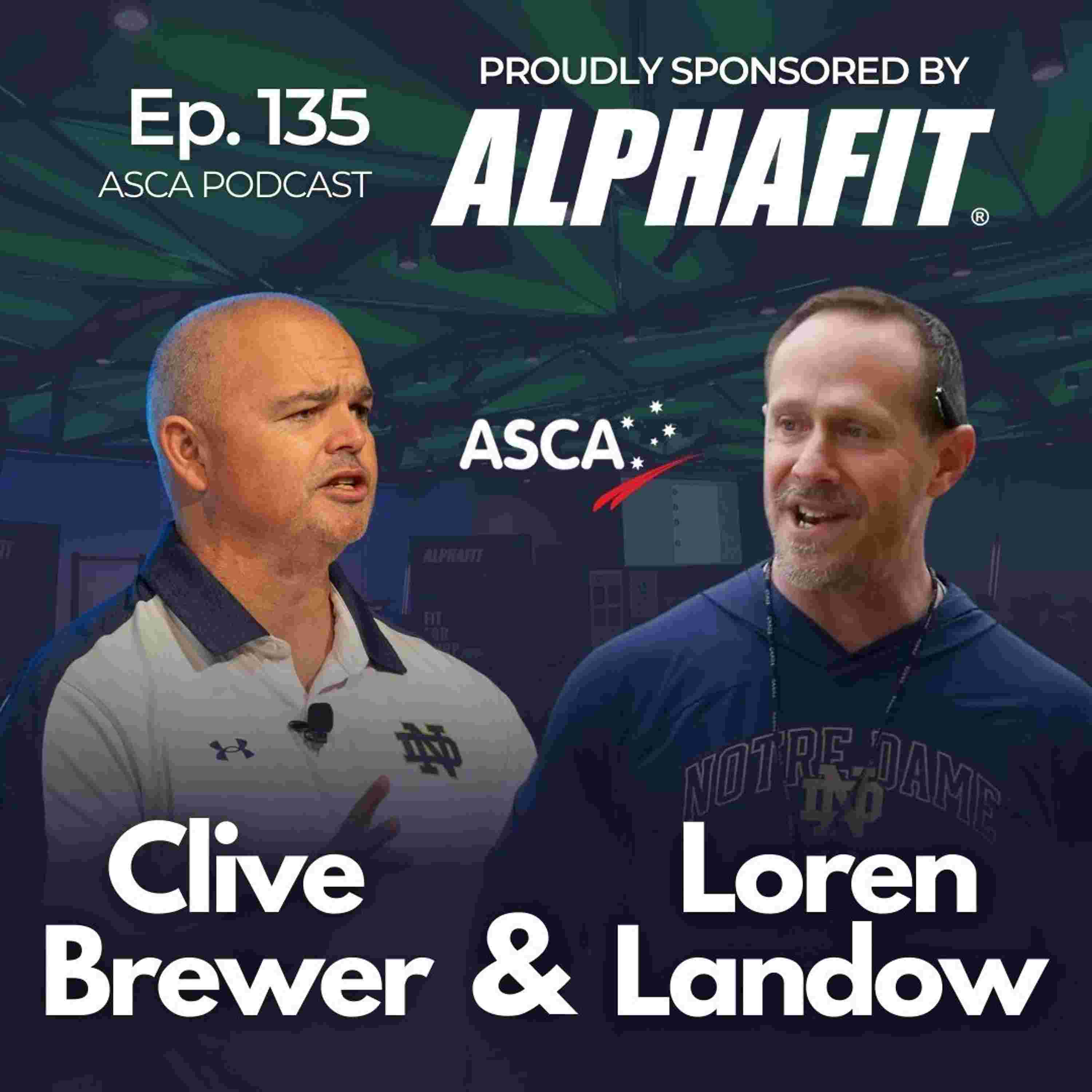
Clive Brewer is the Director of Olympic Strength and Conditioning at the University of Notre Dame where, he is responsible for leading and managing a department focused on maximizing the physical development of Notre Dame’s Olympic sports student-athletes, Prior to his current role, Clive was the Director of Human Performance for Arizona Athletics in Phoenix, and has worked for a number of different sporting organisations including Toronto Blue Jays, Manchester United, Liverpool FC, Columbus Crew, IMG, IAAF, Widnes Vikings & England Rugby League.
Loren Landow is the Director of Football Performance at the University of Notre Dame. Prior to this, Loren served as the head strength and conditioning coach for the Denver Broncos from 2018-2023, and he also owns and directs Landow Performance in Centennial, Colorado, where theyhavce worked with thousands of athletes in all sports to prepare for professional and amateur competition, including NFL, NHL, MLB, UFC, WNBA and Olympic medalists.
QUOTES
"The joke I always use is I'm the world's ugliest bridesmaid. People see the athlete, people see the coach, but they should never see me. We are a guy in the background who's doing a lot of the work and driving things forward, but we ain't that important.”
“And high functioning means that you're able to actually be honest with people, be open with people and them to be open with you too. It's not to respect a hierarchy or anything else. It's like, you have to be open to that critical question asked in the right way, you know, in order to really reflect on what you do and are you doing the best and is there a better way of doing it?”
“I tell my staff, like, we're all going to make mistakes. The goal is not to make the same mistake twice and try to make the mistakes less egregious as we go. So I think part of it is like understanding that it's an okay environment to make a mistake in and we're going to learn from it.”
“But I look at what I call the hat scenario. So the very first exercise I do with my guys is, you know, we understand what hats people wear, right? So there's the blue hat, which is the process hat, right? And there's the green hat, which is the ideas hat. And then there's the red hat, which is the emotional hat. And then there's the yellow hat, is the pleasing people hat. And then there's the black hat, which is, it won't work. And so we explained this, and I use the hats a lot in my scenarios, but the first thing I said to the guys is, just like that, what's your preferred hat? There's no right or wrongs here because each of those is a strength.”
“I think being much more deliberate in terms of creating that environment and realize that my job is to set that up and then stay out of way of it. I've never been good as what I would call the cheerleader coach. I think I've always told players, if I've got to bring the intensity, you're in the wrong job.”
SHOWNOTES
1) Clive and Loren’s update since last episode on the podcast and their new roles at University of Notre Dame
2) Coaching philosophies and how they have evolved over time for Loren and Clive
3) How to frame questions for constructive feedback and the importance of creating an environment to own mistakes
4) The difference between an inter- and mutli-disciplinary performance team
5) The structure of the Notre Dame football and Olympic sport performance staff organisation
6) Tailoring tasks and workflow to staff strengths and the hat analogy for different staff different strengths
7) Demonstrating impact in new environments and obtaining trust through consistency
PEOPLE MENTIONED
John Wagle
Duncan French
ASCA Podcast
Angus McEntrye is a Chiropractor, Athletics coach and Strength & Conditioning Coach. He works out of his practice AM Health & Performance in Sydney and specialises in injury diagnosis, management, and rehabilitation. Angus has worked with several different athletes and teams and has coached athletes competing at World Championships, Commonwealth Games, and the Olympic Games in athletics. Angus is also an accredited Level 4 Athletics Coach and ASCA Elite L3 Strength & Conditioning Coach.
QUOTES
"So what is VBT to me? It's all about speed output. So moving the bar or the body as fast as we can."
"The most important part about the competitive season is that they're competing. We're not trying to be Olympic lifters. We're not trying to be power lifters. We want to make sure that their transfer to the sport is as high as possible. That's submaximal loading, accelerative strengthening, power on the force velocity curve. 60-70 % 1RM comes in as the heavy and then we muck around with 50-30 %; lighter, faster, ballistic tosses, jumping, loud noises, trying to get things moving as fast as we can..."
"How many sports generate force up and down like a squat? There aren't too many. In track and field, it's the hammer throw, skiing, rowing, a couple of examples there, but most of what we do is we're generating force in a split based position"
"So then, you know, going into those lighter loads, and doing it with a snatch, Cameron can lift up to four meters per second with 30% 1RM on the bar"
“I've always been somebody that likes to be creative and just think outside of the box and how might this work? How might this better the output that we're trying to achieve? And then in the gym, it just bolsters that as well. So, you know, as long as you're not being stupid, think being creative in your environment … especially with VBT”
SHOWNOTES
1) Angus’ journey in strength and conditioning, athletics coaching and chiropractic influences
2) Velocity based training (VBT) basics and split snatches in Tokyo
3) Periodizing VBT across general prep, specific prep and competition phases
4) Different exercises, including Olympic lifting variations, that Angus will use in his coaching
5) How VBT metrics and speeds can be adapted for power development, including lifts above 3-4 meters per second
6) The benefits of different coaching cues combined with VBT feedback
7) Being creative in your environment as a coach and the use of different exercises to influence technique
PEOPLE MENTIONED
Cam McEntrye
John Mitchell
Nick Winkelman
John Manenti