Home
Categories
EXPLORE
True Crime
Comedy
Society & Culture
Business
History
TV & Film
Technology
About Us
Contact Us
Copyright
© 2024 PodJoint
00:00 / 00:00
Sign in

or

Don't have an account?
Sign up
Forgot password
https://is1-ssl.mzstatic.com/image/thumb/Podcasts211/v4/f2/56/51/f256516c-7ca0-a1e0-095d-98b42a505a34/mza_2950839120930297173.jpg/600x600bb.jpg
Best AI papers explained
Enoch H. Kang
603 episodes
15 hours ago
Cut through the noise. We curate and break down the most important AI papers so you don’t have to.
Show more...
Technology
RSS
All content for Best AI papers explained is the property of Enoch H. Kang and is served directly from their servers with no modification, redirects, or rehosting. The podcast is not affiliated with or endorsed by Podjoint in any way.
Cut through the noise. We curate and break down the most important AI papers so you don’t have to.
Show more...
Technology
https://d3t3ozftmdmh3i.cloudfront.net/staging/podcast_uploaded_episode/43252366/43252366-1765872164488-ec710acfec1f6.jpg
CLaRa: Bridging Retrieval and Generation with Continuous Latent Reasoning
Best AI papers explained
14 minutes 45 seconds
2 weeks ago
CLaRa: Bridging Retrieval and Generation with Continuous Latent Reasoning

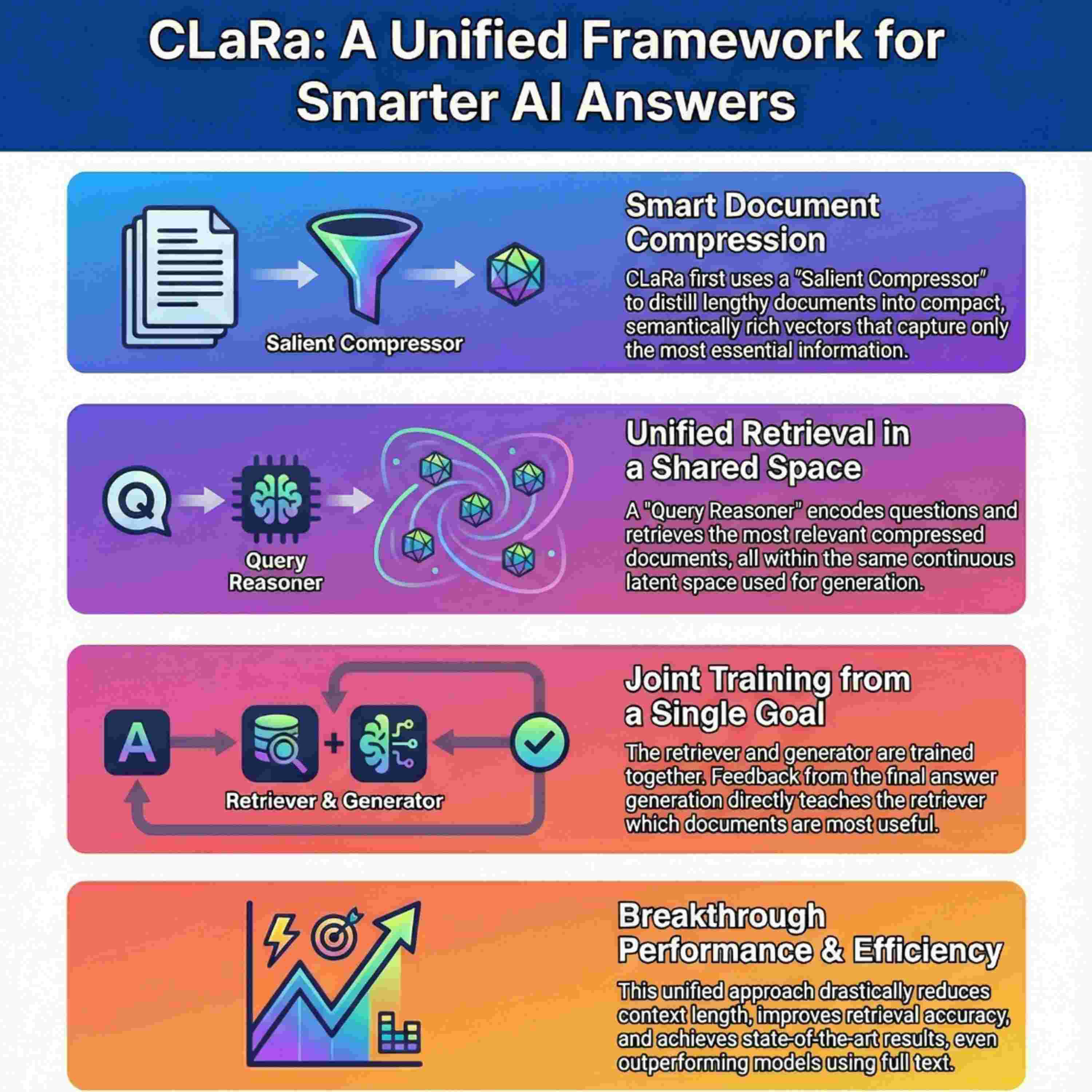
This paper discusses how Retrieval-Augmented Generation (RAG) framework can be designed to overcome the structural issues of separate retrieval and generation modules. The proposed framework, CLaRa, achieves this by employing a **shared latent space** where documents are compressed into concise, continuous memory-token representations, addressing the architectural mismatch and efficiency problems of traditional RAG. Key to CLaRa is its **joint optimization** mechanism, which uses the Next-Token Prediction loss from the generator to provide a weak supervision signal, aligning the retriever with the downstream task objective without requiring explicit relevance labels. The framework uses a diverse dataset of **Simple QA, Complex QA, and Paraphrase pairs** for pretraining, and empirical results show that CLaRa, particularly when initialized from pretraining, achieves **state-of-the-art retrieval performance** that rivals or surpasses fully supervised baselines on various question-answering tasks. Furthermore, analyses confirm that the compressed representations successfully **preserve semantic content** while substantially reducing the context length, significantly improving overall system efficiency.

Best AI papers explained
Cut through the noise. We curate and break down the most important AI papers so you don’t have to.