Neuroscience and artificial intelligence work better together. Brain inspired is a celebration and exploration of the ideas driving our progress to understand intelligence. I interview experts about their work at the interface of neuroscience, artificial intelligence, cognitive science, philosophy, psychology, and more: the symbiosis of these overlapping fields, how they inform each other, where they differ, what the past brought us, and what the future brings. Topics include computational neuroscience, supervised machine learning, unsupervised learning, reinforcement learning, deep learning, convolutional and recurrent neural networks, decision-making science, AI agents, backpropagation, credit assignment, neuroengineering, neuromorphics, emergence, philosophy of mind, consciousness, general AI, spiking neural networks, data science, and a lot more. The podcast is not produced for a general audience. Instead, it aims to educate, challenge, inspire, and hopefully entertain those interested in learning more about neuroscience and AI.
All content for Brain Inspired is the property of Paul Middlebrooks and is served directly from their servers
with no modification, redirects, or rehosting. The podcast is not affiliated with or endorsed by Podjoint in any way.
Neuroscience and artificial intelligence work better together. Brain inspired is a celebration and exploration of the ideas driving our progress to understand intelligence. I interview experts about their work at the interface of neuroscience, artificial intelligence, cognitive science, philosophy, psychology, and more: the symbiosis of these overlapping fields, how they inform each other, where they differ, what the past brought us, and what the future brings. Topics include computational neuroscience, supervised machine learning, unsupervised learning, reinforcement learning, deep learning, convolutional and recurrent neural networks, decision-making science, AI agents, backpropagation, credit assignment, neuroengineering, neuromorphics, emergence, philosophy of mind, consciousness, general AI, spiking neural networks, data science, and a lot more. The podcast is not produced for a general audience. Instead, it aims to educate, challenge, inspire, and hopefully entertain those interested in learning more about neuroscience and AI.
Support the show to get full episodes, full archive, and join the Discord community.
The Transmitter is an online publication that aims to deliver useful information, insights and tools to build bridges across neuroscience and advance research. Visit thetransmitter.org to explore the latest neuroscience news and perspectives, written by journalists and scientists.
Read more about our partnership.
Sign up for the “Brain Inspired” email alerts to be notified every time a new “Brain Inspired” episode is released.
To explore more neuroscience news and perspectives, visit thetransmitter.org.
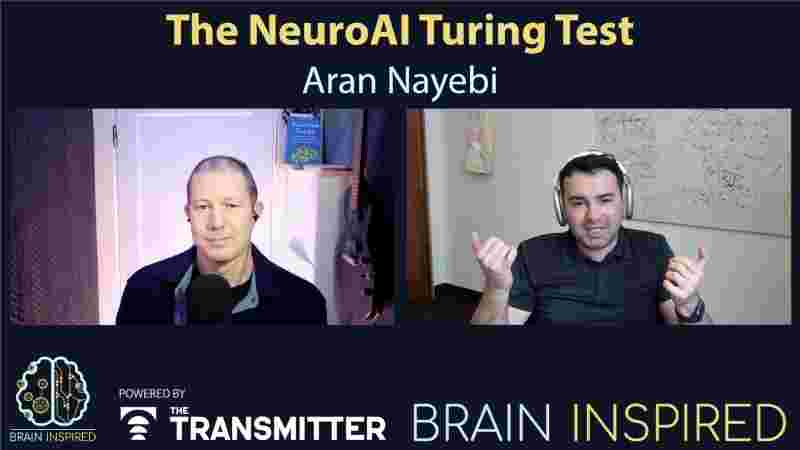
Aran Nayebi is an Assistant Professor at Carnegie Mellon University in the Machine Learning Department. He was there in the early days of using convolutional neural networks to explain how our brains perform object recognition, and since then he's a had a whirlwind trajectory through different AI architectures and algorithms and how they relate to biological architectures and algorithms, so we touch on some of what he has studied in that regard. But he also recently started his own lab, at CMU, and he has plans to integrate much of what he has learned to eventually develop autonomous agents that perform the tasks we want them to perform in similar at least ways that our brains perform them. So we discuss his ongoing plans to reverse-engineer our intelligence to build useful cognitive architectures of that sort.
We also discuss Aran's suggestion that, at least in the NeuroAI world, the Turing test needs to be updated to include some measure of similarity of the internal representations used to achieve the various tasks the models perform. By internal representations, as we discuss, he means the population-level activity in the neural networks, not the mental representations philosophy of mind often refers to, or other philosophical notions of the term representation.
Aran's Website.
Twitter: @ayan_nayebi.
Related papers
Brain-model evaluations need the NeuroAI Turing Test.
Barriers and pathways to human-AI alignment: a game-theoretic approach.
0:00 - Intro
5:24 - Background
20:46 - Building embodied agents
33:00 - Adaptability
49:25 - Marr's levels
54:12 - Sensorimotor loop and intrinsic goals
1:00:05 - NeuroAI Turing Test
1:18:18 - Representations
1:28:18 - How to know what to measure
1:32:56 - AI safety
Brain Inspired
Neuroscience and artificial intelligence work better together. Brain inspired is a celebration and exploration of the ideas driving our progress to understand intelligence. I interview experts about their work at the interface of neuroscience, artificial intelligence, cognitive science, philosophy, psychology, and more: the symbiosis of these overlapping fields, how they inform each other, where they differ, what the past brought us, and what the future brings. Topics include computational neuroscience, supervised machine learning, unsupervised learning, reinforcement learning, deep learning, convolutional and recurrent neural networks, decision-making science, AI agents, backpropagation, credit assignment, neuroengineering, neuromorphics, emergence, philosophy of mind, consciousness, general AI, spiking neural networks, data science, and a lot more. The podcast is not produced for a general audience. Instead, it aims to educate, challenge, inspire, and hopefully entertain those interested in learning more about neuroscience and AI.