
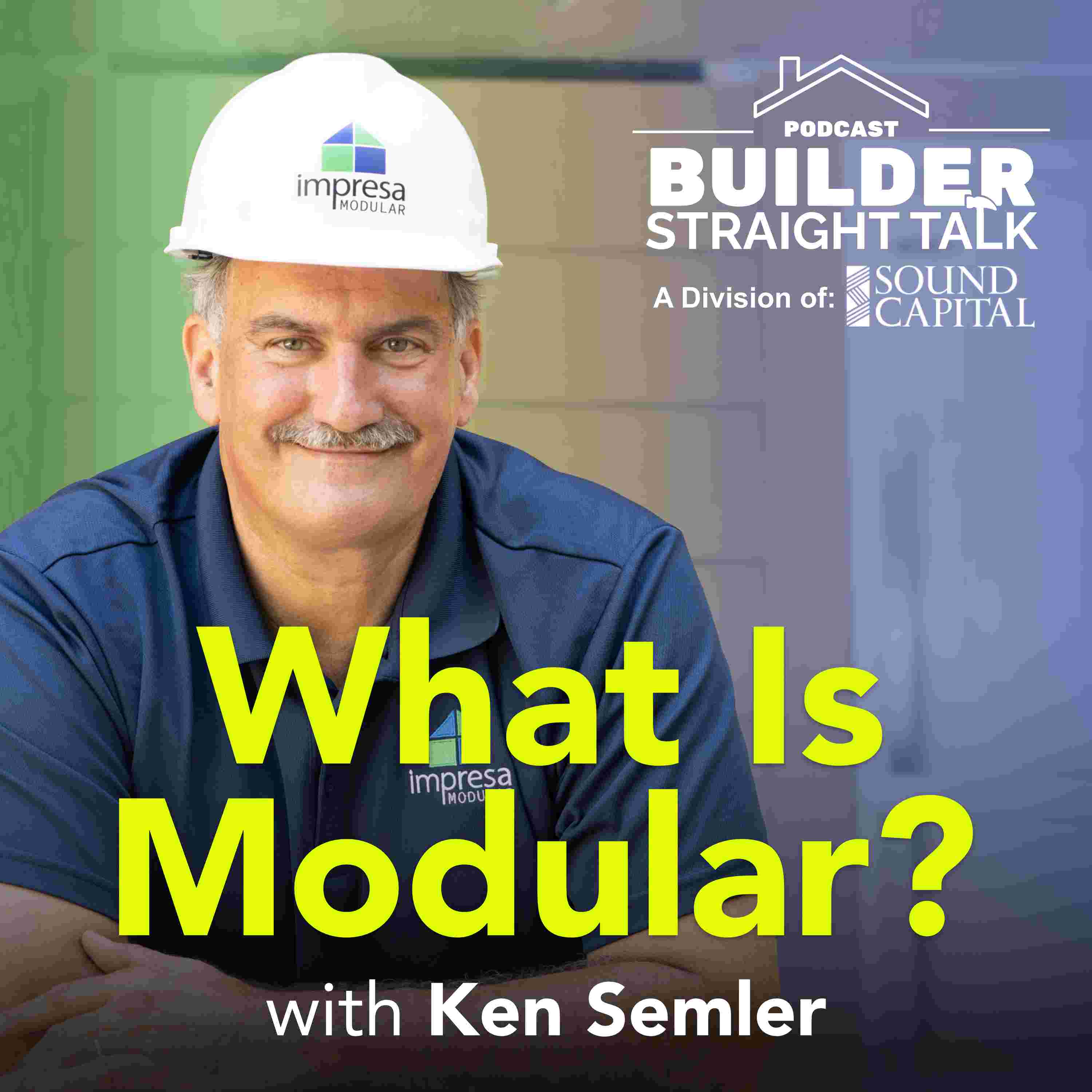
Michael sits down with Ken Semler, President and CEO of Impresa Modular, who's spent 25 years getting people to understand what modular construction actually is. No, it's not a double-wide trailer. If you've ever wondered why we're still building houses the same way we did 50 years ago, this conversation is for you.
Ken's journey started by accident. Flipping houses in 2003, his day job wanted him to move to New York City. He declined, went full-time into construction, and discovered modular fit his crew perfectly. Eight months later, he was the number three builder with his factory. After 2008, he pivoted to commercial work with schools. Then in 2009, he told his wife he'd sell homes over the internet. She thought he was crazy. Today, Ken operates in 44 states with a franchise system and publishes the industry's only dedicated magazine.
Ken breaks down the critical difference: manufactured homes are built to HUD code (affordability standard), modular homes to International Residential Code (same as stick-built). The tell? That label in your kitchen cabinet.
"There is no such thing as a modular home. It's a house built using modular construction."
A four-module, two-story home taking six months on site gets built in three to eight days in a factory. While your foundation is poured, your house moves down an 18-station production line. Ken shares going from a hole in the ground to a 2,200 square foot house with wraparound porch in 36 hours.
Quality control is remarkable. Factories use lag bolts and industrial epoxy, not 16-penny nails. Customers have called Ken three years later, frustrated it took three days to tear down a wall for an addition. Modules must survive 65 mph transport over potholes and mountain roads, so they're built to level two seismic activity as standard.
Efficiency goes beyond speed. That 30 cubic yard dumpster at every job site, filled once or twice per house? You paid for everything in it. Factories use three cubic yard dumpsters for wood, gypsum, and recycling.
Ken tackles financing challenges head-on.
"If a project gets half built and 50 units get built, I've paid for those 50 units as they come offline, but I've got 50 units that are packaged, finished... I actually have an asset that's protected. It's just not real estate."
Compare that to a half-built house in a field.
We're short at least 250,000 homes yearly. For every five construction workers retiring, only 1.5 enter the trades.
"Labor in the U.S. has evaporated... the two biggest users of illegal labor has been probably the construction industry and the agriculture industry. And that labor's going out the door."
Ken's franchise solves the knowledge gap. Most factories don't train new builders.
"We've done a horrible job of training new to modular builders. If you decide you want to get into modular and call a factory, there's really no place to learn unless you've worked with somebody before."
Looking at 2026, Ken sees the perfect storm: falling interest rates, premium labor costs, and lenders figuring out modular projects.
This isn't a sales pitch. It's an honest conversation about why we build the way we do and what's possible when construction moves into a controlled environment.
Ken Semler is President & CEO of Impresa Modular, the nation's first internet-based custom modular home builder, now operating in 43 states and partnering with more than 20 offsite factories. With over 25 years in construction, Ken has become a national voice for modular innovation, scalability, and modernizing the building process.
He also pioneered Impresa Modular Franchising—the first modular home franchise system in the U.S.—helping builders and entrepreneurs adopt factory-built precision in their local markets. A frequent speaker at national builder conferences, author of 200+ articles, and publisher of Offsite Builder Magazine.
Ken on LinkedIn:
https://www.linkedin.com/in/kensemler
Impresa Modular:
https://impresamodular.com