Center for Russia, East Europe, and Central Asia at the University of Wisconsin, Madison
173 episodes
1 month ago
In 1991, as the USSR broke apart and its population became open to the reforming discourse of Mikhail Gorbachev’s reform program of perestroika, Soviet dissident historian Roy Medvedev set the tone for subsequent writing on Leonid Ilich Brezhnev, concluding that he was “a personality so mediocre and a politician so ordinary” that he “quickly disappeared from the political scene and also in the literal and metaphorical sense.” But not for long. When it became clear by the end of the decade that market capitalism and democracy had not improved people’s lives, nostalgia for the Brezhnev era rightly raised the question of whether he had been given his just due and unfairly blamed for the shortcomings of the Soviet system. This reversal of fortune also makes clear that no Soviet leader has been as neglected or as misunderstood as Brezhnev and therefore no Soviet party boss is in such need of a fresh historical reassessment. Divided into two parts, my presentation will first make a case for Brezhnev, emphasizing his vision of guaranteeing stability, assuring peace, and letting people live well. Earlier I coined the term “Soviet man of peace,” to characterize Brezhnev. I emphasize this point here, arguing that his dream of wanting to be remembered as an asset for world peace made him a leader who changed the world. In part 2 of my presentation, I zoom in on the Leonid Brezhnev that, as his biographer, I might never know and propose what these unresolved questions might mean.
Donald J. Raleigh is the Jay Richard Judson Distinguished Professor of Russian History Emeritus at the University of North Carolina, Chapel Hill. He has authored, translated, and edited numerous books on modern Russian history including Revolution on the Volga (1986), Experiencing Russia’s Civil War (2002), Russia’s Sputnik Generation (2006) and Soviet Baby Boomers (2012). He currently is writing a biography of Soviet leader Leonid Ilich Brezhnev, research for which has taken him to archives in Russia, Moldova, Ukraine, Kazakhstan, the UK, and the US.
This lecture is sponsored by the Alice D. Mortenson/Petrovich Distinguished Chair of Russian History and University Lectures.
All content for CREECA Lecture Series Podcast is the property of Center for Russia, East Europe, and Central Asia at the University of Wisconsin, Madison and is served directly from their servers
with no modification, redirects, or rehosting. The podcast is not affiliated with or endorsed by Podjoint in any way.
In 1991, as the USSR broke apart and its population became open to the reforming discourse of Mikhail Gorbachev’s reform program of perestroika, Soviet dissident historian Roy Medvedev set the tone for subsequent writing on Leonid Ilich Brezhnev, concluding that he was “a personality so mediocre and a politician so ordinary” that he “quickly disappeared from the political scene and also in the literal and metaphorical sense.” But not for long. When it became clear by the end of the decade that market capitalism and democracy had not improved people’s lives, nostalgia for the Brezhnev era rightly raised the question of whether he had been given his just due and unfairly blamed for the shortcomings of the Soviet system. This reversal of fortune also makes clear that no Soviet leader has been as neglected or as misunderstood as Brezhnev and therefore no Soviet party boss is in such need of a fresh historical reassessment. Divided into two parts, my presentation will first make a case for Brezhnev, emphasizing his vision of guaranteeing stability, assuring peace, and letting people live well. Earlier I coined the term “Soviet man of peace,” to characterize Brezhnev. I emphasize this point here, arguing that his dream of wanting to be remembered as an asset for world peace made him a leader who changed the world. In part 2 of my presentation, I zoom in on the Leonid Brezhnev that, as his biographer, I might never know and propose what these unresolved questions might mean.
Donald J. Raleigh is the Jay Richard Judson Distinguished Professor of Russian History Emeritus at the University of North Carolina, Chapel Hill. He has authored, translated, and edited numerous books on modern Russian history including Revolution on the Volga (1986), Experiencing Russia’s Civil War (2002), Russia’s Sputnik Generation (2006) and Soviet Baby Boomers (2012). He currently is writing a biography of Soviet leader Leonid Ilich Brezhnev, research for which has taken him to archives in Russia, Moldova, Ukraine, Kazakhstan, the UK, and the US.
This lecture is sponsored by the Alice D. Mortenson/Petrovich Distinguished Chair of Russian History and University Lectures.
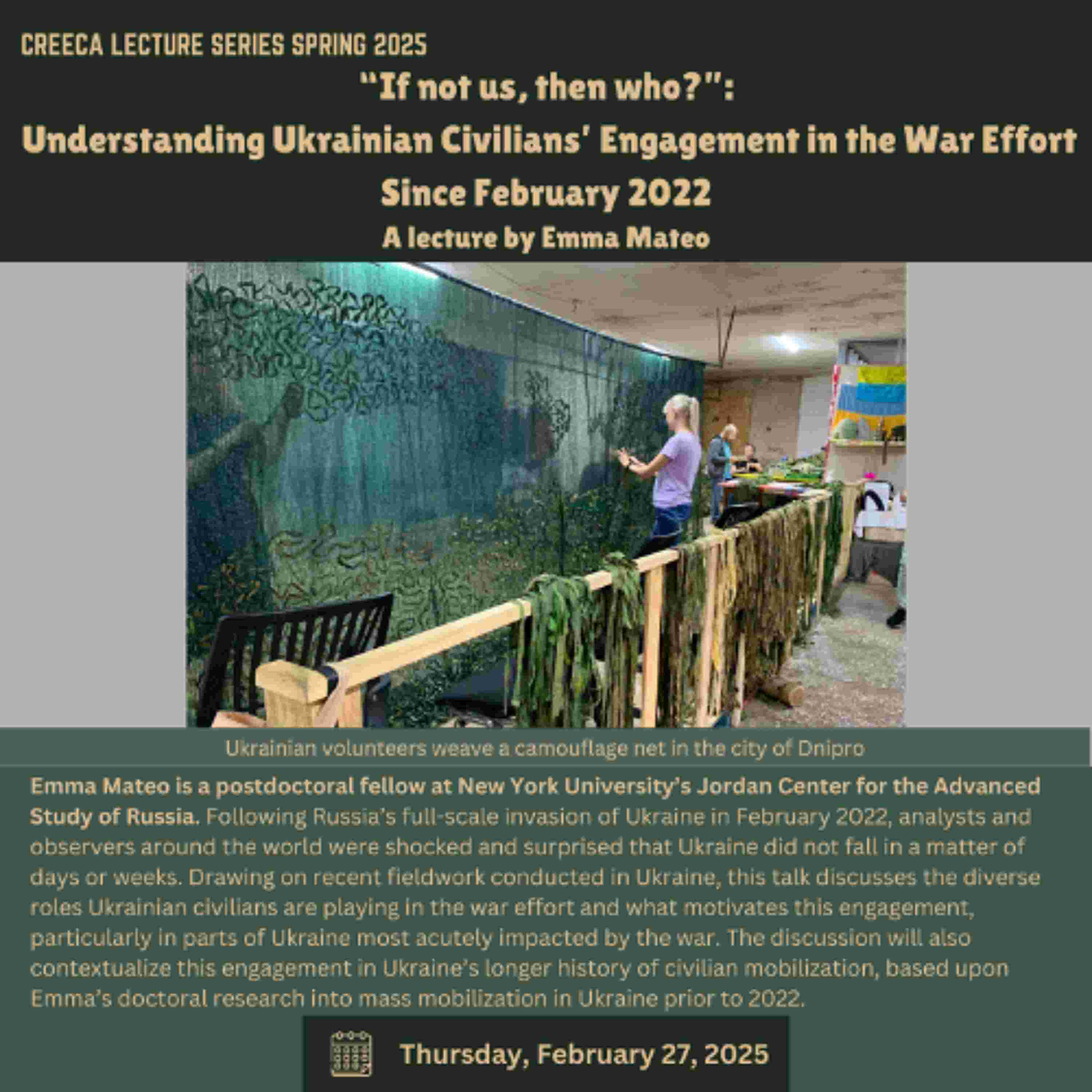
“If not us, then who?”: Understanding Ukrainian Civilians’ Engagement in the War Effort Since February 2022
CREECA Lecture Series Podcast
52 minutes 33 seconds
9 months ago
“If not us, then who?”: Understanding Ukrainian Civilians’ Engagement in the War Effort Since February 2022
About the Lecture:
Following Russia’s full-scale invasion of Ukraine in February 2022, analysts and observers around the world were shocked and surprised that Ukraine did not fall in a matter of days or weeks. Instead people across the country resisted with both military and civilian means, halting the Russian advance. Surveys indicate that over 80% of the Ukrainian population contributed to the war effort in some way (e.g. Onuch et al 2022, 2023), suggesting that Ukrainian civilians have made a crucial, if hard-to-quantify, contribution to Ukraine’s continued resistance. However, scholarship on civilian wartime engagement more broadly tends to focus on decisions to join the military or to flee following the onset of conflict – meaning that our understanding of how and why civilians mobilise in non-combatant roles is limited. Drawing on recent fieldwork conducted in Ukraine, this talk discusses the diverse roles Ukrainian civilians are playing in the war effort and what motivates this engagement, particularly in parts of Ukraine most acutely impacted by the war. The discussion will also contextualize this engagement in Ukraine’s longer history of civilian mobilization, based upon Emma’s doctoral research into mass mobilization in Ukraine prior to 2022.
About the Speaker:
Emma Mateo is a postdoctoral fellow at New York University’s Jordan Center for the Advanced Study of Russia. She studies political behaviour in times of crisis, such as mass protest and war, with a regional focus on eastern Europe, particularly Ukraine and Belarus. Her current monograph project explores civilian responses to conflict, focusing on the case of Ukrainian mobilisation during the Russo-Ukrainian war. Drawing upon fieldwork in Ukraine and systematic analysis of local and social media data, the project investigates the actions and motivations of ordinary Ukrainians in different local contexts who engaged in the war effort as civilians. Emma also researches subnational mobilisation during mass protest, mapping and analysing local protests Belarus and Ukraine for her doctoral research. Emma’s interest in the intersection of protest, civil society, media and technology has led her to make innovative use of social media data, such as Telegram Messenger. Her work has been published in Post-Soviet Affairs and Social Media + Society, and featured at major conferences and expert workshops in the US, Canada, UK, and EU. She has previously worked at Columbia University as a Postdoctoral Fellow at The Harriman Institute, and Adjunct Lecturer in Sociology. Emma holds a PhD in Sociology (2022) and MPhil in Russian and East European Studies (2018) from the University of Oxford, and a BA in Modern Languages (Russian, French and Ukrainian) from the University of Cambridge.
CREECA Lecture Series Podcast
In 1991, as the USSR broke apart and its population became open to the reforming discourse of Mikhail Gorbachev’s reform program of perestroika, Soviet dissident historian Roy Medvedev set the tone for subsequent writing on Leonid Ilich Brezhnev, concluding that he was “a personality so mediocre and a politician so ordinary” that he “quickly disappeared from the political scene and also in the literal and metaphorical sense.” But not for long. When it became clear by the end of the decade that market capitalism and democracy had not improved people’s lives, nostalgia for the Brezhnev era rightly raised the question of whether he had been given his just due and unfairly blamed for the shortcomings of the Soviet system. This reversal of fortune also makes clear that no Soviet leader has been as neglected or as misunderstood as Brezhnev and therefore no Soviet party boss is in such need of a fresh historical reassessment. Divided into two parts, my presentation will first make a case for Brezhnev, emphasizing his vision of guaranteeing stability, assuring peace, and letting people live well. Earlier I coined the term “Soviet man of peace,” to characterize Brezhnev. I emphasize this point here, arguing that his dream of wanting to be remembered as an asset for world peace made him a leader who changed the world. In part 2 of my presentation, I zoom in on the Leonid Brezhnev that, as his biographer, I might never know and propose what these unresolved questions might mean.
Donald J. Raleigh is the Jay Richard Judson Distinguished Professor of Russian History Emeritus at the University of North Carolina, Chapel Hill. He has authored, translated, and edited numerous books on modern Russian history including Revolution on the Volga (1986), Experiencing Russia’s Civil War (2002), Russia’s Sputnik Generation (2006) and Soviet Baby Boomers (2012). He currently is writing a biography of Soviet leader Leonid Ilich Brezhnev, research for which has taken him to archives in Russia, Moldova, Ukraine, Kazakhstan, the UK, and the US.
This lecture is sponsored by the Alice D. Mortenson/Petrovich Distinguished Chair of Russian History and University Lectures.