Center for Russia, East Europe, and Central Asia at the University of Wisconsin, Madison
173 episodes
1 month ago
In 1991, as the USSR broke apart and its population became open to the reforming discourse of Mikhail Gorbachev’s reform program of perestroika, Soviet dissident historian Roy Medvedev set the tone for subsequent writing on Leonid Ilich Brezhnev, concluding that he was “a personality so mediocre and a politician so ordinary” that he “quickly disappeared from the political scene and also in the literal and metaphorical sense.” But not for long. When it became clear by the end of the decade that market capitalism and democracy had not improved people’s lives, nostalgia for the Brezhnev era rightly raised the question of whether he had been given his just due and unfairly blamed for the shortcomings of the Soviet system. This reversal of fortune also makes clear that no Soviet leader has been as neglected or as misunderstood as Brezhnev and therefore no Soviet party boss is in such need of a fresh historical reassessment. Divided into two parts, my presentation will first make a case for Brezhnev, emphasizing his vision of guaranteeing stability, assuring peace, and letting people live well. Earlier I coined the term “Soviet man of peace,” to characterize Brezhnev. I emphasize this point here, arguing that his dream of wanting to be remembered as an asset for world peace made him a leader who changed the world. In part 2 of my presentation, I zoom in on the Leonid Brezhnev that, as his biographer, I might never know and propose what these unresolved questions might mean.
Donald J. Raleigh is the Jay Richard Judson Distinguished Professor of Russian History Emeritus at the University of North Carolina, Chapel Hill. He has authored, translated, and edited numerous books on modern Russian history including Revolution on the Volga (1986), Experiencing Russia’s Civil War (2002), Russia’s Sputnik Generation (2006) and Soviet Baby Boomers (2012). He currently is writing a biography of Soviet leader Leonid Ilich Brezhnev, research for which has taken him to archives in Russia, Moldova, Ukraine, Kazakhstan, the UK, and the US.
This lecture is sponsored by the Alice D. Mortenson/Petrovich Distinguished Chair of Russian History and University Lectures.
All content for CREECA Lecture Series Podcast is the property of Center for Russia, East Europe, and Central Asia at the University of Wisconsin, Madison and is served directly from their servers
with no modification, redirects, or rehosting. The podcast is not affiliated with or endorsed by Podjoint in any way.
In 1991, as the USSR broke apart and its population became open to the reforming discourse of Mikhail Gorbachev’s reform program of perestroika, Soviet dissident historian Roy Medvedev set the tone for subsequent writing on Leonid Ilich Brezhnev, concluding that he was “a personality so mediocre and a politician so ordinary” that he “quickly disappeared from the political scene and also in the literal and metaphorical sense.” But not for long. When it became clear by the end of the decade that market capitalism and democracy had not improved people’s lives, nostalgia for the Brezhnev era rightly raised the question of whether he had been given his just due and unfairly blamed for the shortcomings of the Soviet system. This reversal of fortune also makes clear that no Soviet leader has been as neglected or as misunderstood as Brezhnev and therefore no Soviet party boss is in such need of a fresh historical reassessment. Divided into two parts, my presentation will first make a case for Brezhnev, emphasizing his vision of guaranteeing stability, assuring peace, and letting people live well. Earlier I coined the term “Soviet man of peace,” to characterize Brezhnev. I emphasize this point here, arguing that his dream of wanting to be remembered as an asset for world peace made him a leader who changed the world. In part 2 of my presentation, I zoom in on the Leonid Brezhnev that, as his biographer, I might never know and propose what these unresolved questions might mean.
Donald J. Raleigh is the Jay Richard Judson Distinguished Professor of Russian History Emeritus at the University of North Carolina, Chapel Hill. He has authored, translated, and edited numerous books on modern Russian history including Revolution on the Volga (1986), Experiencing Russia’s Civil War (2002), Russia’s Sputnik Generation (2006) and Soviet Baby Boomers (2012). He currently is writing a biography of Soviet leader Leonid Ilich Brezhnev, research for which has taken him to archives in Russia, Moldova, Ukraine, Kazakhstan, the UK, and the US.
This lecture is sponsored by the Alice D. Mortenson/Petrovich Distinguished Chair of Russian History and University Lectures.
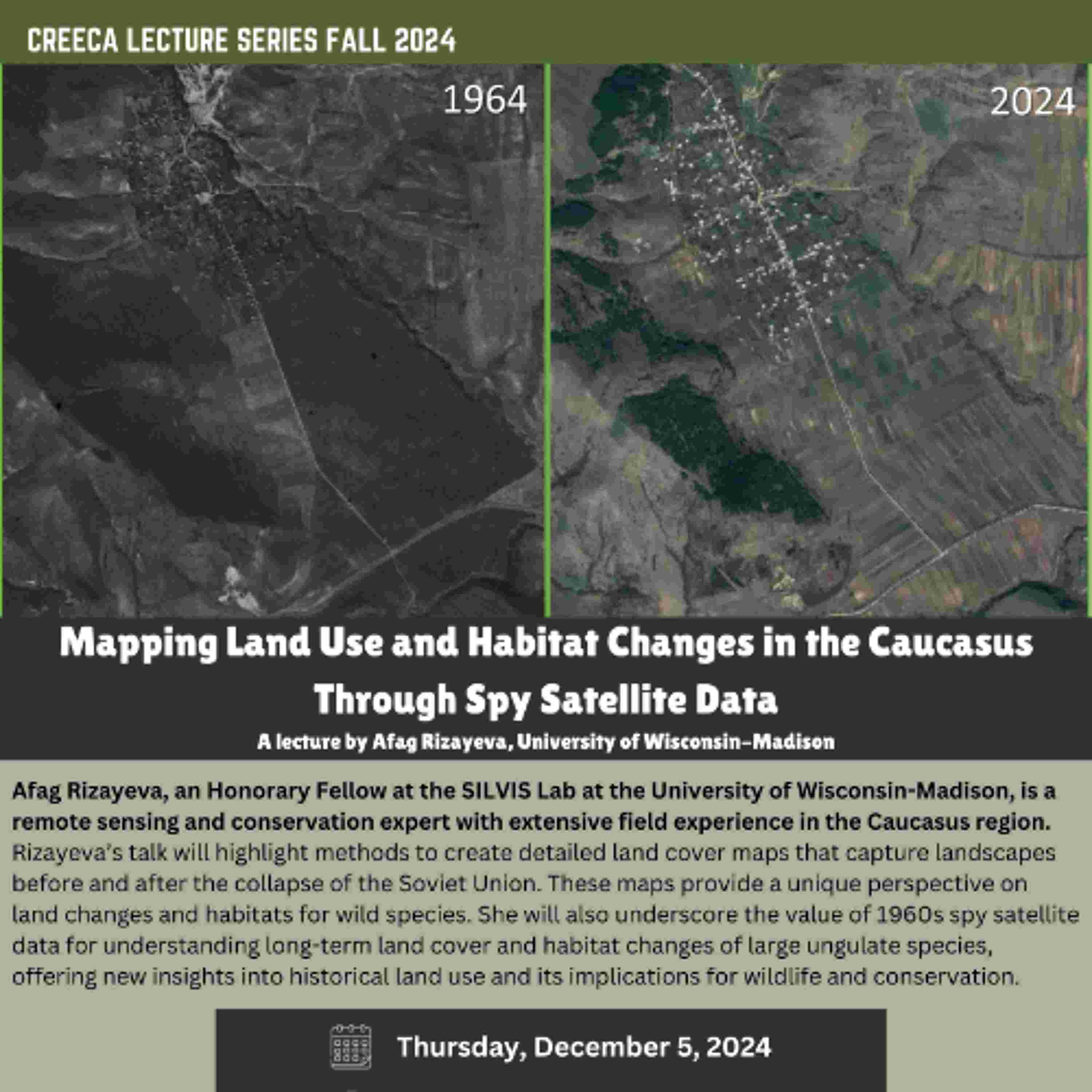
Mapping Land Use and Habitat Changes in the Caucasus Through Spy Satellite Data
CREECA Lecture Series Podcast
41 minutes 48 seconds
1 year ago
Mapping Land Use and Habitat Changes in the Caucasus Through Spy Satellite Data
About the lecture: The legacy of past human activities strongly shapes current landscapes and ecosystems, with today’s actions set to leave similar long-term impacts. Predicting future landscape changes, however, requires a thorough understanding of past ones, yet most land and habitat change studies are limited to recent decades—starting only in the 1980s with the availability of 30-m satellite data or in the 2000s with commercial high-resolution satellites. This presentation will introduce an alternative approach, using high-resolution imagery from the 1960s U.S. Corona spy satellites series to trace landscape changes over the past half-century. Focusing on the diverse Caucasus region, with its wide variation in elevation, climate, ecosystems, and historical land-use patterns, this presentation will highlight methods to create detailed land cover maps capturing landscapes before and after the collapse of the Soviet Union. These historical maps provide a unique perspective on land changes, as well as habitat changes for wild species. This presentation will underscore the value of 1960s spy satellite data for understanding long-term land cover and habitat changes of large ungulate species, offering new insights into historical land use and its implications for wildlife and conservation.
About the speaker: Afag (pronounced ah-fah) is a remote sensing and conservation expert with extensive field experience in the Caucasus region. Currently an Honorary Fellow at the SILVIS Lab at the University of Wisconsin-Madison (https://silvis.forest.wisc.edu/people/), she holds a PhD in Forestry from the University of Wisconsin-Madison and a Postgraduate Diploma in Wildlife Conservation from the University of Oxford. Afag’s research employs high-resolution satellite data to map historical land cover in the Caucasus eco-region, investigating long-term landscape changes and their impacts on wild habitats. Her past work has contributed to projects in wild mammal species’ reintroduction, habitat management, and human-wildlife conflict mitigation, and she has shared her findings in various publications (link to google scholar – https://scholar.google.com/citations?user=sqSt3H4AAAAJ&hl=en&oi=ao). In addition, employed as a data scientist at Spatial Informatics Group (SIG), she is currently involved in environmental projects in developing countries. Fluent in three languages and conversant in two others, Afag brings a global perspective to her work.
CREECA Lecture Series Podcast
In 1991, as the USSR broke apart and its population became open to the reforming discourse of Mikhail Gorbachev’s reform program of perestroika, Soviet dissident historian Roy Medvedev set the tone for subsequent writing on Leonid Ilich Brezhnev, concluding that he was “a personality so mediocre and a politician so ordinary” that he “quickly disappeared from the political scene and also in the literal and metaphorical sense.” But not for long. When it became clear by the end of the decade that market capitalism and democracy had not improved people’s lives, nostalgia for the Brezhnev era rightly raised the question of whether he had been given his just due and unfairly blamed for the shortcomings of the Soviet system. This reversal of fortune also makes clear that no Soviet leader has been as neglected or as misunderstood as Brezhnev and therefore no Soviet party boss is in such need of a fresh historical reassessment. Divided into two parts, my presentation will first make a case for Brezhnev, emphasizing his vision of guaranteeing stability, assuring peace, and letting people live well. Earlier I coined the term “Soviet man of peace,” to characterize Brezhnev. I emphasize this point here, arguing that his dream of wanting to be remembered as an asset for world peace made him a leader who changed the world. In part 2 of my presentation, I zoom in on the Leonid Brezhnev that, as his biographer, I might never know and propose what these unresolved questions might mean.
Donald J. Raleigh is the Jay Richard Judson Distinguished Professor of Russian History Emeritus at the University of North Carolina, Chapel Hill. He has authored, translated, and edited numerous books on modern Russian history including Revolution on the Volga (1986), Experiencing Russia’s Civil War (2002), Russia’s Sputnik Generation (2006) and Soviet Baby Boomers (2012). He currently is writing a biography of Soviet leader Leonid Ilich Brezhnev, research for which has taken him to archives in Russia, Moldova, Ukraine, Kazakhstan, the UK, and the US.
This lecture is sponsored by the Alice D. Mortenson/Petrovich Distinguished Chair of Russian History and University Lectures.