
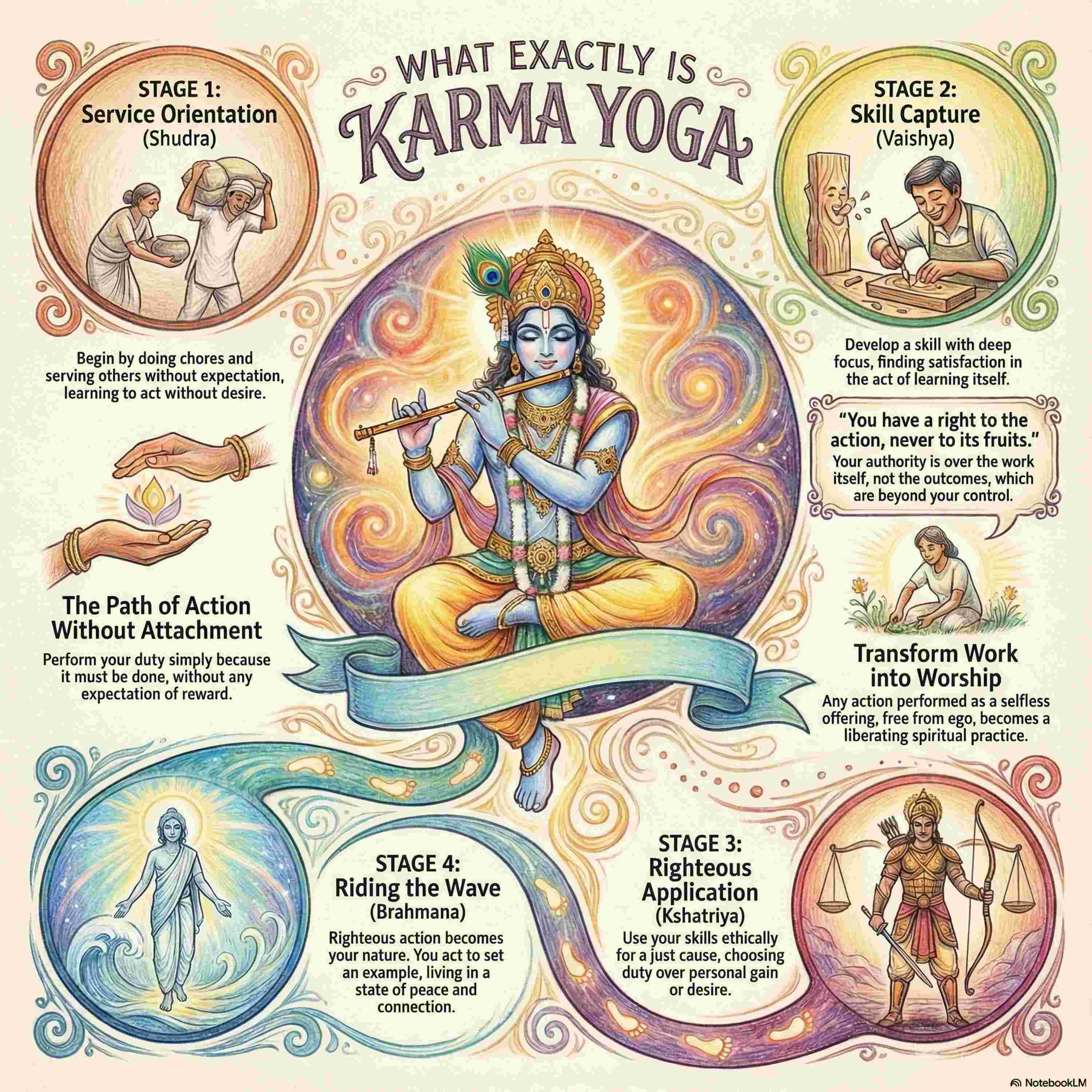
This episode explores the philosophical underpinnings of Karm Yoga through the legendary dialogue between Krishna and Arjuna on the battlefield of the Mahabharata.
It frames the Gita not just as a religious scripture, but as a practical ritual of actions designed to help individuals move beyond the paralysis of desire and duality.
The author outlines a developmental roadmap consisting of four stages—service, skill building, righteous application, and realization—to guide seekers from menial chores to the embodiment of universal truth. By advocating for a total separation of actions from outcomes, the narrative teaches that focusing on the "how" of a task rather than its "fruit" leads to mastery of the self and eternal peace.
Ultimately, the source presents Karm Yoga as a transformative skill that empowers people to fulfill their worldly duties while accessing the deep, hidden knowledge within their own souls.
#KarmaYoga – The overarching discipline of achieving union through action.
#KaryamKarma – Specifically refers to "obligatory duty" or actions that "must be done."
#NishkamaKarma – The methodology of acting without desire for results or "fruits."
#BhagavadGita – The primary source text for these teachings.
#GitaWisdom – General search term for insights from the scripture.
#NonAttachment – The internal state of being Asakta while performing duty.
#Duty – Centering the conversation on obligation over personal inclination.
These hashtags highlight the developmental framework described in the sources.
#ServiceOrientation – The first stage (Shoodra), focusing on selfless physical tasks to break desire-driven habits.
#SkillBuilding – The second stage (Vaishya), focusing on "Skill Capture" or Yajna.
#RighteousAction – The third stage (Kshtriya), applying skills ethically amidst conflict.
#SpiritualEvolution – The progression toward becoming a Bramhana or "Riding the Wave."
#SelflessService – Performing chores and errands as a way to find internal peace.
#ProfessionalEthics – Applying the "Righteous Application of Skills" to modern fields like medicine, law, and AI.
#ActionVsOutcome – The central psychological shift from chasing "jackpots" to focusing on the process.
#OvercomingProcrastination – Using service-oriented tasks to gain freedom from desire-led motivation.
#Equanimity – Maintaining balance during success and failure.
#InnerPeace – The byproduct of relinquishing outcome obsession.
#MindfulnessInAction – Bringing full attention and excellence to the present task.
#SelfRealization – Using action as a mirror to see into the "black box" of the self.
#Vedanta – The broader philosophical system encompassing these teachings.
#AdiShankaracharya – For the Advaita view of duty as a means for Chitta Shuddhi (mind purification).
#Ramanujacharya – For the Vishishtadvaita view of duty as divine service.
#Madhvacharya – For the Dvaita focus on grace and devotion through duty.
#LokaSamgraha – The concept of acting for the "maintenance of the world" and social order.
#Akarma – Achieving the state of "non-action" or transcendental activity that does not bind.
#LordKrishna – The supreme teacher and strategist of the Gita.
#Arjuna – The archetype of the skilled individual facing an ethical crisis.
#Mahabharata – The epic context for the conversation between the two Yogis.
#ArjunUvaach – Direct reference to the dialogue and inquiry of the student.