In 2025, Ukraine is facing unprecedented pressure from one of its key partners, the United States. The Trump administration has chosen not to act as Ukraine’s ally, but rather as a mediator between Ukraine and Europe on the one hand, and Russia on the other.
This shift has fundamentally changed the geopolitical framework of Russia’s war against Ukraine. Around the world, the language of victory has largely been replaced by the language of peace. Yet under current conditions, “peace” often implies that Ukraine will not regain its occupied territories—and such a peace may, in fact, amount to Ukraine’s defeat.
In this episode, we explain why this is a dangerous path. We also look back at 2025 and summarize its key developments
***
Host: Volodymyr Yermolenko, a Ukrainian philosopher, editor-in-chief of UkraineWorld, and president of PEN Ukraine.
Guest: Tetyana Ogarkova, a Ukrainian journalist and public intellectual, the head of the international department at the Ukraine Crisis Media Centre, and author of the podcast “L’Ukraine face a la guerre”, “Ukraine facing the war”, in French.
***
Explaining Ukraine is a podcast by UkraineWorld, an English-language media platform about Ukraine, run by Internews Ukraine.
Listen on various platforms: https://li.sten.to/explaining-ukraine
UkraineWorld: https://ukraineworld.org/en
***
SUPPORT:
You can support our work on https://www.patreon.com/c/ukraineworld
Your help is crucial, as we rely heavily on crowdfunding.
You can also contribute to our volunteer missions to frontline areas in Ukraine, where we deliver aid to both soldiers and civilians.
Donations are welcome via PayPal at: ukraine.resisting@gmail.com.
***
CONTENTS:
00:00 - Introduction
01:46 - US's shift from ally to mediator in Russia-Ukraine war. The impact of the Trump administration's approach to military aid.
06:13 - Trump and Putin's similar world vision regarding spheres of influence.
07:03 - Key elements of proposed peace plans: territorial concessions, security guarantees, and military withdrawal.
08:38 - Ukraine's public opinion against territorial concessions.
13:55 - The "fog" of peace negotiations occurring amidst ongoing total war and Russia's strategy of buying time.
17:33 - Legal and moral challenges of territorial concessions and skepticism about the legitimacy of peace plan negotiators.
20:48 - The escalation of the war, increased civilian suffering due to infrastructure bombardments, and Ukraine's strategy to target the Russian economy.
25:01 - Ukraine's dilemma in peace talks and Russia's strategy of worsening conditions over time.
29:04 - Donald Trump's political weaknesses and Zelenskyy's strategy
30:57 - The security situation on the front line: the rise of drone warfare, its increasing danger to civilians, and the expanding "kill zone."
39:07 - Ukrainian internal politics: the war against corruption, the role of civil society, and Zelenskyy's responsiveness to public opinion.
46:45 - Concluding remarks and a call for support for UkraineWorld.
All content for Explaining Ukraine is the property of UkraineWorld and is served directly from their servers
with no modification, redirects, or rehosting. The podcast is not affiliated with or endorsed by Podjoint in any way.
In 2025, Ukraine is facing unprecedented pressure from one of its key partners, the United States. The Trump administration has chosen not to act as Ukraine’s ally, but rather as a mediator between Ukraine and Europe on the one hand, and Russia on the other.
This shift has fundamentally changed the geopolitical framework of Russia’s war against Ukraine. Around the world, the language of victory has largely been replaced by the language of peace. Yet under current conditions, “peace” often implies that Ukraine will not regain its occupied territories—and such a peace may, in fact, amount to Ukraine’s defeat.
In this episode, we explain why this is a dangerous path. We also look back at 2025 and summarize its key developments
***
Host: Volodymyr Yermolenko, a Ukrainian philosopher, editor-in-chief of UkraineWorld, and president of PEN Ukraine.
Guest: Tetyana Ogarkova, a Ukrainian journalist and public intellectual, the head of the international department at the Ukraine Crisis Media Centre, and author of the podcast “L’Ukraine face a la guerre”, “Ukraine facing the war”, in French.
***
Explaining Ukraine is a podcast by UkraineWorld, an English-language media platform about Ukraine, run by Internews Ukraine.
Listen on various platforms: https://li.sten.to/explaining-ukraine
UkraineWorld: https://ukraineworld.org/en
***
SUPPORT:
You can support our work on https://www.patreon.com/c/ukraineworld
Your help is crucial, as we rely heavily on crowdfunding.
You can also contribute to our volunteer missions to frontline areas in Ukraine, where we deliver aid to both soldiers and civilians.
Donations are welcome via PayPal at: ukraine.resisting@gmail.com.
***
CONTENTS:
00:00 - Introduction
01:46 - US's shift from ally to mediator in Russia-Ukraine war. The impact of the Trump administration's approach to military aid.
06:13 - Trump and Putin's similar world vision regarding spheres of influence.
07:03 - Key elements of proposed peace plans: territorial concessions, security guarantees, and military withdrawal.
08:38 - Ukraine's public opinion against territorial concessions.
13:55 - The "fog" of peace negotiations occurring amidst ongoing total war and Russia's strategy of buying time.
17:33 - Legal and moral challenges of territorial concessions and skepticism about the legitimacy of peace plan negotiators.
20:48 - The escalation of the war, increased civilian suffering due to infrastructure bombardments, and Ukraine's strategy to target the Russian economy.
25:01 - Ukraine's dilemma in peace talks and Russia's strategy of worsening conditions over time.
29:04 - Donald Trump's political weaknesses and Zelenskyy's strategy
30:57 - The security situation on the front line: the rise of drone warfare, its increasing danger to civilians, and the expanding "kill zone."
39:07 - Ukrainian internal politics: the war against corruption, the role of civil society, and Zelenskyy's responsiveness to public opinion.
46:45 - Concluding remarks and a call for support for UkraineWorld.
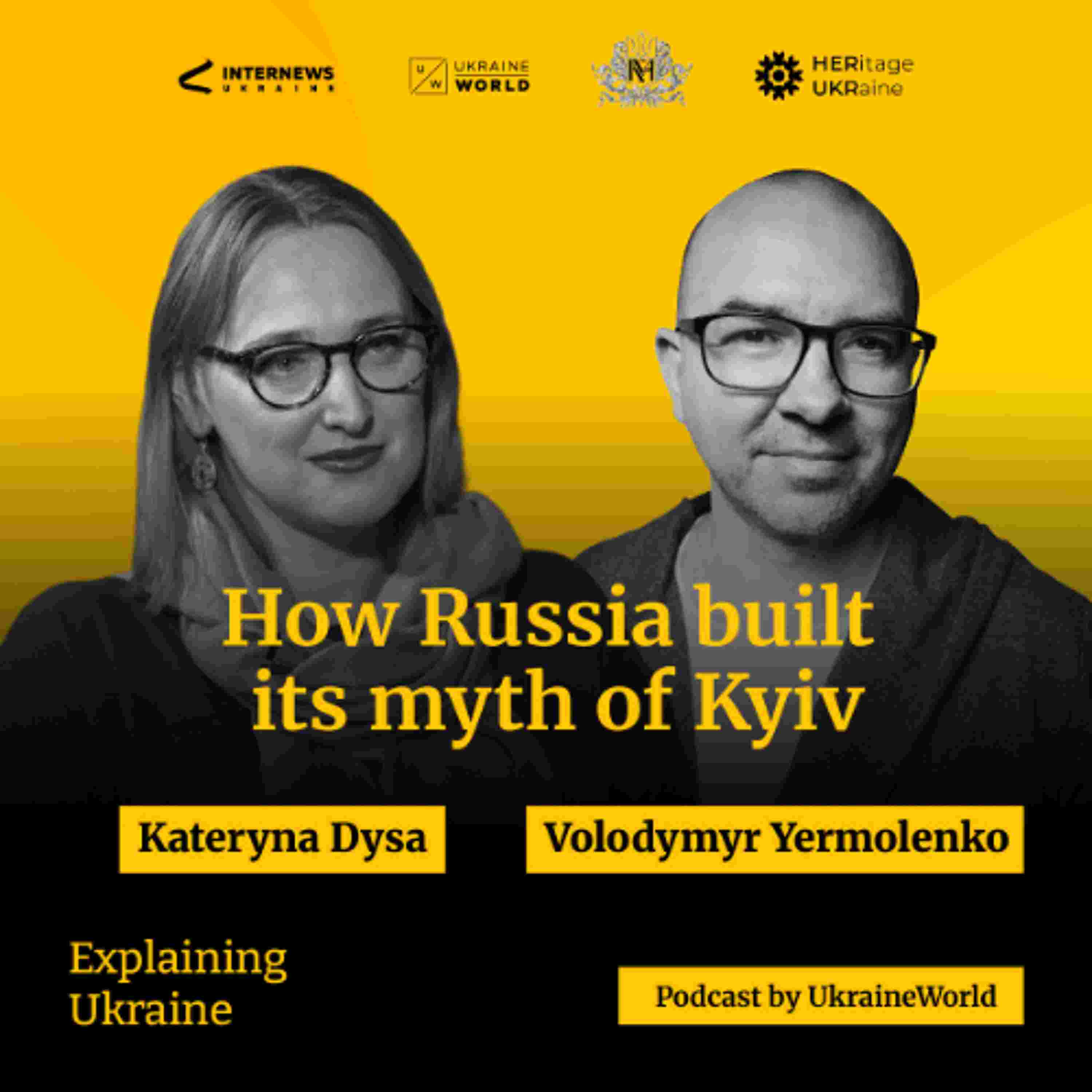
How Russia built its myth of Kyiv - with Kateryna Dysa
Explaining Ukraine
42 minutes 13 seconds
1 month ago
How Russia built its myth of Kyiv - with Kateryna Dysa
Russian propaganda claims that Ukraine is not a separate nation, but merely a “preliminary form” of Russia. Today’s Kremlin ideology seeks to annex Ukrainian history in order to justify its territorial aggression. But this myth has a birth certificate. It emerged in the 19th century, when the Russian Empire started inventing its “ancient” medieval roots. Before that, Russian travellers in Ukrainian lands showed little interest in such historical questions.
In this episode, we trace the genealogy of the myth that Kyiv is a “Russian city” and that its history somehow belongs to Muscovy.
***
Explaining Ukraine is a podcast by UkraineWorld, an English-language media platform about Ukraine, run by Internews Ukraine.
Host: Volodymyr Yermolenko, a Ukrainian philosopher, editor-in-chief of UkraineWorld, and president of PEN Ukraine.
Listen on various platforms: https://li.sten.to/explaining-ukraine
UkraineWorld: https://ukraineworld.org/en
***
Guest: Kateryna Dysa, a Ukrainian historian and Associate Professor at Kyiv-Mohyla Academy. She has been a visiting fellow at Harvard, Stanford, Paris, and Oxford, and a visiting professor at the University of Basel. Currently, she is researching how the image of Kyiv was constructed in travel literature from the late eighteenth to early twentieth centuries.
***
SUPPORT:
You can support our work on https://www.patreon.com/c/ukraineworld
Your help is crucial, as we rely heavily on crowdfunding.
You can also contribute to our volunteer missions to frontline areas in Ukraine, where we deliver aid to both soldiers and civilians.
Donations are welcome via PayPal at: ukraine.resisting@gmail.com.
***
CONTENTS:
00:00 Kateryna Dysa, a Ukrainian historian and associate professor at Kyiv-Mohyla Academy.
00:15 Where and when did the myth of Kyiv belonging to Moscow actually begin?
02:05 How did 18th-century Russian travelers initially view Kyiv, and why was their interest superficial?
04:05 How did the rise of history as a discipline change Russia's perception of Kyiv?
12:17 Why did the French philosopher Madame de Staël describe Kyiv as a "semi-Tatar" or nomadic place?
15:17 What were the two extreme ways Westerners described Kyiv?
21:04 When did the annexation of the past become an "aggressive policy" and a part of Russian imperial ideology?
35:03 Why were Russian travelers unwilling to communicate with locals, stressing that Ukrainians were "the other"?
38:07 Why did Russian travelers consistently feel "not at home" in a place the Empire claimed as its "cradle"?
39:16 What aspects of Kyiv's social and cultural history in the 19th century still remain "understudied"?
***
This episode is made in partnership with Kyiv-Mohyla Academy and under the framework of the project “HER-UKR: Challenges and opportunities for EU heritage diplomacy in Ukraine”, co-funded by the EU within the ERASMUS+ Jean Monnet Policy Debate action.
Explaining Ukraine
In 2025, Ukraine is facing unprecedented pressure from one of its key partners, the United States. The Trump administration has chosen not to act as Ukraine’s ally, but rather as a mediator between Ukraine and Europe on the one hand, and Russia on the other.
This shift has fundamentally changed the geopolitical framework of Russia’s war against Ukraine. Around the world, the language of victory has largely been replaced by the language of peace. Yet under current conditions, “peace” often implies that Ukraine will not regain its occupied territories—and such a peace may, in fact, amount to Ukraine’s defeat.
In this episode, we explain why this is a dangerous path. We also look back at 2025 and summarize its key developments
***
Host: Volodymyr Yermolenko, a Ukrainian philosopher, editor-in-chief of UkraineWorld, and president of PEN Ukraine.
Guest: Tetyana Ogarkova, a Ukrainian journalist and public intellectual, the head of the international department at the Ukraine Crisis Media Centre, and author of the podcast “L’Ukraine face a la guerre”, “Ukraine facing the war”, in French.
***
Explaining Ukraine is a podcast by UkraineWorld, an English-language media platform about Ukraine, run by Internews Ukraine.
Listen on various platforms: https://li.sten.to/explaining-ukraine
UkraineWorld: https://ukraineworld.org/en
***
SUPPORT:
You can support our work on https://www.patreon.com/c/ukraineworld
Your help is crucial, as we rely heavily on crowdfunding.
You can also contribute to our volunteer missions to frontline areas in Ukraine, where we deliver aid to both soldiers and civilians.
Donations are welcome via PayPal at: ukraine.resisting@gmail.com.
***
CONTENTS:
00:00 - Introduction
01:46 - US's shift from ally to mediator in Russia-Ukraine war. The impact of the Trump administration's approach to military aid.
06:13 - Trump and Putin's similar world vision regarding spheres of influence.
07:03 - Key elements of proposed peace plans: territorial concessions, security guarantees, and military withdrawal.
08:38 - Ukraine's public opinion against territorial concessions.
13:55 - The "fog" of peace negotiations occurring amidst ongoing total war and Russia's strategy of buying time.
17:33 - Legal and moral challenges of territorial concessions and skepticism about the legitimacy of peace plan negotiators.
20:48 - The escalation of the war, increased civilian suffering due to infrastructure bombardments, and Ukraine's strategy to target the Russian economy.
25:01 - Ukraine's dilemma in peace talks and Russia's strategy of worsening conditions over time.
29:04 - Donald Trump's political weaknesses and Zelenskyy's strategy
30:57 - The security situation on the front line: the rise of drone warfare, its increasing danger to civilians, and the expanding "kill zone."
39:07 - Ukrainian internal politics: the war against corruption, the role of civil society, and Zelenskyy's responsiveness to public opinion.
46:45 - Concluding remarks and a call for support for UkraineWorld.