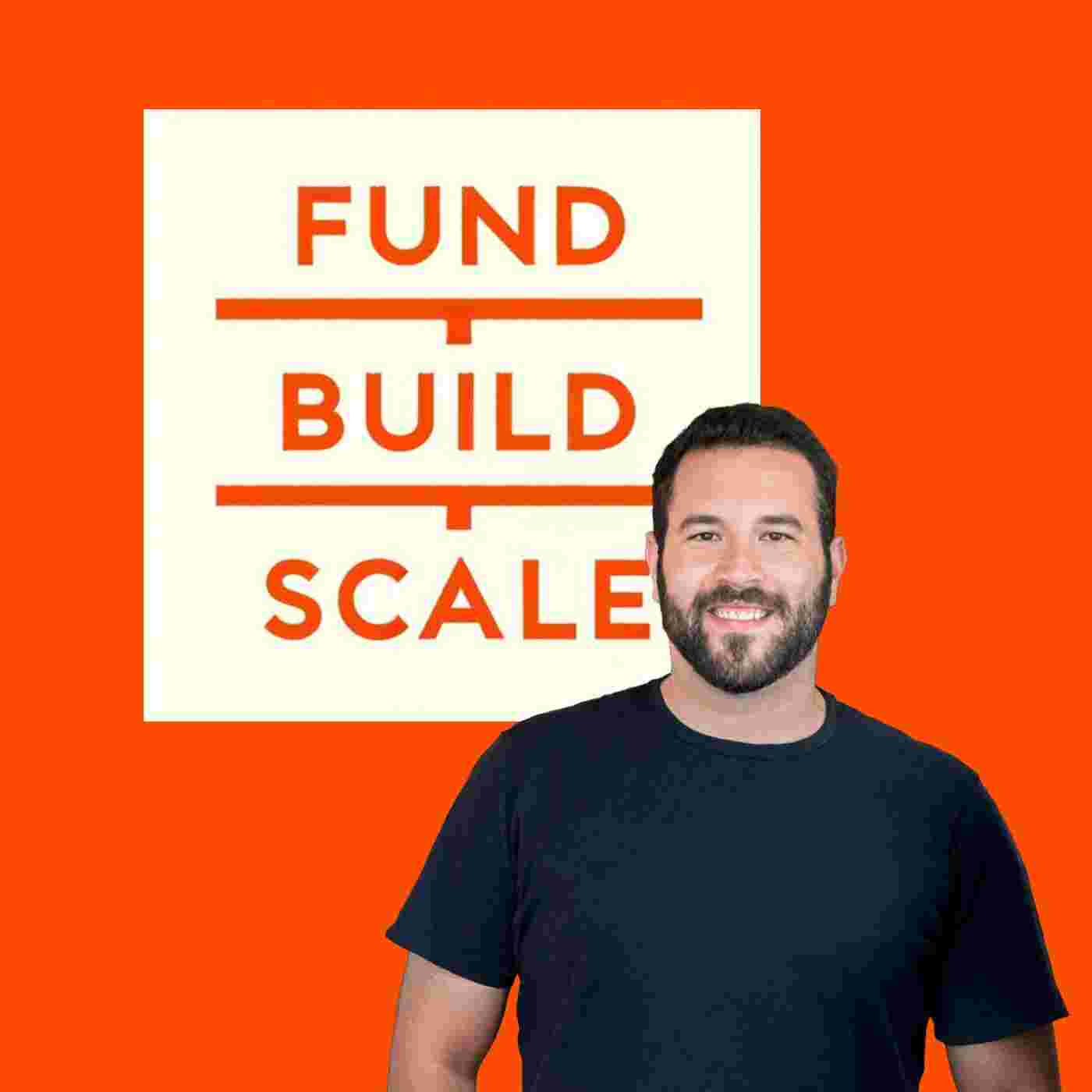
After working for years in early-stage startups and as a journalist, here are three hard truths I’ve learned:
1. Success in Silicon Valley hinges on connections, hard work and luck.
2. Startups often fail because founders lack fundamental business knowledge.
3. Real, actionable advice comes from those who’ve actually done it.
There’s no such thing as “founder DNA.” If you’re willing to take on risk and invest years of your life in something that has maybe a 10% chance of paying off — less if you’re a woman or person of color — you can be a startup founder.
Here’s why I founded Fund/Build/Scale:
1. To help founders make fewer mistakes.
2. To share successful strategies that can accelerate your go-to-market journey.
3. To inspire more people to see themselves as potential founders. There’s a lot of overlooked talent out there, and we are missing out.
This podcast is for anyone who’s interested in learning the basic skills required to launch a startup, secure initial funding and transform an idea into a sustainable business.
I’m talking to guests about everything: finding a co-founder, conducting customer discovery, recruiting early employees, developing a PLG strategy, fundraising when you’re outside a major tech hub — all of it.
Interested? Subscribe to Fund/Build/Scale on all major platforms and follow the podcast on LinkedIn or Substack to get articles, excerpts, transcripts and more.
All content for Fund/Build/Scale is the property of Walter Thompson and is served directly from their servers
with no modification, redirects, or rehosting. The podcast is not affiliated with or endorsed by Podjoint in any way.
After working for years in early-stage startups and as a journalist, here are three hard truths I’ve learned:
1. Success in Silicon Valley hinges on connections, hard work and luck.
2. Startups often fail because founders lack fundamental business knowledge.
3. Real, actionable advice comes from those who’ve actually done it.
There’s no such thing as “founder DNA.” If you’re willing to take on risk and invest years of your life in something that has maybe a 10% chance of paying off — less if you’re a woman or person of color — you can be a startup founder.
Here’s why I founded Fund/Build/Scale:
1. To help founders make fewer mistakes.
2. To share successful strategies that can accelerate your go-to-market journey.
3. To inspire more people to see themselves as potential founders. There’s a lot of overlooked talent out there, and we are missing out.
This podcast is for anyone who’s interested in learning the basic skills required to launch a startup, secure initial funding and transform an idea into a sustainable business.
I’m talking to guests about everything: finding a co-founder, conducting customer discovery, recruiting early employees, developing a PLG strategy, fundraising when you’re outside a major tech hub — all of it.
Interested? Subscribe to Fund/Build/Scale on all major platforms and follow the podcast on LinkedIn or Substack to get articles, excerpts, transcripts and more.
April co-founder and CEO Ben Borodach joins Fund/Build/Scale to break down how he built a compound startup in one of the hardest markets in fintech: U.S. taxes.
We talk about why some problems can’t be solved with a simple wedge product, how to sequence engineering, compliance, and distribution, and what it takes to operate inside complexity for years before the market catches up.
Ben shares the early customer discovery work, the “science experiments” that shaped April’s product, and the cultural frameworks he and his co-founder developed before they wrote any code.
If you’re an early-stage founder deciding what to build — or how to build it — this episode offers a clear playbook for choosing hard problems and de-risking them the right way.
RUNTIME 48:00
EPISODE BREAKDOWN
01:08 How Ben and Daniel met + connecting over complex data problems
01:47 Ben’s background: Deloitte, crypto infra, cyber, fintech
02:51 Why pick tax? Choosing a hard, high-impact market
03:44 Outdated incumbents + the opportunity hidden in “don’t touch that” markets
04:57 Why tax innovation is so rare: regulatory hurdles and decades-old engines
05:29 Founder-market fit: complementary backgrounds + AI expertise
06:38 Translating congressional law into code + achieving 20× engineering leverage
07:25 The pseudo-manifesto: conflict resolution, culture, and founder alignment
08:40 What “compound startup” means and why narrow wedges don’t work in B2B
09:57 Stitching data, workflows, and software into a flexible platform
10:39 Building for multiple configurations across financial institutions
11:26 How complexity becomes a moat
13:01 Why compound startups require longer gestation and patience
14:46 Sequencing layers: engine → coverage → interfaces → embedded infra
15:50 The rigid annual regulatory calendar and “Manhattan-style” planning
17:13 Serving customers early: friction with the market by design
18:46 Manual work vs. automation: the constant balancing act
19:27 The early KPI wasn’t revenue it was proving technical and trust viability
20:46 Running “science experiments” to de-risk assumptions
21:16 Investor expectations vs. seasonal learning cycles
22:47 Surviving four years of annual gauntlets before scale
23:02 Inside the regulatory maze: IRS approval, state forms, arbitrary specs
24:04 Data governance challenges: CCPA, IRS 7216, portability
25:20 Why April participates in the industry’s private governance body
26:18 Why April chose embedded distribution over a consumer app
27:32 The crumbling moats of financial institutions
29:08 Tax as the missing data layer enabling personalization
30:47 How customer discovery differed across banking, wealth, and SMB
31:07 Thousands of conversations across dozens of institutions
32:51 What April had to prove at Seed, Series A, Series B
33:49 Why rigid VC benchmarks can be unhelpful for complex companies
37:02 Headcount growth: seed → A → B
38:20 Why Ben doesn’t interview every employee anymore
39:48 Founder evolution: doing → delegating → maintaining quality
40:55 Resilience, wellbeing, and founder longevity
41:39 The mythology of 996 and why it’s unsustainable
44:07 The most common mistakes first-time fintech founders make
46:14 The one question Ben would ask if he were interviewing a founder
LINKS
Ben Borodach
April
Daniel Marcous
april Raises $38M Series B to Embed Tax into Every Financial Decision
April Careers
SUBSCRIBE
📥 Get the Fund/Build/Scale newsletter on Beehiiv: https://fundbuildscale.beehiiv.com/
📸 Follow Fund/Build/Scale on Instagram: https://www.instagram.com/fundbuildscale/
📺 Watch Fund/Build/Scale on YouTube: https://www.youtube.com/channel/UCFFH4cs2B1BKatPGs8SFRJw
Thanks for listening!
– Walter
Fund/Build/Scale
After working for years in early-stage startups and as a journalist, here are three hard truths I’ve learned:
1. Success in Silicon Valley hinges on connections, hard work and luck.
2. Startups often fail because founders lack fundamental business knowledge.
3. Real, actionable advice comes from those who’ve actually done it.
There’s no such thing as “founder DNA.” If you’re willing to take on risk and invest years of your life in something that has maybe a 10% chance of paying off — less if you’re a woman or person of color — you can be a startup founder.
Here’s why I founded Fund/Build/Scale:
1. To help founders make fewer mistakes.
2. To share successful strategies that can accelerate your go-to-market journey.
3. To inspire more people to see themselves as potential founders. There’s a lot of overlooked talent out there, and we are missing out.
This podcast is for anyone who’s interested in learning the basic skills required to launch a startup, secure initial funding and transform an idea into a sustainable business.
I’m talking to guests about everything: finding a co-founder, conducting customer discovery, recruiting early employees, developing a PLG strategy, fundraising when you’re outside a major tech hub — all of it.
Interested? Subscribe to Fund/Build/Scale on all major platforms and follow the podcast on LinkedIn or Substack to get articles, excerpts, transcripts and more.