
Hosted on Acast. See acast.com/privacy for more information.
Hosted on Acast. See acast.com/privacy for more information.
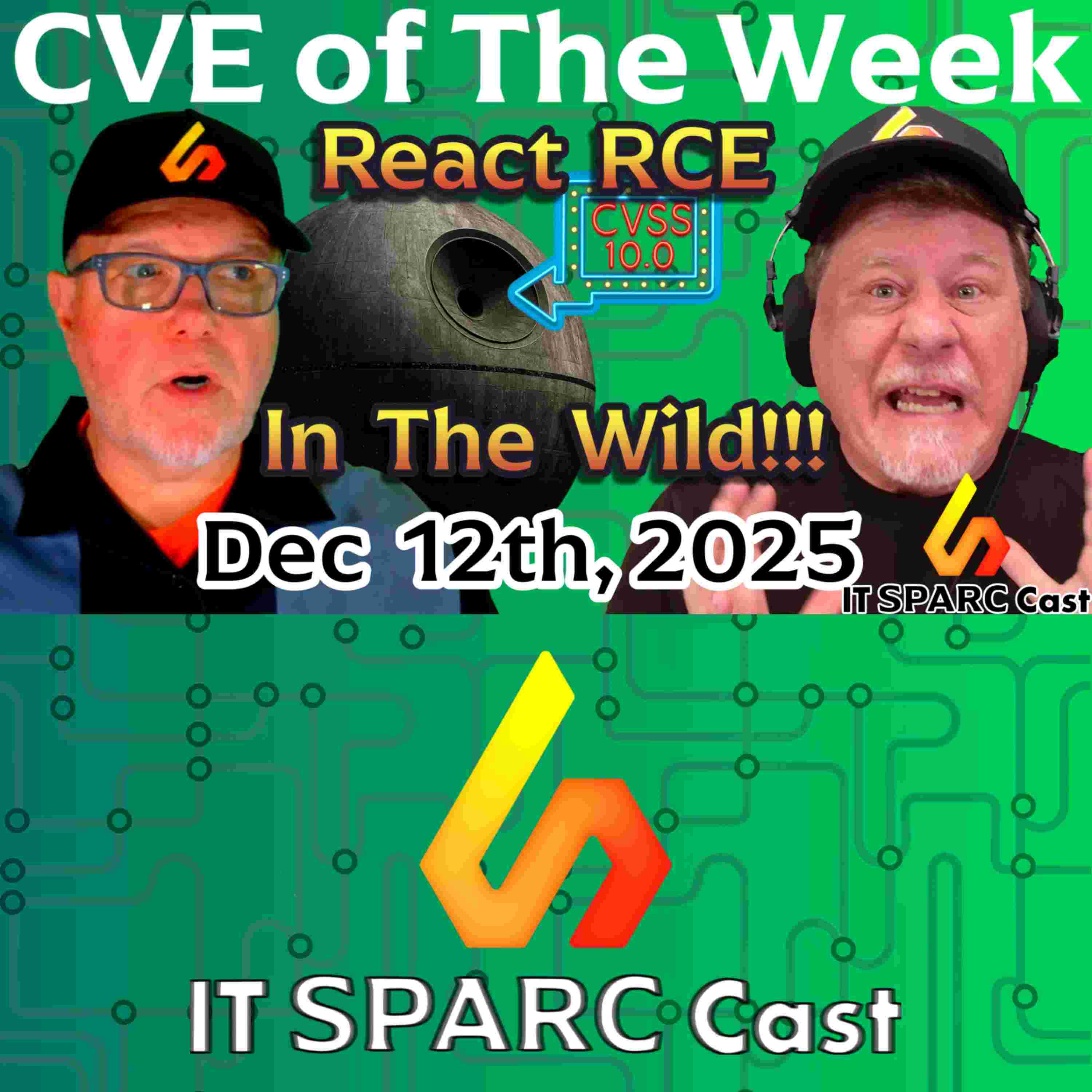
This week on IT SPARC Cast – CVE of the Week, John Barger and Lou Schmidt break down a code-red security situation affecting a massive portion of the modern web. CVE-2025-55182 is a critical, actively exploited vulnerability in React Server Components (RSC) that enables unauthenticated remote code execution, even in applications that don’t explicitly use server functions.
With an estimated 33–35% of cloud-based services running React, attackers are already leveraging automated tooling to deploy cryptominers, Linux backdoors, and persistent malware across vulnerable systems. If you run React, Next.js, or containerized web workloads, this episode outlines exactly why this exploit is so dangerous, how attackers are weaponizing it, and what you must do right now to mitigate risk—from emergency patching to Zero Trust and micro-segmentation strategies.
⸻
Show Notes
🔴 CVE of the Week: CVE-2025-55182 (React Server Components RCE)
In this episode, John and Lou sound the alarm on a critical vulnerability in React Server Components that has escalated from disclosure to active, automated exploitation in the wild.
Key points covered:
•CVE-2025-55182 allows unauthenticated remote code execution via unsafe serialization and deserialization in React Server Component endpoints
•Vulnerable components include:
•react-server-dom-webpack
•react-server-dom-parcel
•react-server-dom-turbopack
•A related issue impacts Next.js App Router deployments, tracked separately as CVE-2025-66478
•Even applications that do not explicitly use server functions may still be exploitable if RSC support exists
🚨 Active Exploitation Confirmed
Lou shares real-time intelligence showing attackers using automated tooling dubbed “React-to-Shell”, delivering:
•Cryptocurrency miners
•Linux backdoors (PeerBlight)
•Reverse proxy tooling (CowTunnel)
•Go-based post-exploitation implants (ZinFoq)
This is no longer theoretical—production systems are being compromised right now.
🛡️ Immediate Mitigation Guidance
If you run React or Next.js workloads:
•Patch immediately to fixed versions
•Disable or strictly isolate RSC server function endpoints if not required
•Place RSC behind WAFs and strict network controls
•Harden container and OS permissions
•Implement payload anomaly detection
•Move toward micro-segmentation and Zero Trust architectures to limit blast radius
John and Lou emphasize that patching alone is no longer enough in an era of AI-accelerated exploitation.
⸻
Wrap Up & Community Feedback
The episode closes with listener feedback from LinkedIn discussing CXL memory pooling and how it is changing enterprise infrastructure economics—plus a recommendation to check out deep-dive demos from Serve The Home.
As always, the team invites listener input on whether future episodes should focus on individual CVEs or broader security themes.
⸻
Follow & Connect
IT SPARC Cast
@ITSPARCCast on X
https://www.linkedin.com/company/sparc-sales/
John Barger
@john_Video on X
https://www.linkedin.com/in/johnbarger/
Lou Schmidt
@loudoggeek on X
https://www.linkedin.com/in/louis-schmidt-b102446/
Hosted on Acast. See acast.com/privacy for more information.