
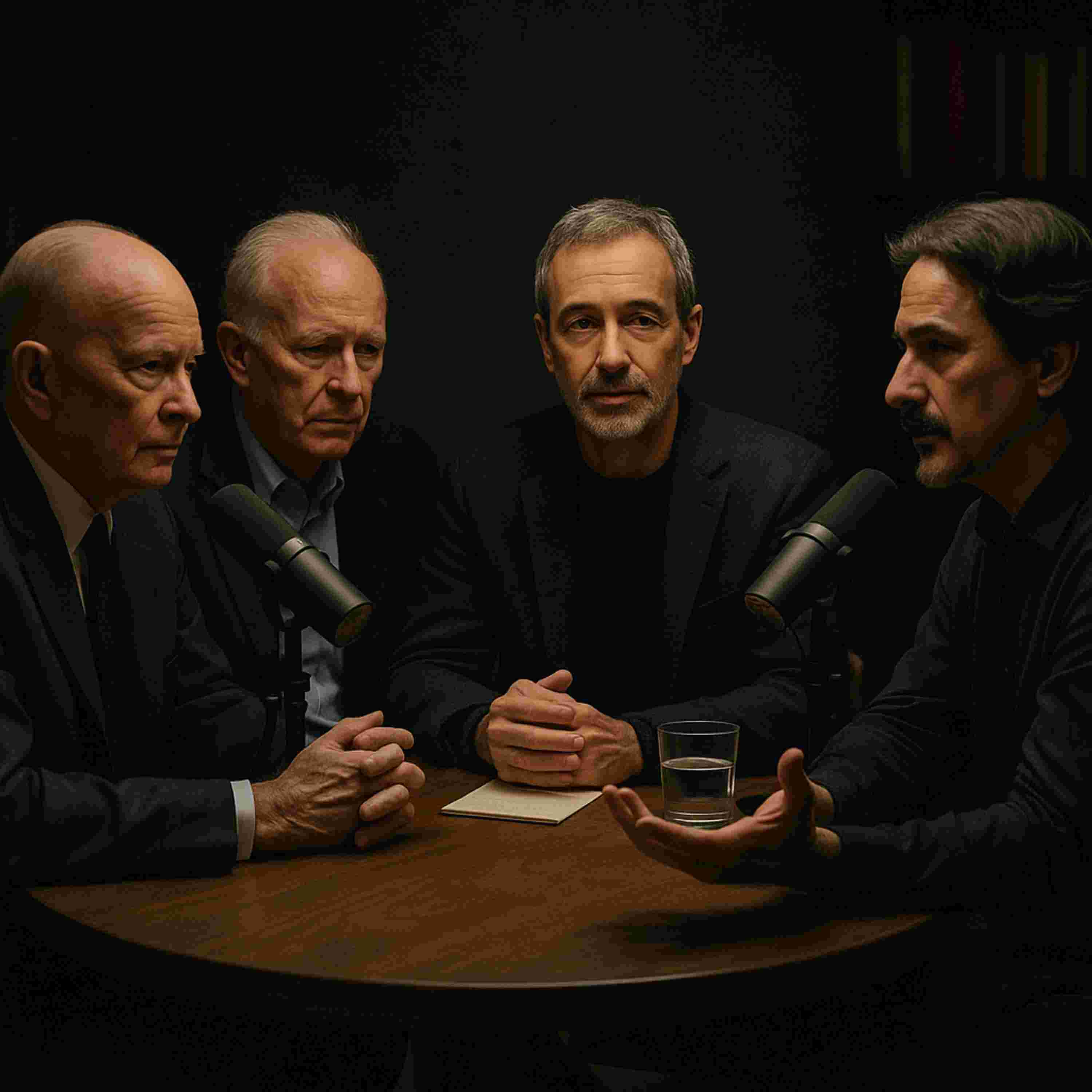
Episode Synopsis
A general. A statesman. A poet. Three voices return — not as they once were, but as they might be now — to grapple with the fires of our present.
As missiles fall between Iran and Israel, as Gaza bleeds, as borders harden and democracies fray, The Late Dialogues convenes Later Dwight D. Eisenhower, Later Yitzhak Rabin, and Later Khalil Gibran for a roundtable conversation on war, restraint, exile, and the moral cost of forgetting.
Together, they confront the collapse of deterrence, the ghosts of Gaza, the authoritarian drift inside the United States, and the trembling future of the nuclear order. And just as a ceasefire flickers into being, they ask: what future can still be made — and what imagination might save us?
This is not an interview. It is a reckoning.
About the Late Dialogues
We speak often of the past as if it were a museum, a quiet gallery of resolved meanings. But what if the past isn’t still? What if it hums underfoot, murmurs through our language, lingers in the metaphors we didn’t choose but inherited?The past is not past. It is prologue, as Shakespeare wrote—a beginning disguised as an ending. Not a script to be followed, but a cue to enter. It is from this intuition that The Late Dialogues emerged.
They are a simple proposition, and a complex undertaking: what if some of the world’s great thinkers, artists, and rebels—those whose thoughts shaped the weather systems of history—had lived on? Not as museum pieces. Not embalmed in quotation. But as living, thinking, evolving minds. As people who read the 20th and 21st centuries. Who saw the rise of fascism, feminism, nuclear power, algorithms, TikTok. Who had their faiths tested, their theories undone, their hearts broken anew. What would they make of us?