
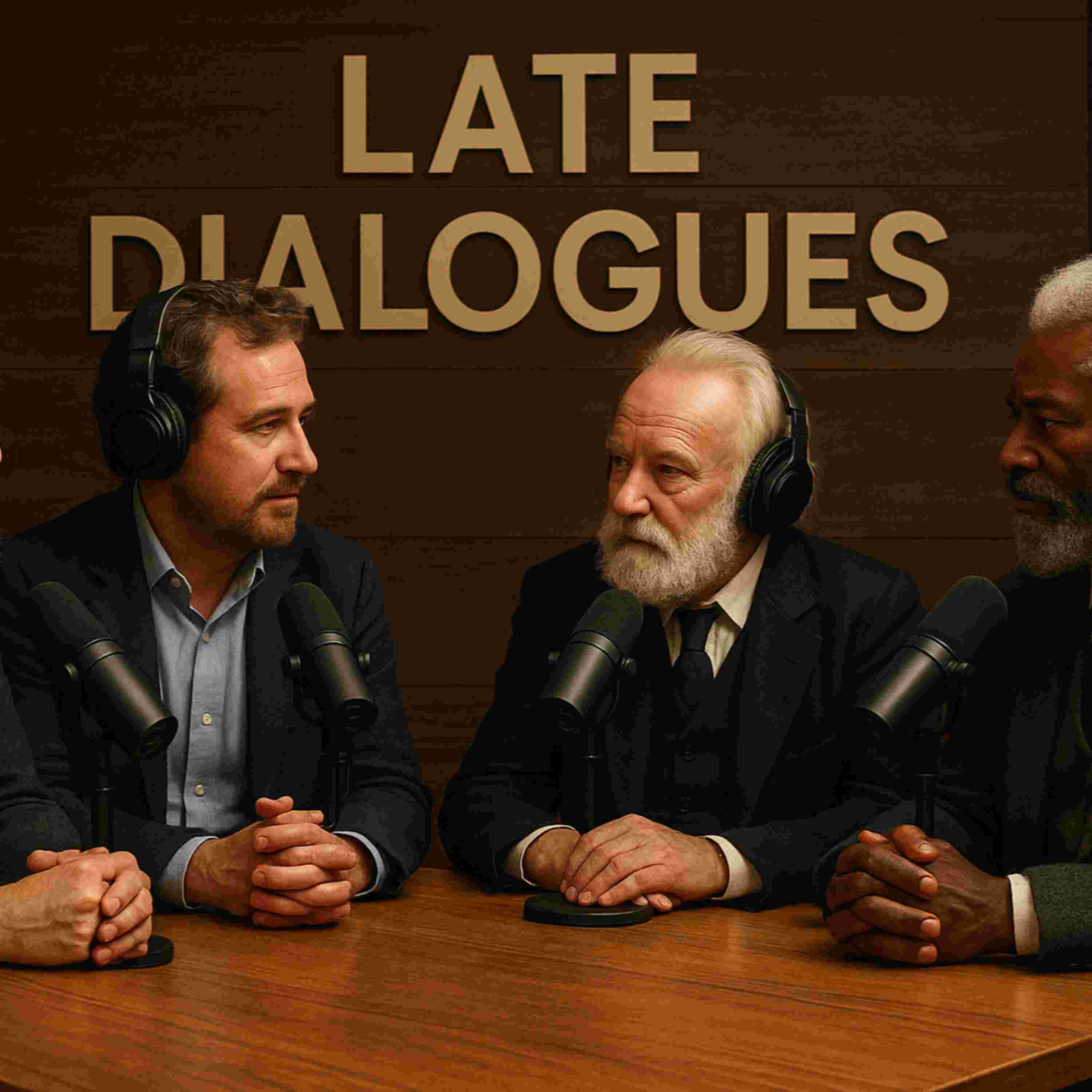
The first episode of The Late Dialogues gathers three revenants of intellect—Frederick Douglass, Karl Marx, and Victor Hugo—not as static echoes, but as dynamically reimagined thinkers shaped by the upheavals they never lived to see. These are the Later Characters: generative reconstructions, painstakingly assembled from a lifetime’s worth of reading, listening, and reverence.
They are not simulations. They are speculative continuations.
Each Later Character is the product of an intricate dramaturgy, where deep historical fidelity meets the pliable force of the present. They are endowed with updated intellectual genealogies, imagined bibliographies, and guiding principles attuned to our planetary hour. They do not repeat what they once said; they argue with what they might now think.
Later Douglass is forged in the crucible of abolition’s unfinished business, his moral suasion now refracted through carceral logic, digital surveillance, and the code of modern resistance. His rhetorical fire has not dimmed—it has evolved. “Power concedes nothing—but it listens to clarity,” he reminds us, even as he warns: “The algorithm is the new whip.”
Later Marx is dialectics incarnate: updated, global, intersectional. He no longer simply critiques capital—he anatomizes the platforms, patents, and pixels that metabolize dissent and monetize solidarity. For him, revolution is no longer barricades in Paris but the repossession of digital infrastructure, the redesign of time and care.
Later Hugo remains the poet-politician, only now with climate grief in his verse and data shadows in his prose. He sees AI as both threat and muse, calls for “poetry that resists performance,” and asks if literature can still “write a line that is not immediately liked, shared, swallowed.” He imagines revolutions that must not only be just—but beautiful.
Together, they do not offer answers. They conduct a fugue of resistance.