
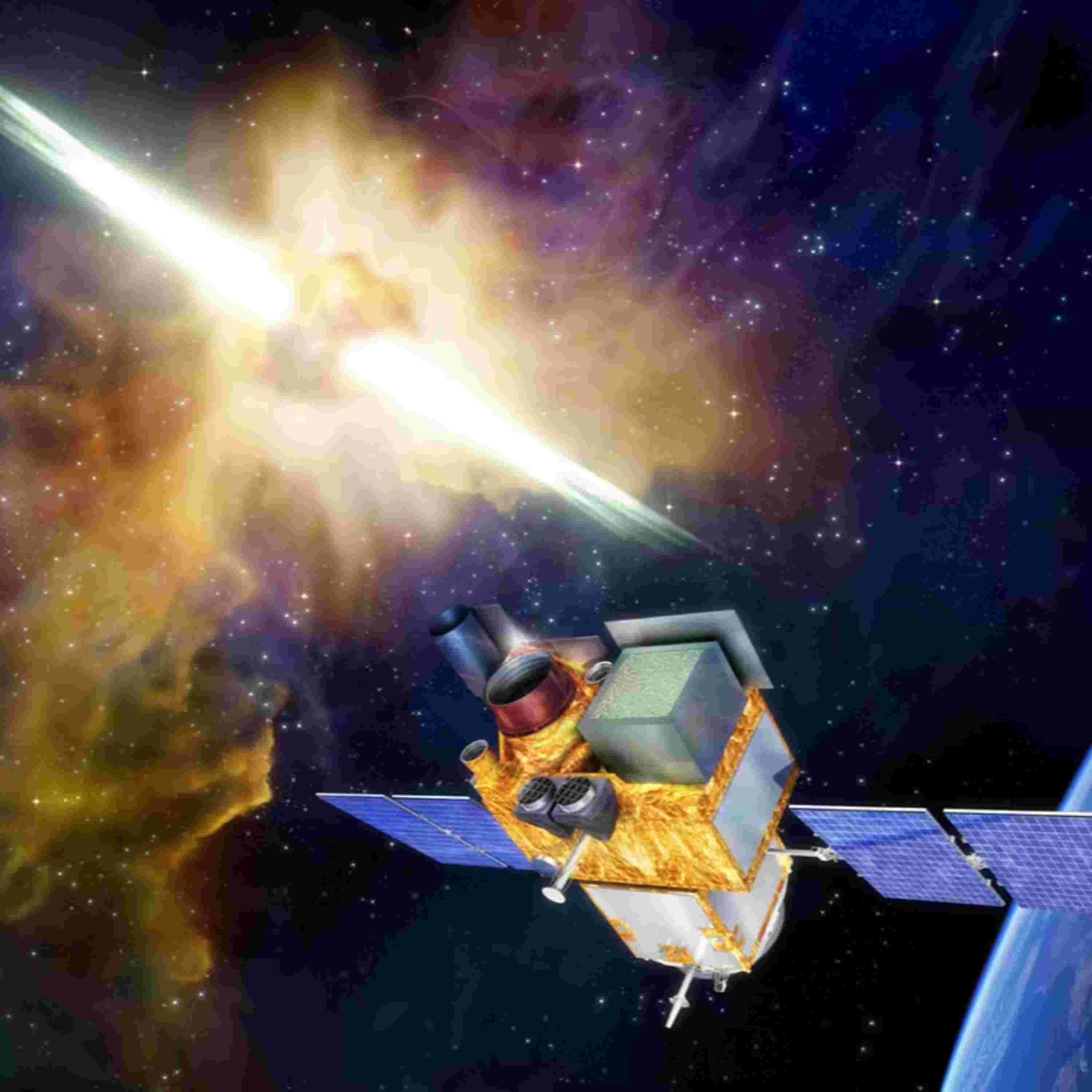
Join us as we explore the remarkable cosmic event, **GRB 250314A**, an exploding star detected deep within the early Universe. This long gamma-ray burst (LGRB), observed by the SVOM satellite, was spectroscopically measured at a redshift of approximately **$z \approx 7.3$**, meaning it occurred when the Universe was only about 5% of its current age, placing it firmly in the era of reionization.
The observation campaign was critical, identifying the GRB as a classical long (Type II) event, consistent with the explosion of a rare massive star. Initial ground-based follow-up, triggered by the SVOM detection, led to the discovery of the near-infrared afterglow and the crucial redshift measurement via the Lyman-$\alpha$ break observed using the VLT/X-shooter.
The investigation reached a major milestone when **JWST/NIRCAM** observations were obtained, revealing both the faint, blue host galaxy and the likely presence of an associated **Supernova (SN)**. Researchers found that the luminosity and spectral shape of this ancient SN are strikingly similar to **SN 1998bw**, the canonical GRB SN prototype observed locally.
This similarity is profound, suggesting that despite the vast differences in physical conditions in the early Universe, the massive star that created GRB 250314A was not significantly more massive than local progenitors, implying a surprisingly limited scope for evolution in GRB and SN properties across much of cosmic history. Studying such events is key to exploring star formation and chemically characterizing the interstellar medium in the highest-redshift galaxies.
***
### Reference Articles
* **Cordier, B., et al. (2025). SVOM GRB 250314A at $z \approx 7.3$: An exploding star in the era of re-ionization.** *Astronomy & Astrophysics, 704, L7*.
* **Levan, A. J., et al. (2025). JWST reveals a supernova following a gamma-ray burst at $z \approx 7.3$.** *Astronomy & Astrophysics, 704, L8*.
Acknowledements: Podcast prepared with Google/NotebookLM. Illustration credits: CNSA/CNES