#6 Pink Power at Harvard? Feminism, Ambition, and Cultural Legacy in "Legally Blonde"
For our sixth English episode, we take a fresh look at "Legally Blonde" (US 2001, Robert Luketic), this time in a faster, focused format: one film, one conversation, directly after the screening. We recommend (re)watching Legally Blonde before listening to our episode - just right in time for the 2026 premiere of the prequel series "Elle".
We watched the film together in Cambridge, Massachusetts, so this episode is tied to place and context. While Barbara is spending the fall and spring semester as a visiting scholar at Harvard and Bianca is conducting research at the Schlesinger Library/ Harvard, it felt only fitting to revisit a film so deeply entangled with Harvard’s cultural imagination and representation.
"Legally Blonde" is often dismissed as serving only as light entertainment, yet its influence is anything but superficial. From Elle Woods’ unapologetic femininity to her navigation of elite academic spaces, the film raises many questions about gender, ambition, social class and belonging. We discuss how the movie plays with stereotypes, sometimes reinforcing them, sometimes strategically subverting them, and why its vision of feminist success continues to resonate more than twenty years later.
The film’s lasting cultural power was palpable at the beginning of the fall term, when "Legally Blonde" was screened outdoors in front of Harvard’s Widener library for incoming students. The collective movie-going experience, complete with quoted lines and audience interaction, made clear how deeply the film is embedded in popular memory. Adding to this, Reese Witherspoon herself visited Harvard Business School this semester to discuss her production company Hello Sunshine, the business side of female-lead storytelling and the long-term impact of "Legally Blonde" on her approach to storytelling.
In this episode, we ask: What kind of feminism does "Legally Blonde" offer? How performative is its feminism? How does it imagine access to elite institutions and at what cost? Why does its depiction of sexual harassment at the workplace feel right? And why does Elle Woods remain such a powerful figure for conversations about women, work and visibility up to today?
All content for Ned Wuascht is the property of Ned Wuascht and is served directly from their servers
with no modification, redirects, or rehosting. The podcast is not affiliated with or endorsed by Podjoint in any way.
#6 Pink Power at Harvard? Feminism, Ambition, and Cultural Legacy in "Legally Blonde"
For our sixth English episode, we take a fresh look at "Legally Blonde" (US 2001, Robert Luketic), this time in a faster, focused format: one film, one conversation, directly after the screening. We recommend (re)watching Legally Blonde before listening to our episode - just right in time for the 2026 premiere of the prequel series "Elle".
We watched the film together in Cambridge, Massachusetts, so this episode is tied to place and context. While Barbara is spending the fall and spring semester as a visiting scholar at Harvard and Bianca is conducting research at the Schlesinger Library/ Harvard, it felt only fitting to revisit a film so deeply entangled with Harvard’s cultural imagination and representation.
"Legally Blonde" is often dismissed as serving only as light entertainment, yet its influence is anything but superficial. From Elle Woods’ unapologetic femininity to her navigation of elite academic spaces, the film raises many questions about gender, ambition, social class and belonging. We discuss how the movie plays with stereotypes, sometimes reinforcing them, sometimes strategically subverting them, and why its vision of feminist success continues to resonate more than twenty years later.
The film’s lasting cultural power was palpable at the beginning of the fall term, when "Legally Blonde" was screened outdoors in front of Harvard’s Widener library for incoming students. The collective movie-going experience, complete with quoted lines and audience interaction, made clear how deeply the film is embedded in popular memory. Adding to this, Reese Witherspoon herself visited Harvard Business School this semester to discuss her production company Hello Sunshine, the business side of female-lead storytelling and the long-term impact of "Legally Blonde" on her approach to storytelling.
In this episode, we ask: What kind of feminism does "Legally Blonde" offer? How performative is its feminism? How does it imagine access to elite institutions and at what cost? Why does its depiction of sexual harassment at the workplace feel right? And why does Elle Woods remain such a powerful figure for conversations about women, work and visibility up to today?
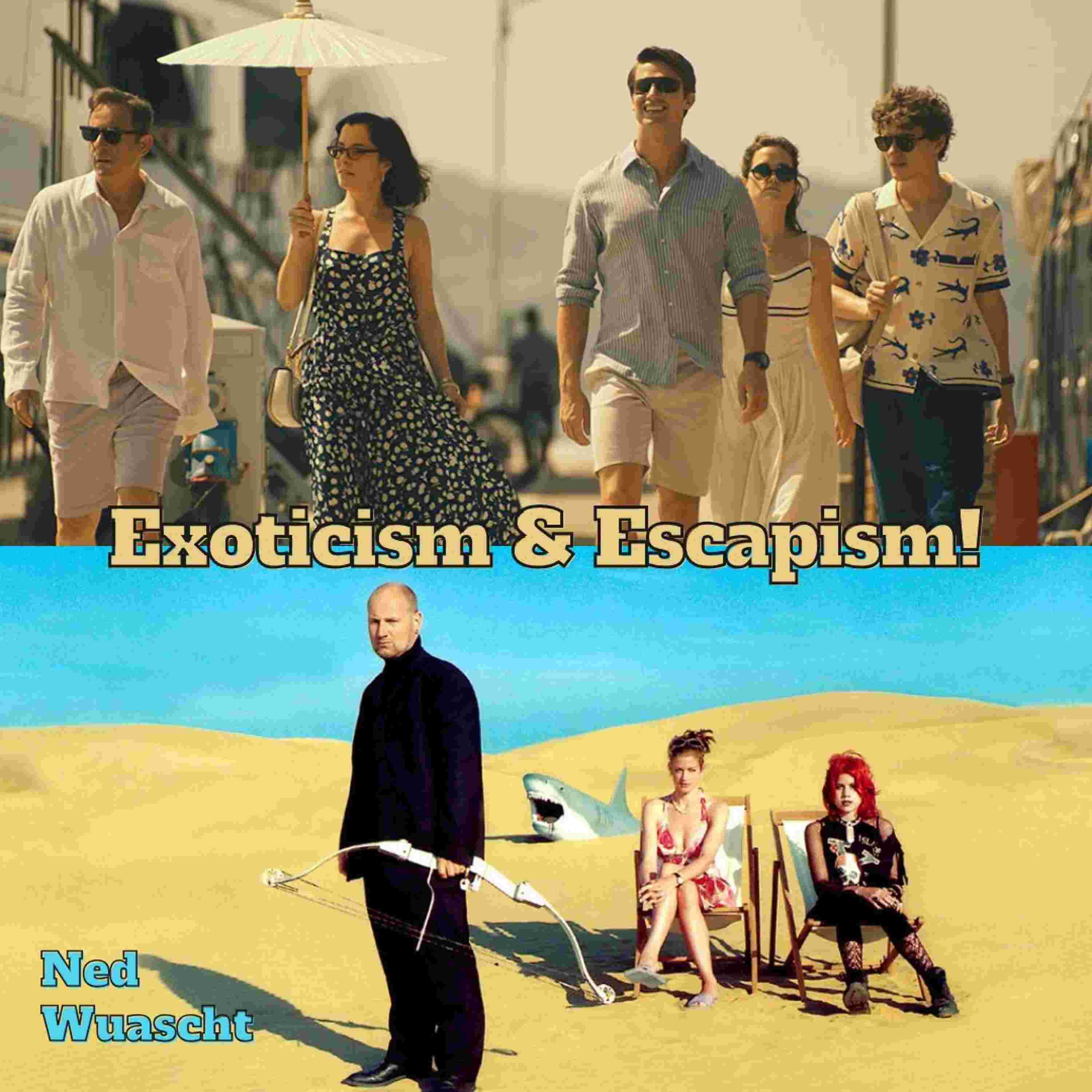
Exoticism and Escapism! Class, Coloniality and Gendered Tourism
Ned Wuascht
1 hour 4 minutes 25 seconds
7 months ago
Exoticism and Escapism! Class, Coloniality and Gendered Tourism
This time it's all about westerner's all-inclusive getaways—and the ideological baggage the characters as well as the viewers bring with them. But does anybody care about the places they visit and the workers?
In our third English podcast episode, we travel to The White Lotus Season 3 (US 2025) and revisit the early-2000s Austrian cult comedy Poppitz (AT 2002), each set in a more or less luxury holiday resort, each revealing just as much about its vacationers as it does about the place and the viewer it/him/her/*self. But what exactly lies beneath the beach towels and palm trees? With a focus on gender, whiteness, and class, we unpack the fantasies, projections, and power imbalances embedded in these two very different, yet surprisingly resonant, resort narratives.
Our analysis builds on diverse-feminist film readings and digs into how The White Lotus and Poppitz render masculinity in crisis, exoticize their local contexts, and reproduce—or subtly question—privileged perspectives.
Key questions in this episode include: What does it mean when white, Western characters escape to the Global South—or to a fictional place similar to Tunisia, in the Austrian imagination? What labor remains invisible in these glossy resorts, and who is allowed to desire, to complain, to act out?
***
We are sorry for the bad sound quality of Bianca's track!
Ned Wuascht
#6 Pink Power at Harvard? Feminism, Ambition, and Cultural Legacy in "Legally Blonde"
For our sixth English episode, we take a fresh look at "Legally Blonde" (US 2001, Robert Luketic), this time in a faster, focused format: one film, one conversation, directly after the screening. We recommend (re)watching Legally Blonde before listening to our episode - just right in time for the 2026 premiere of the prequel series "Elle".
We watched the film together in Cambridge, Massachusetts, so this episode is tied to place and context. While Barbara is spending the fall and spring semester as a visiting scholar at Harvard and Bianca is conducting research at the Schlesinger Library/ Harvard, it felt only fitting to revisit a film so deeply entangled with Harvard’s cultural imagination and representation.
"Legally Blonde" is often dismissed as serving only as light entertainment, yet its influence is anything but superficial. From Elle Woods’ unapologetic femininity to her navigation of elite academic spaces, the film raises many questions about gender, ambition, social class and belonging. We discuss how the movie plays with stereotypes, sometimes reinforcing them, sometimes strategically subverting them, and why its vision of feminist success continues to resonate more than twenty years later.
The film’s lasting cultural power was palpable at the beginning of the fall term, when "Legally Blonde" was screened outdoors in front of Harvard’s Widener library for incoming students. The collective movie-going experience, complete with quoted lines and audience interaction, made clear how deeply the film is embedded in popular memory. Adding to this, Reese Witherspoon herself visited Harvard Business School this semester to discuss her production company Hello Sunshine, the business side of female-lead storytelling and the long-term impact of "Legally Blonde" on her approach to storytelling.
In this episode, we ask: What kind of feminism does "Legally Blonde" offer? How performative is its feminism? How does it imagine access to elite institutions and at what cost? Why does its depiction of sexual harassment at the workplace feel right? And why does Elle Woods remain such a powerful figure for conversations about women, work and visibility up to today?