Home
Categories
EXPLORE
True Crime
Comedy
Society & Culture
Business
Sports
History
Music
About Us
Contact Us
Copyright
© 2024 PodJoint
00:00 / 00:00
Sign in

or

Don't have an account?
Sign up
Forgot password
https://is1-ssl.mzstatic.com/image/thumb/Podcasts221/v4/81/48/2a/81482a18-3223-a3c7-3285-bfffec80bc77/mza_17066979910753137591.jpg/600x600bb.jpg
Perspectives with Neilo
PwNeilo
81 episodes
1 week ago
There’s a metaphor often used in diplomatic and academic circles to describe China’s influence — the anaconda in the chandelier. Everyone can see it. Everyone knows it’s there. But no one wants to acknowledge it, because naming it would mean having to act. The phrase was coined in 2002 by the American scholar Perry Link, in an essay for The New York Review of Books. One of the world’s foremost experts on Chinese language, literature, and political expression, Link used the metaphor to describe the quiet but pervasive power of the Chinese Communist Party — a system that enforces obedience not only through censorship, but through fear and self-censorship. He wrote that the Chinese state’s authority doesn’t resemble a roaring tiger or a fire-breathing dragon, but a massive anaconda coiled silently overhead. It rarely moves. It doesn’t need to. Its message is implicit: you decide. And under its shadow, people — journalists, academics, politicians — instinctively adjust what they say and do, often without being told. The fear this creates isn’t dramatic or overt. It’s subtle, normalized, and deeply ingrained — a quiet calculation that becomes part of the landscape. And it is precisely that psychological control that makes the anaconda so effective. Legend tells us that St Patrick banished all the snakes from Ireland. But by the early 1990s, it appears that one very large snake had quietly found its way back into the Oireachtas — not as a myth, but as a political reality. In this special episode of Perspectives with Neilo, we examine how fear of offending Beijing has shaped Irish government behaviour for decades. From Ireland’s muted response to China’s human rights abuses, to its cautious stance on Tibet, Xinjiang, and Taiwan, we explore how economic pressure and political self-censorship have influenced policy, limited transparency, and raised serious questions about Ireland’s democratic resilience. This is a conversation about power, fear, and silence — and about what happens to a democracy when everyone sees the anaconda, but no one dares to say its name. Music Credits: Cinematic Piano Ambient Trailer Soundtrack by Open-Music-for-Videos via Pixabay Sound Soul (This Logo Reveal) by Diamond_Tunes via Pixabay Slow immersion by SamuelFJohanns via Pixabay Tibet by AdvGold via Pixabay Shining Bright Dusk by FreeSoundServer via Pixabay Enter the realm - no Piano by SamuelFJohanns via Pixabay Speeches: Excerpt from Closing statement by Josep Borrell Fonelles, High Representative of the Union for Foreign Affairs and Security Policy and Vice-President of the European Commission on Sept 13th, 2022, provided courtesy of the European Parliament Multimedia Centre. © European Union, 2022 – Source: EP. / Excerpts from Senator Michael McDowell's speech at Seanad Eireann, Human Rights in China: Motion, Dec 1st, 2021 provided courtesy of the Houses of the Oireachtas. © Houses of the Oireachtas, 2021.
Show more...
News
RSS
All content for Perspectives with Neilo is the property of PwNeilo and is served directly from their servers with no modification, redirects, or rehosting. The podcast is not affiliated with or endorsed by Podjoint in any way.
There’s a metaphor often used in diplomatic and academic circles to describe China’s influence — the anaconda in the chandelier. Everyone can see it. Everyone knows it’s there. But no one wants to acknowledge it, because naming it would mean having to act. The phrase was coined in 2002 by the American scholar Perry Link, in an essay for The New York Review of Books. One of the world’s foremost experts on Chinese language, literature, and political expression, Link used the metaphor to describe the quiet but pervasive power of the Chinese Communist Party — a system that enforces obedience not only through censorship, but through fear and self-censorship. He wrote that the Chinese state’s authority doesn’t resemble a roaring tiger or a fire-breathing dragon, but a massive anaconda coiled silently overhead. It rarely moves. It doesn’t need to. Its message is implicit: you decide. And under its shadow, people — journalists, academics, politicians — instinctively adjust what they say and do, often without being told. The fear this creates isn’t dramatic or overt. It’s subtle, normalized, and deeply ingrained — a quiet calculation that becomes part of the landscape. And it is precisely that psychological control that makes the anaconda so effective. Legend tells us that St Patrick banished all the snakes from Ireland. But by the early 1990s, it appears that one very large snake had quietly found its way back into the Oireachtas — not as a myth, but as a political reality. In this special episode of Perspectives with Neilo, we examine how fear of offending Beijing has shaped Irish government behaviour for decades. From Ireland’s muted response to China’s human rights abuses, to its cautious stance on Tibet, Xinjiang, and Taiwan, we explore how economic pressure and political self-censorship have influenced policy, limited transparency, and raised serious questions about Ireland’s democratic resilience. This is a conversation about power, fear, and silence — and about what happens to a democracy when everyone sees the anaconda, but no one dares to say its name. Music Credits: Cinematic Piano Ambient Trailer Soundtrack by Open-Music-for-Videos via Pixabay Sound Soul (This Logo Reveal) by Diamond_Tunes via Pixabay Slow immersion by SamuelFJohanns via Pixabay Tibet by AdvGold via Pixabay Shining Bright Dusk by FreeSoundServer via Pixabay Enter the realm - no Piano by SamuelFJohanns via Pixabay Speeches: Excerpt from Closing statement by Josep Borrell Fonelles, High Representative of the Union for Foreign Affairs and Security Policy and Vice-President of the European Commission on Sept 13th, 2022, provided courtesy of the European Parliament Multimedia Centre. © European Union, 2022 – Source: EP. / Excerpts from Senator Michael McDowell's speech at Seanad Eireann, Human Rights in China: Motion, Dec 1st, 2021 provided courtesy of the Houses of the Oireachtas. © Houses of the Oireachtas, 2021.
Show more...
News
https://i1.sndcdn.com/artworks-SxwOJW3j2KtZHdcT-XFAhvA-t3000x3000.png
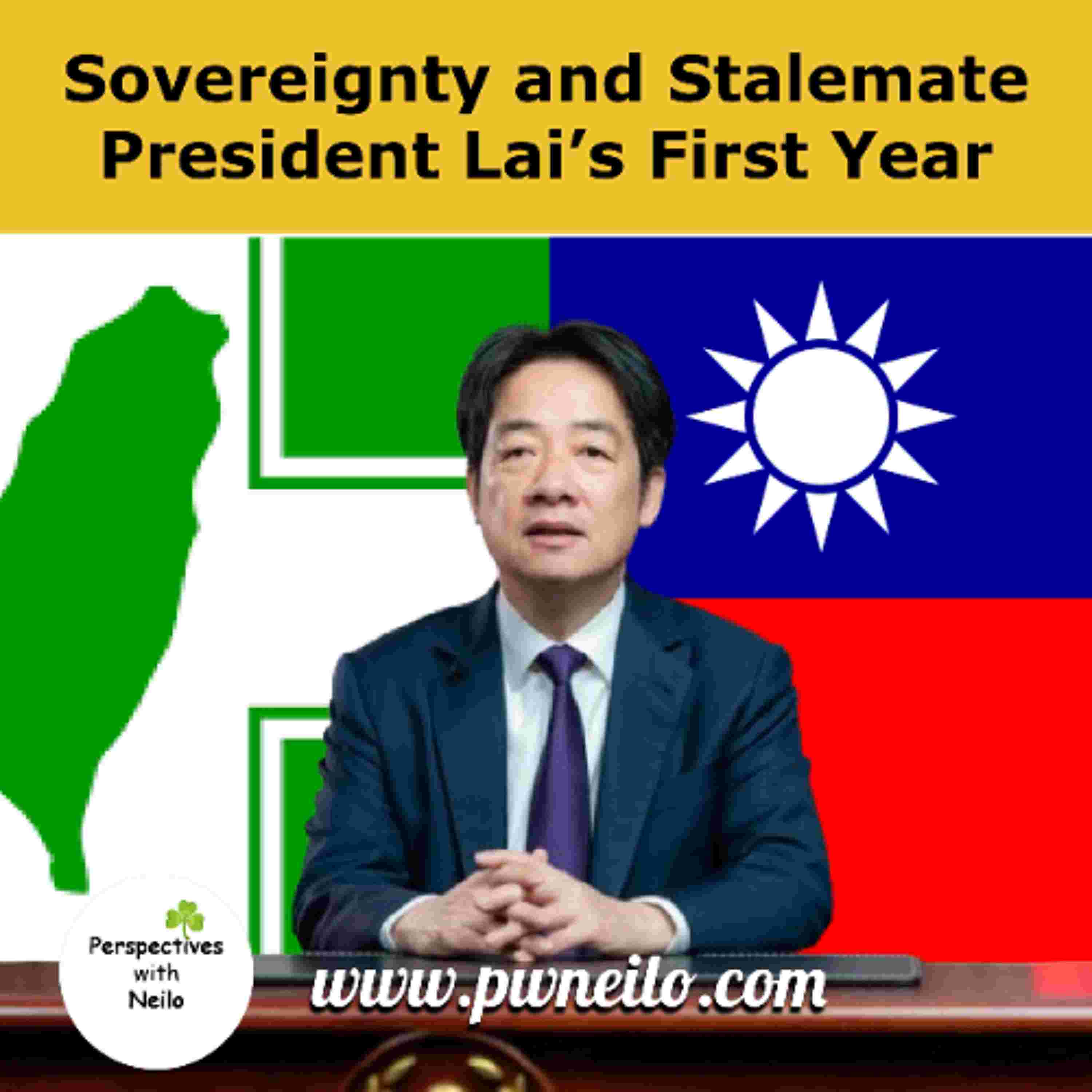
Sovereignty and Stalemate - President Lai's First Year
Perspectives with Neilo
48 minutes 1 second
6 months ago
Sovereignty and Stalemate - President Lai's First Year
These are challenging times for many world leaders, and no less so for the democratically elected leader of Taiwan, Lai Ching-te (賴清德). Lai Ching-te or William Lai was inaugurated as the President of Taiwan on May 20th, 2024. He succeeded Tsai Ing-wen and his election to the presidential office marks the first time for his party, the Democratic Progressive Party (DPP)(民主進步黨) to hold this office for three consecutive terms. While the DPP won the presidential vote, they failed to maintain a majority in the Legislative Yuan or parliament. As a result, the parliament has been controlled by the Chinese Nationalist Party (中國國民黨) or Kuomintang (KMT) and their smaller ally the Taiwan People’s Party (TPP) (台灣民眾黨) who have sought to block Lai’s agenda, freeze or cut budgets including defense programs and interfere with operations of the country’s top court. While the KMT insist that they are seeking to strengthen and protect Taiwan’s democracy, the general public would not appear to agree and a mass recall effort is well underway which could unseat up to 20 KMT lawmakers and change the balance of power for Lai’s administration. This is a topic we will deal with in more detail in upcoming episodes. In the area of cross strait relations, President Lai has adopted a stronger rhetoric that characterises Taiwan as a de facto sovereign state, and has moved away from the more cautious tone of his predecessor. In a speech on March 13th, 2025, President Lai publicly characterized China as a "foreign hostile force" trying to "annex Taiwan and stamp out the Republic of China," a phrasing unprecedented for a Taiwanese president. In response Beijing has repeatedly described Lai as a dangerous "separatist" and increased Military Drills and Grey-Zone Operations around Taiwan - including conducting large-scale "blockade-style military exercises" in response to his major speeches. In this episode, I chat with William Yang, Senior Northeast Asia Analyst at the International Crisis Group — an independent, non-profit NGO dedicated to preventing and resolving deadly conflict. We dive into William’s recent article on President Lai’s first year in office, and examine how his administration has responded to mounting pressure from China. We also look at Taiwan public opinion and the challenges President Lai faces in navigating political tensions with the opposition KMT and TPP. #Taiwan #TaiwanPolitics #Geopolitics #InternationalRelations #LaiChingTe #WilliamLai #TaiwanPresident #DemocraticProgressiveParty #DPP #TaiwanSovereignty #CrossStraitRelations #ChinaTaiwan #TaiwanSovereignty #ChinaMilitaryDrills #Kuomintang #KMT #TaiwanPeoplesParty #TaiwanPolitics2025 #TaiwanRecall #TaiwanElections #TaiwanProtests #PodcastEpisode #PoliticalPodcast #AsiaPodcast #CurrentAffairsPodcast #InternationalCrisisGroup
Perspectives with Neilo
There’s a metaphor often used in diplomatic and academic circles to describe China’s influence — the anaconda in the chandelier. Everyone can see it. Everyone knows it’s there. But no one wants to acknowledge it, because naming it would mean having to act. The phrase was coined in 2002 by the American scholar Perry Link, in an essay for The New York Review of Books. One of the world’s foremost experts on Chinese language, literature, and political expression, Link used the metaphor to describe the quiet but pervasive power of the Chinese Communist Party — a system that enforces obedience not only through censorship, but through fear and self-censorship. He wrote that the Chinese state’s authority doesn’t resemble a roaring tiger or a fire-breathing dragon, but a massive anaconda coiled silently overhead. It rarely moves. It doesn’t need to. Its message is implicit: you decide. And under its shadow, people — journalists, academics, politicians — instinctively adjust what they say and do, often without being told. The fear this creates isn’t dramatic or overt. It’s subtle, normalized, and deeply ingrained — a quiet calculation that becomes part of the landscape. And it is precisely that psychological control that makes the anaconda so effective. Legend tells us that St Patrick banished all the snakes from Ireland. But by the early 1990s, it appears that one very large snake had quietly found its way back into the Oireachtas — not as a myth, but as a political reality. In this special episode of Perspectives with Neilo, we examine how fear of offending Beijing has shaped Irish government behaviour for decades. From Ireland’s muted response to China’s human rights abuses, to its cautious stance on Tibet, Xinjiang, and Taiwan, we explore how economic pressure and political self-censorship have influenced policy, limited transparency, and raised serious questions about Ireland’s democratic resilience. This is a conversation about power, fear, and silence — and about what happens to a democracy when everyone sees the anaconda, but no one dares to say its name. Music Credits: Cinematic Piano Ambient Trailer Soundtrack by Open-Music-for-Videos via Pixabay Sound Soul (This Logo Reveal) by Diamond_Tunes via Pixabay Slow immersion by SamuelFJohanns via Pixabay Tibet by AdvGold via Pixabay Shining Bright Dusk by FreeSoundServer via Pixabay Enter the realm - no Piano by SamuelFJohanns via Pixabay Speeches: Excerpt from Closing statement by Josep Borrell Fonelles, High Representative of the Union for Foreign Affairs and Security Policy and Vice-President of the European Commission on Sept 13th, 2022, provided courtesy of the European Parliament Multimedia Centre. © European Union, 2022 – Source: EP. / Excerpts from Senator Michael McDowell's speech at Seanad Eireann, Human Rights in China: Motion, Dec 1st, 2021 provided courtesy of the Houses of the Oireachtas. © Houses of the Oireachtas, 2021.