Home
Categories
EXPLORE
True Crime
Comedy
Society & Culture
Business
History
Sports
Technology
About Us
Contact Us
Copyright
© 2024 PodJoint
00:00 / 00:00
Sign in

or

Don't have an account?
Sign up
Forgot password
https://is1-ssl.mzstatic.com/image/thumb/Podcasts221/v4/81/48/2a/81482a18-3223-a3c7-3285-bfffec80bc77/mza_17066979910753137591.jpg/600x600bb.jpg
Perspectives with Neilo
PwNeilo
81 episodes
1 week ago
There’s a metaphor often used in diplomatic and academic circles to describe China’s influence — the anaconda in the chandelier. Everyone can see it. Everyone knows it’s there. But no one wants to acknowledge it, because naming it would mean having to act. The phrase was coined in 2002 by the American scholar Perry Link, in an essay for The New York Review of Books. One of the world’s foremost experts on Chinese language, literature, and political expression, Link used the metaphor to describe the quiet but pervasive power of the Chinese Communist Party — a system that enforces obedience not only through censorship, but through fear and self-censorship. He wrote that the Chinese state’s authority doesn’t resemble a roaring tiger or a fire-breathing dragon, but a massive anaconda coiled silently overhead. It rarely moves. It doesn’t need to. Its message is implicit: you decide. And under its shadow, people — journalists, academics, politicians — instinctively adjust what they say and do, often without being told. The fear this creates isn’t dramatic or overt. It’s subtle, normalized, and deeply ingrained — a quiet calculation that becomes part of the landscape. And it is precisely that psychological control that makes the anaconda so effective. Legend tells us that St Patrick banished all the snakes from Ireland. But by the early 1990s, it appears that one very large snake had quietly found its way back into the Oireachtas — not as a myth, but as a political reality. In this special episode of Perspectives with Neilo, we examine how fear of offending Beijing has shaped Irish government behaviour for decades. From Ireland’s muted response to China’s human rights abuses, to its cautious stance on Tibet, Xinjiang, and Taiwan, we explore how economic pressure and political self-censorship have influenced policy, limited transparency, and raised serious questions about Ireland’s democratic resilience. This is a conversation about power, fear, and silence — and about what happens to a democracy when everyone sees the anaconda, but no one dares to say its name. Music Credits: Cinematic Piano Ambient Trailer Soundtrack by Open-Music-for-Videos via Pixabay Sound Soul (This Logo Reveal) by Diamond_Tunes via Pixabay Slow immersion by SamuelFJohanns via Pixabay Tibet by AdvGold via Pixabay Shining Bright Dusk by FreeSoundServer via Pixabay Enter the realm - no Piano by SamuelFJohanns via Pixabay Speeches: Excerpt from Closing statement by Josep Borrell Fonelles, High Representative of the Union for Foreign Affairs and Security Policy and Vice-President of the European Commission on Sept 13th, 2022, provided courtesy of the European Parliament Multimedia Centre. © European Union, 2022 – Source: EP. / Excerpts from Senator Michael McDowell's speech at Seanad Eireann, Human Rights in China: Motion, Dec 1st, 2021 provided courtesy of the Houses of the Oireachtas. © Houses of the Oireachtas, 2021.
Show more...
News
RSS
All content for Perspectives with Neilo is the property of PwNeilo and is served directly from their servers with no modification, redirects, or rehosting. The podcast is not affiliated with or endorsed by Podjoint in any way.
There’s a metaphor often used in diplomatic and academic circles to describe China’s influence — the anaconda in the chandelier. Everyone can see it. Everyone knows it’s there. But no one wants to acknowledge it, because naming it would mean having to act. The phrase was coined in 2002 by the American scholar Perry Link, in an essay for The New York Review of Books. One of the world’s foremost experts on Chinese language, literature, and political expression, Link used the metaphor to describe the quiet but pervasive power of the Chinese Communist Party — a system that enforces obedience not only through censorship, but through fear and self-censorship. He wrote that the Chinese state’s authority doesn’t resemble a roaring tiger or a fire-breathing dragon, but a massive anaconda coiled silently overhead. It rarely moves. It doesn’t need to. Its message is implicit: you decide. And under its shadow, people — journalists, academics, politicians — instinctively adjust what they say and do, often without being told. The fear this creates isn’t dramatic or overt. It’s subtle, normalized, and deeply ingrained — a quiet calculation that becomes part of the landscape. And it is precisely that psychological control that makes the anaconda so effective. Legend tells us that St Patrick banished all the snakes from Ireland. But by the early 1990s, it appears that one very large snake had quietly found its way back into the Oireachtas — not as a myth, but as a political reality. In this special episode of Perspectives with Neilo, we examine how fear of offending Beijing has shaped Irish government behaviour for decades. From Ireland’s muted response to China’s human rights abuses, to its cautious stance on Tibet, Xinjiang, and Taiwan, we explore how economic pressure and political self-censorship have influenced policy, limited transparency, and raised serious questions about Ireland’s democratic resilience. This is a conversation about power, fear, and silence — and about what happens to a democracy when everyone sees the anaconda, but no one dares to say its name. Music Credits: Cinematic Piano Ambient Trailer Soundtrack by Open-Music-for-Videos via Pixabay Sound Soul (This Logo Reveal) by Diamond_Tunes via Pixabay Slow immersion by SamuelFJohanns via Pixabay Tibet by AdvGold via Pixabay Shining Bright Dusk by FreeSoundServer via Pixabay Enter the realm - no Piano by SamuelFJohanns via Pixabay Speeches: Excerpt from Closing statement by Josep Borrell Fonelles, High Representative of the Union for Foreign Affairs and Security Policy and Vice-President of the European Commission on Sept 13th, 2022, provided courtesy of the European Parliament Multimedia Centre. © European Union, 2022 – Source: EP. / Excerpts from Senator Michael McDowell's speech at Seanad Eireann, Human Rights in China: Motion, Dec 1st, 2021 provided courtesy of the Houses of the Oireachtas. © Houses of the Oireachtas, 2021.
Show more...
News
https://i1.sndcdn.com/artworks-UfOfiTnmKyaGSBLb-O1xPQA-t3000x3000.png
The FIMI Iceberg - Decoding Foreign Interference Threats
Perspectives with Neilo
56 minutes 34 seconds
9 months ago
The FIMI Iceberg - Decoding Foreign Interference Threats
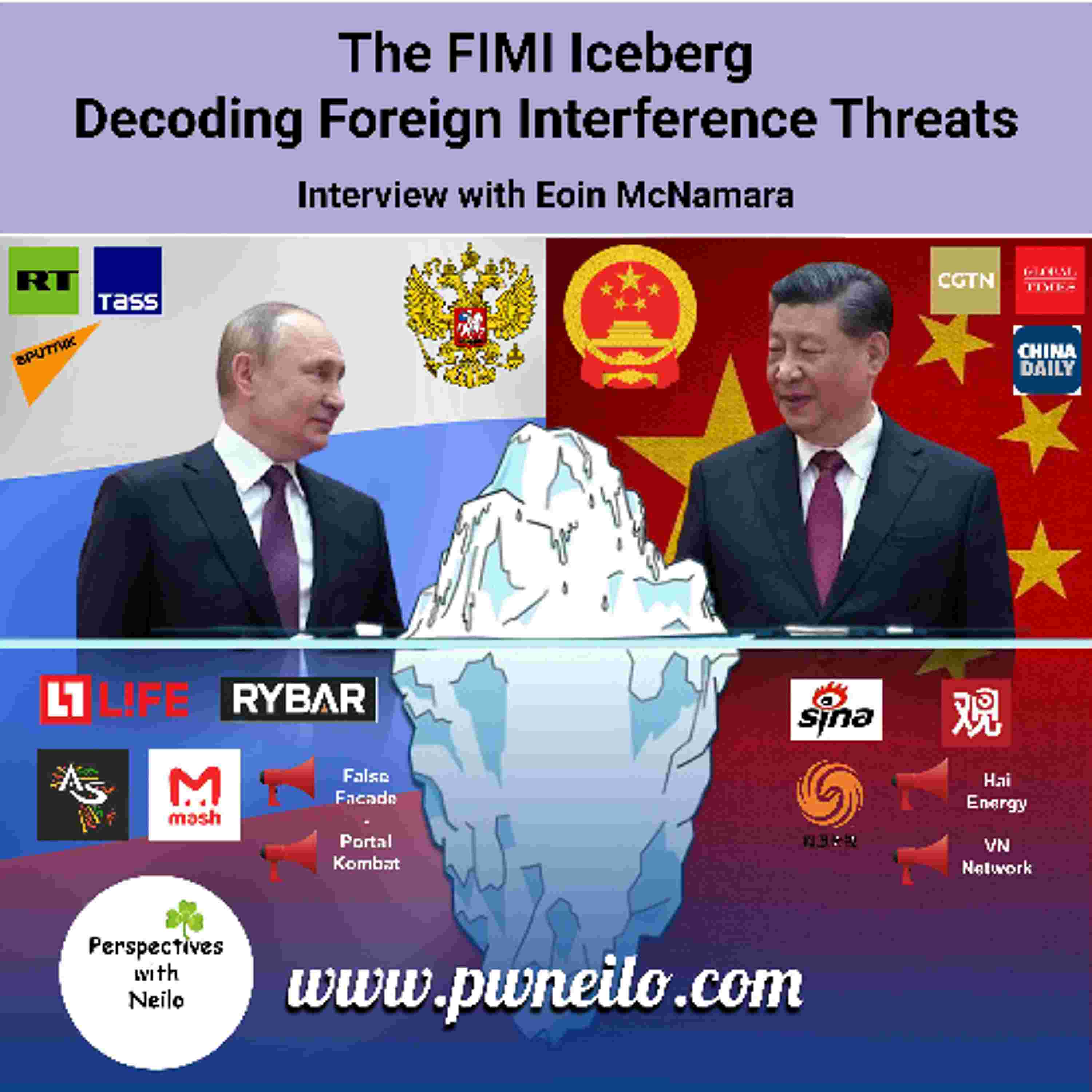
According to data gathered by the European External Action Service (EEAS), last year over eighty countries and over two hundred organizations were targets of attacks from Foreign Information Manipulation and Interference - or FIMI. These attacks targeted everything from major international events like the Paris Olympics, to national elections, regional conflicts and local protests. The main instigators of these influence operations were China and Russia and they use FIMI to manipulate public opinion, fuel polarization and interfere with democratic processes within the EU and worldwide. They employ a multi-layered strategy using both state and non-state actors to exert long term influence. According to the EEAS report, "their aim is to destabilize societies, damage democracies, drive wedges between different groups and undermine the EU's global standing". The EU's High Representative for Foreign Affairs and Security Policy, Kaja Kallas says "FIMI is not merely a tool for disseminating deceptive narratives. It is an integral part of military operations used by foreign states to lay the way for kinetic action on the ground," and "is a major security threat to the EU." And it would appear that no country is immune. Even a small neutral country like Ireland was mentioned thousands of times by Russian and Chinese influence networks during a monitoring period from September 2023 to September 2024 according to an in-depth study carried out by Norway's Defense Research Strategy. In this episode of Perspectives with Neilo, we chat with Eoin McNamara, Research Fellow at the Finnish Institute of International Affairs in Helsinki to unpack some of the key findings in these reports. We discuss what motives lie behind these manipulation and interference campaigns as well as some examples of recent case studies and their impact. In addition we talk about the vulnerability of western society to such interference and what democracies can do to protect their citizens from such nefarious interference in the future. Music Credits: Title music: Uplifting by Plastic3 used under Tribe of Noise license Break: Shining Bright Dusk by FreeSoundServer via Pixabay #FIMI, #InformationWarfare, #Geopolitics, #Cybersecurity, #Disinformation, #DigitalWarfare, #ForeignInterference, #Propaganda, #CyberThreats, #ElectionInterference, #ChinaInfluence, #RussiaInterference, #HybridWarfare, #ChinesePropaganda, #AuthoritarianInfluence, #EUDemocracy, #EuropeanSecurity, #EUPolitics, #EUForeignPolicy, #DefendDemocracy, #IrelandSecurity, #IrelandPolitics, #NeutralIreland, #SocialMediaManipulation, #DigitalPropoganda, #FakeNews, #CyberTactics, #Podcast, #PodcastEpisode
Perspectives with Neilo
There’s a metaphor often used in diplomatic and academic circles to describe China’s influence — the anaconda in the chandelier. Everyone can see it. Everyone knows it’s there. But no one wants to acknowledge it, because naming it would mean having to act. The phrase was coined in 2002 by the American scholar Perry Link, in an essay for The New York Review of Books. One of the world’s foremost experts on Chinese language, literature, and political expression, Link used the metaphor to describe the quiet but pervasive power of the Chinese Communist Party — a system that enforces obedience not only through censorship, but through fear and self-censorship. He wrote that the Chinese state’s authority doesn’t resemble a roaring tiger or a fire-breathing dragon, but a massive anaconda coiled silently overhead. It rarely moves. It doesn’t need to. Its message is implicit: you decide. And under its shadow, people — journalists, academics, politicians — instinctively adjust what they say and do, often without being told. The fear this creates isn’t dramatic or overt. It’s subtle, normalized, and deeply ingrained — a quiet calculation that becomes part of the landscape. And it is precisely that psychological control that makes the anaconda so effective. Legend tells us that St Patrick banished all the snakes from Ireland. But by the early 1990s, it appears that one very large snake had quietly found its way back into the Oireachtas — not as a myth, but as a political reality. In this special episode of Perspectives with Neilo, we examine how fear of offending Beijing has shaped Irish government behaviour for decades. From Ireland’s muted response to China’s human rights abuses, to its cautious stance on Tibet, Xinjiang, and Taiwan, we explore how economic pressure and political self-censorship have influenced policy, limited transparency, and raised serious questions about Ireland’s democratic resilience. This is a conversation about power, fear, and silence — and about what happens to a democracy when everyone sees the anaconda, but no one dares to say its name. Music Credits: Cinematic Piano Ambient Trailer Soundtrack by Open-Music-for-Videos via Pixabay Sound Soul (This Logo Reveal) by Diamond_Tunes via Pixabay Slow immersion by SamuelFJohanns via Pixabay Tibet by AdvGold via Pixabay Shining Bright Dusk by FreeSoundServer via Pixabay Enter the realm - no Piano by SamuelFJohanns via Pixabay Speeches: Excerpt from Closing statement by Josep Borrell Fonelles, High Representative of the Union for Foreign Affairs and Security Policy and Vice-President of the European Commission on Sept 13th, 2022, provided courtesy of the European Parliament Multimedia Centre. © European Union, 2022 – Source: EP. / Excerpts from Senator Michael McDowell's speech at Seanad Eireann, Human Rights in China: Motion, Dec 1st, 2021 provided courtesy of the Houses of the Oireachtas. © Houses of the Oireachtas, 2021.