
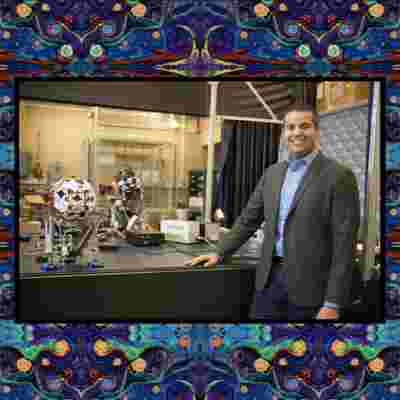
Richard Linares is an assistant professor at MIT’s Department of Aeronautics and Astronautics and is the Co-Director of the Space Systems Laboratory. His research areas are astrodynamics, estimation and controls, satellite guidance and navigation, space situational awareness, and space traffic management.
We start talking about his interest in space traffic management, focusing on the importance of modelling the space environment: the thermosphere, the ionosphere and space weather. We discuss some of his works looking into reduced-order modelling techniques, like principal component analysis and dynamic mode decomposition, for the modelling of the thermospheric density field. We then discuss the use of machine learning techniques, like autoencoders and neural networks more in general, as promising generalizations, without neglecting their downsides.
Discussing the use of the Koopman Operator Theory in the same context, we move to its relevance in low dimensional, highly nonlinear dynamical systems, encountered every day in astrodynamics. We talk about its use for the study of the earth gravity field and for the construction of halo orbits in the restricted three-body problem. We discuss its implications for the engineering community, talking about optimal control, estimation and uncertainty quantification, about which we also outline the unification potential of techniques such as polynomial chaos expansion, differential algebra.
We then look into the potential of the Koopman Operator for dynamical systems theory in space. We discuss its potential for the analysis of invariant manifolds, its limitations for the study of chaotic systems, and finally its relations to the hamiltonian formalism of classical mechanics.
LINKS:
http://arclab.mit.edu/
https://aeroastro.mit.edu/people/richard-linares/
Richard Linares LinkedIn
RESOURCES:
Anchor: https://anchor.fm/poincare-podcast
Youtube: https://www.youtube.com/watch.v
RSS: https://anchor.fm/s/84561ce0/podcast/rss
Linktree: https://linktr.ee/poincaretrajectories
Company: https://www.linkedin.com/company/poincaretrajectories/