
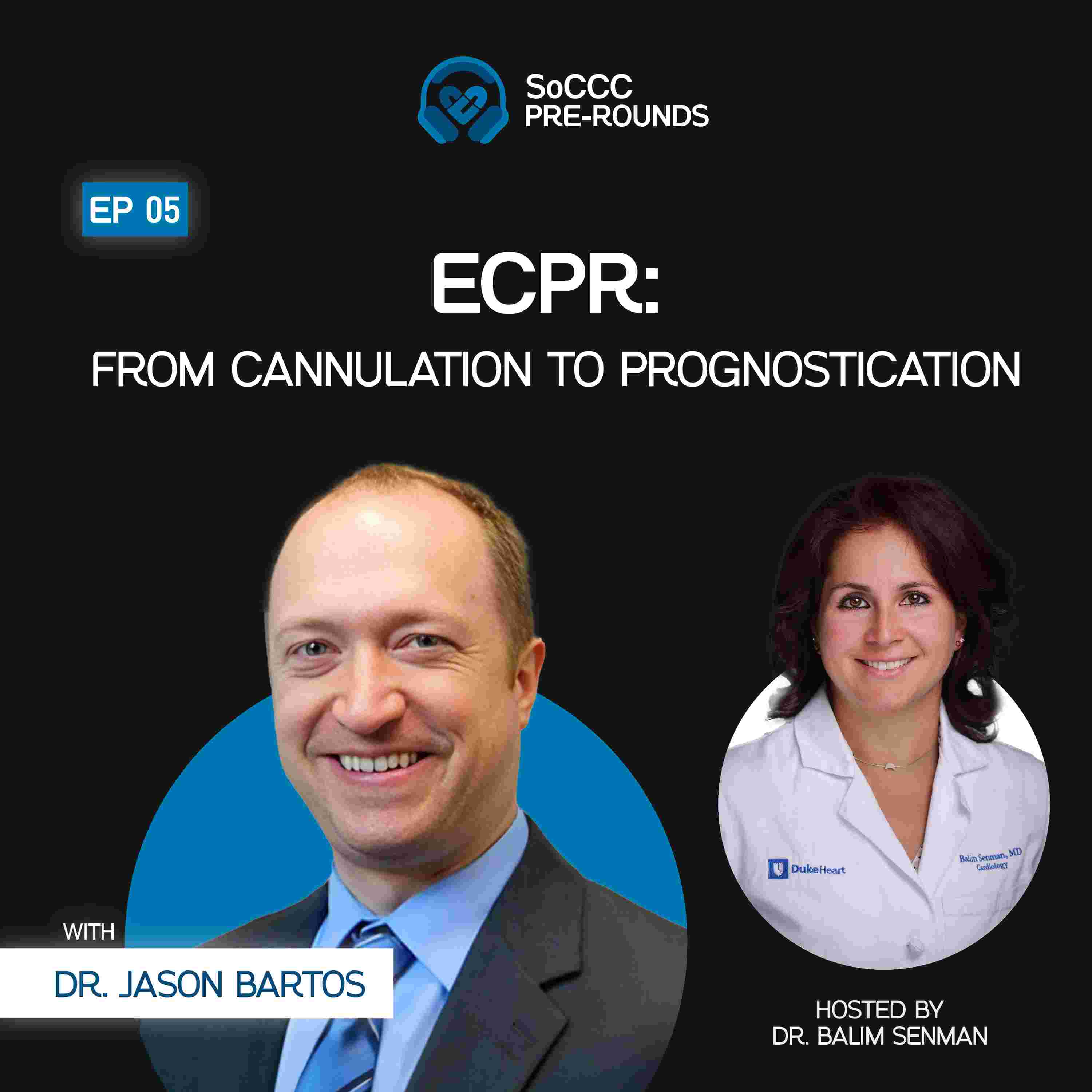
Should we be using ECMO during cardiac arrest? In this episode of SoCCC Pre-Rounds, Dr. Balim Senman sits down with Dr. Jason Bartos, interventional and critical care cardiologist at the University of Minnesota and one of the nation’s leading voices on extracorporeal cardiopulmonary resuscitation (ECPR). Together, they break down when and why to consider ECMO in cardiac arrest, the patient selection puzzle, and what truly impacts outcomes in the field.
Dr. Bartos shares pearls from the ARREST trial and offers hard-won insights into what it takes to build an ECPR program that saves lives from timing and volume to sedation, TTM, and neuroprognostication. Whether you’re a trainee encountering ECPR for the first time or a team leader building a resuscitation program, this episode delivers essential guidance grounded in real-world experience.
Key Takeaways
ECPR = ECMO during or shortly after cardiac arrest; best for patients with witnessed arrest and refractory shockable rhythms
Avoid ECPR in patients with poor baseline function, irreversible comorbidities, or prohibitive vascular anatomy
Outcomes depend on systems: high-volume centers, early activation, and streamlined protocols improve survival
Don’t oversedate; sedation is not required for ECMO; prioritize comfort and cannula safety
Use 37°C TTM with aggressive fever prevention; ECMO allows precise temperature control
In This Episode
[00:00] Introduction
[00:45] Episode introduction & guest welcome
[01:25] What is ECPR?
[02:14] Rationale and data behind ECPR
[03:13] Key ECPR trials and outcomes
[08:56] ECPR patient selection & center volume
[10:15] Selection criteria details
[13:06] Absolute and relative contraindications
[15:11] In-hospital ECPR activation & information gathering
[16:21] Standardizing in-hospital ECPR response
[18:22] Timing and team mobilization for ECR
[19:56] Post-ECMO management: sedation & temperature
[21:40] Sedation practices on ECMO
[23:28] Temperature management evolution
[25:29] Neuroprognostication after ECPR
Notable Quotes
[01:34] "ECPR is extracorporeal cardiopulmonary resuscitation. It's the use of ECMO for patients with cardiac arrest." — Dr. Jason Bartos
[25:40] "The danger to the patients in the ICU post-arrest is us. We really have the task of trying to determine and predict and inform family members of how their loved one is going to do in this worst circumstance of their life." — Dr. Jason Bartos
[25:29] "Neuroprognostication is near and dear to my heart, partly because I think it's honestly the most important thing we do in the ICU for any post-arrest patient, but particularly for this population." — Dr. Jason Bartos
Dr. Jason Bartos
Dr. Jason Bartos is an interventional and critical care cardiologist at the University of Minnesota. He leads one of the nation’s highest-volume ECPR programs and is a founding member of the Center for Resuscitation Medicine. He is nationally recognized for his leadership in post-arrest care, real-world ECMO implementation, and advancing cardiac arrest science.
Resources and Links
Become a member of the Community: https://www.soccc.org/subscribe
Dr. Jason Bartos
Dr. Balim Senman
Supported By:
This episode is made possible by unrestricted support from Zoll LifeVest — thanks for keeping high-impact education free for our community.
Disclaimer
This podcast is not medical advice, just candid, practical discussions about what your hosts do every day in the CICU. Always consult your supervising team and current guidelines before applying any interventions.