Jakarta is said to be in a water crisis. This is a familiar claim that has been repeated for years as parts of the city sink, groundwater is over-extracted, and access to clean water remains uneven. Yet what, precisely, is the crisis that Jakarta is facing?
In this episode of Talking Indonesia, I speak with Wahyu Astuti, a PhD candidate at the University of Sydney, whose research shows that Jakarta’s water crisis is not singular, but defined in multiple and competing ways. She traces how certain framings of the crisis are sidelined, while others are actively promoted, and asks how the state narrates the water problem amid pressures to move away from privatization.
Following UN-Habitat’s recent designation of Jakarta and the surrounding regions as the world’s largest city, with an estimated 42 million people across its metropolitan region, questions of how life is sustained at this scale become unavoidable. Water sits at the centre of these questions. This conversation unpacks the political and financial logics shaping water governance today, revealing how efforts to make water provision financially viable draw in different levels of government, new institutional arrangements, investment actors, and private businesses.
As Ayu’s research makes clear, the drive to build a water system that can “pay for itself” does not resolve Jakarta’s water crisis. Instead, it produces a governance system riddled with contradictions that shapes how the crisis is understood, and who ultimately bears its consequences.
In 2025, the Talking Indonesia podcast is co-hosted by Dr Elisabeth Kramer from the University of New South Wales, Dr Clara Siagian from University College London, Dr Jemma Purdey from the Australia-Indonesia Centre, Dr Tito Ambyo from RMIT, and Dr Jacqui Baker from Murdoch University.
All content for Talking Indonesia is the property of Talking Indonesia and is served directly from their servers
with no modification, redirects, or rehosting. The podcast is not affiliated with or endorsed by Podjoint in any way.
Jakarta is said to be in a water crisis. This is a familiar claim that has been repeated for years as parts of the city sink, groundwater is over-extracted, and access to clean water remains uneven. Yet what, precisely, is the crisis that Jakarta is facing?
In this episode of Talking Indonesia, I speak with Wahyu Astuti, a PhD candidate at the University of Sydney, whose research shows that Jakarta’s water crisis is not singular, but defined in multiple and competing ways. She traces how certain framings of the crisis are sidelined, while others are actively promoted, and asks how the state narrates the water problem amid pressures to move away from privatization.
Following UN-Habitat’s recent designation of Jakarta and the surrounding regions as the world’s largest city, with an estimated 42 million people across its metropolitan region, questions of how life is sustained at this scale become unavoidable. Water sits at the centre of these questions. This conversation unpacks the political and financial logics shaping water governance today, revealing how efforts to make water provision financially viable draw in different levels of government, new institutional arrangements, investment actors, and private businesses.
As Ayu’s research makes clear, the drive to build a water system that can “pay for itself” does not resolve Jakarta’s water crisis. Instead, it produces a governance system riddled with contradictions that shapes how the crisis is understood, and who ultimately bears its consequences.
In 2025, the Talking Indonesia podcast is co-hosted by Dr Elisabeth Kramer from the University of New South Wales, Dr Clara Siagian from University College London, Dr Jemma Purdey from the Australia-Indonesia Centre, Dr Tito Ambyo from RMIT, and Dr Jacqui Baker from Murdoch University.
A growing protest movement
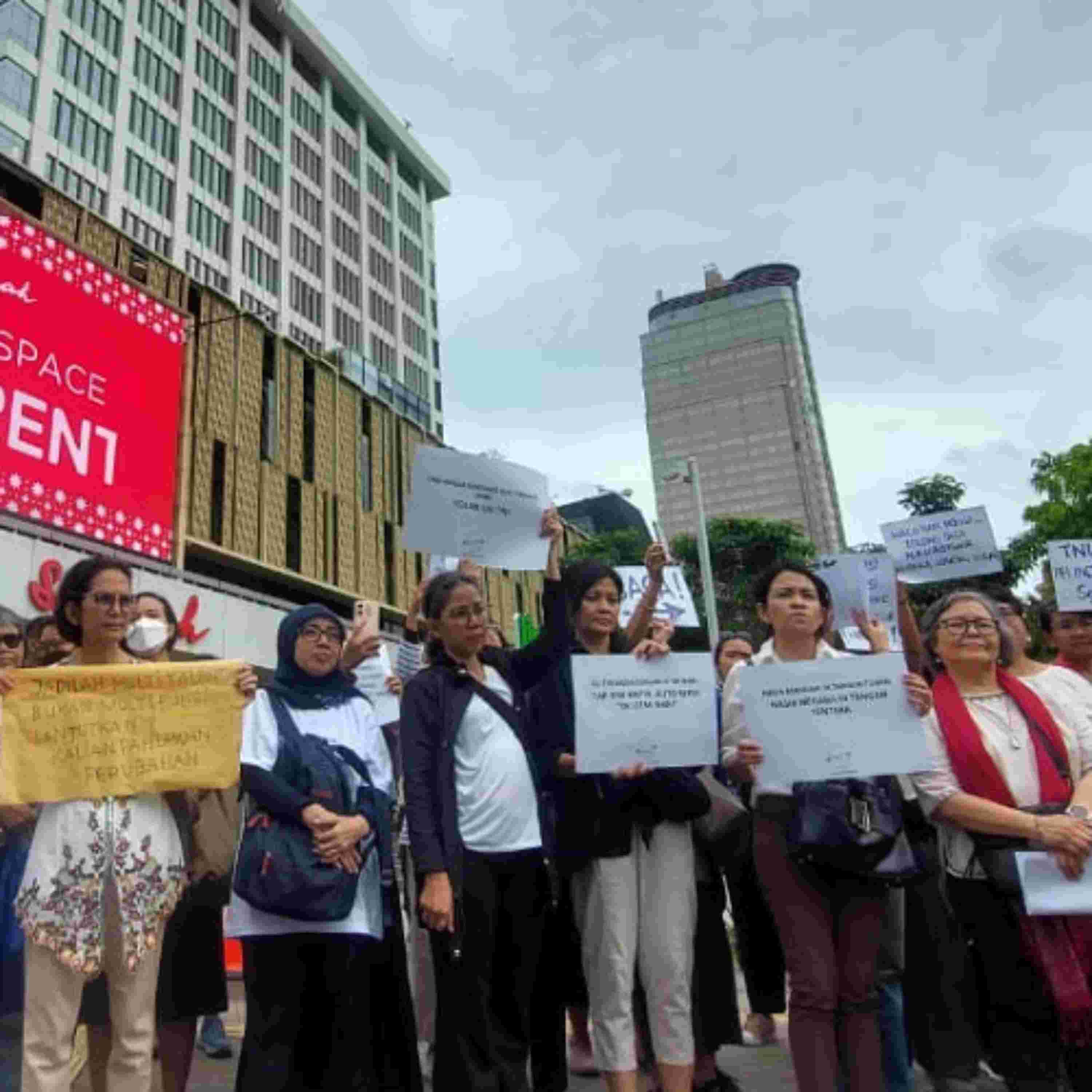
On 28 March, in downtime Jakarta across from the Sarinah department store, an unlikely group of protesters gathered holding signs and making speeches. The crowd largely consisted of middleclass women of various ages, gathered under the name ‘Suara Ibu Indonesia’ (Voices of Indonesian Mothers). For the organisers, the choice of name and location for their protest was deliberately designed to evoke a moment in Indonesia’s past, now 27 years ago, when in the final months of the autocratic Suharto regime an economic and political crisis saw student protests met with deadly violence at the hands of the military and police. Then a group called Suara Ibu Peduli (Voices of Concerned Mothers, SIP), tapped into growing concern within wider society about the state of their country.
In late March 2025, as student protests at campuses and in front of law offices were once again met with violence by state law enforcement, the women who gathered in downtown Jakarta expressed their fear of a return to unbridled militarism and a contempt for democracy. The revision of the Military (TNI) Law a few weeks earlier, which opens the door for active military figures to occupy more and key positions in the government and bureaucracy, appears to have sparked a broadening of the growing protest movement. As one of the original SIP organisers, Karlina Supelli was quoted as saying, “If mothers have joined the protests, this means that the situation has become critical.”
What compelled the Suara Ibu Indonesia protesters to go to the streets now? What are the urgent concerns of activists and students amid a time they describe as ‘Indonesia Gelap’? Can such opposition to the newly installed Prabowo government be sustained for the long haul?
In this week's episode Jemma chats with Olin Montiero, a feminist activist, researcher, writer, consultant and producer. Olin has been working for the women 's movement since the 1990s and was a member of the Suara Ibu Peduli movement in 1998. She has founded several women organisations in Indonesia, including the network Peace Women Across the Globe Indonesia and ArtsforWomen, connecting women activists, artists, art workers and cultural workers for a feminist collaborative space. Olin facilitates feminist networks Jagat Setara (Online platform feminist discussion), Woke Asia Feminist (young feminist in Asia network), and FeministArt Community (a new young people discussion on art creativity and feminism).
In 2025, the Talking Indonesia podcast is co-hosted by Dr Jemma Purdey from the Australia-Indonesia Centre, Dr Jacqui Baker from Murdoch University, Dr Elisabeth Kramer from the University of New South Wales and Tito Ambyo from RMIT.
Image: Olin Monteiro
Talking Indonesia
Jakarta is said to be in a water crisis. This is a familiar claim that has been repeated for years as parts of the city sink, groundwater is over-extracted, and access to clean water remains uneven. Yet what, precisely, is the crisis that Jakarta is facing?
In this episode of Talking Indonesia, I speak with Wahyu Astuti, a PhD candidate at the University of Sydney, whose research shows that Jakarta’s water crisis is not singular, but defined in multiple and competing ways. She traces how certain framings of the crisis are sidelined, while others are actively promoted, and asks how the state narrates the water problem amid pressures to move away from privatization.
Following UN-Habitat’s recent designation of Jakarta and the surrounding regions as the world’s largest city, with an estimated 42 million people across its metropolitan region, questions of how life is sustained at this scale become unavoidable. Water sits at the centre of these questions. This conversation unpacks the political and financial logics shaping water governance today, revealing how efforts to make water provision financially viable draw in different levels of government, new institutional arrangements, investment actors, and private businesses.
As Ayu’s research makes clear, the drive to build a water system that can “pay for itself” does not resolve Jakarta’s water crisis. Instead, it produces a governance system riddled with contradictions that shapes how the crisis is understood, and who ultimately bears its consequences.
In 2025, the Talking Indonesia podcast is co-hosted by Dr Elisabeth Kramer from the University of New South Wales, Dr Clara Siagian from University College London, Dr Jemma Purdey from the Australia-Indonesia Centre, Dr Tito Ambyo from RMIT, and Dr Jacqui Baker from Murdoch University.