
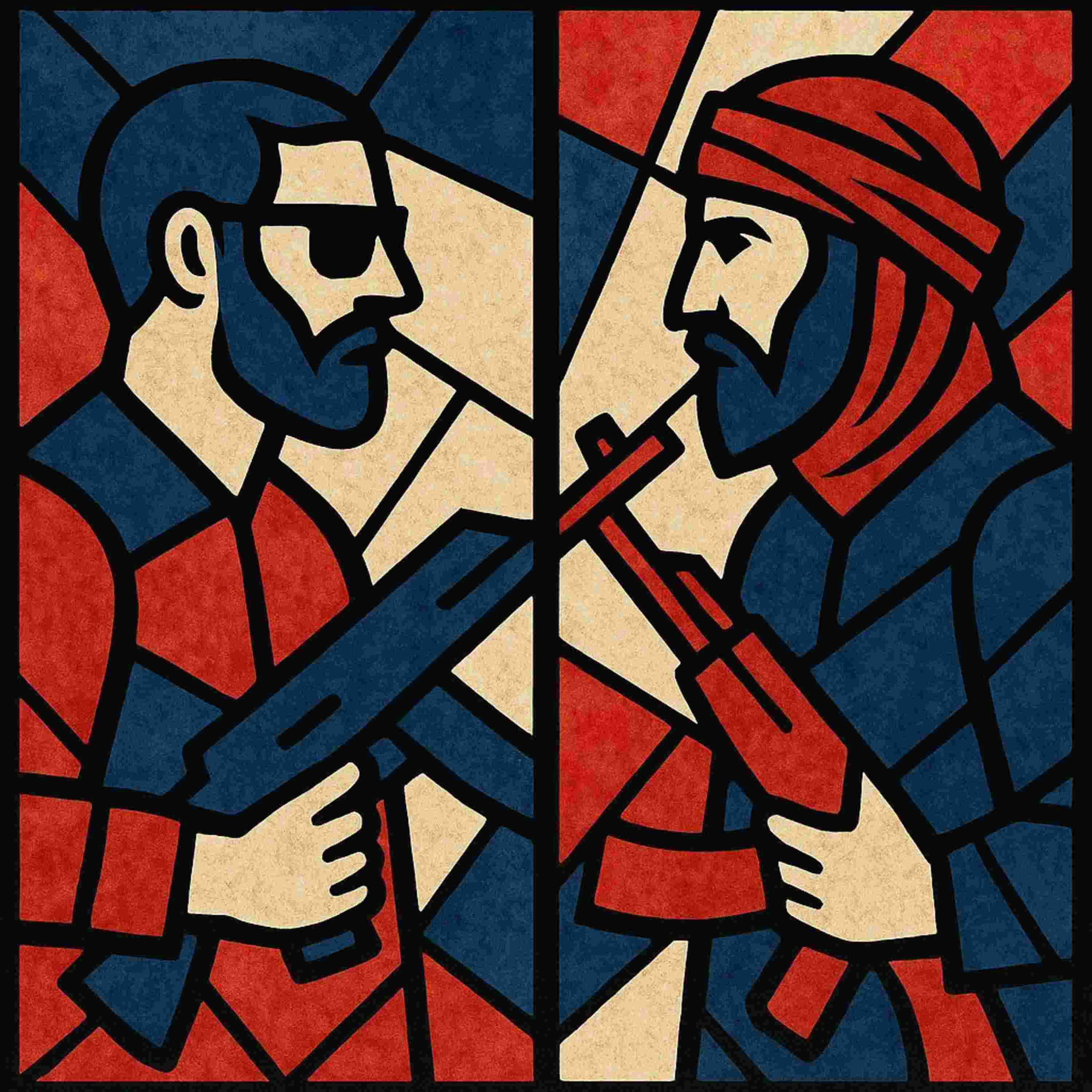
When people debate terrorism, cartel violence, insurgency, or the so-called war on drugs, they usually argue morality — who is good, who is evil, who is defending civilization, who is poisoning it. But morality, for all its emotional voltage, explains almost nothing. What explains far more is power — who has it, who wants it, and who steps in when the official architecture of governance collapses or simply stops caring. The line between freedom fighter and terrorist, protector and predator, patriot and criminal, isn’t drawn by ethics. It’s drawn by legitimacy — and legitimacy is an asset backed not by universal truth but by narrative control.
In this episode, we explore the three-layer structure that exists in every conflict zone, every “failed state,” and, increasingly, every major American city. There is the official government, the one on paper, the one with flags, seals, and press briefings. There is the shadow authority, the unofficial power that feeds the hungry, settles disputes, provides jobs and revenge and punishment. Then there is the outside force — the state that flies drones overhead, signs extradition orders, raids safe houses, or sends special operators to kick down doors at 3 AM and drag someone out as the neighbors silently watch through blinds.
Overseas this looks like Marines patrolling Helmand, tribes negotiating in back rooms, and politicians promising order they cannot enforce. At home it looks like city councils, street crews, and federal task forces — each claiming jurisdiction, none fully in control. The actors change — militants, cartels, militias, gangs, extremist networks — but the logic doesn’t. Wherever the state fails, someone else shows up with cash or guns. Often with both. And once people become reliant on the parallel system that pays them, protects them, or threatens them, the question of “who is the terrorist” depends entirely on who is holding the microphone that day.
We also dismantle one of the most stubborn myths: that non-state actors are monsters operating outside the logic of community. They are not. They are community solutions — brutal, corrupt, violent solutions — but solutions to real needs that governments ignored or failed to address. The drug boss who funds funerals and buys school supplies is not benevolent. But he is present, and presence is power. The insurgent who promises justice through the barrel of a rifle may be wrong — but he is visible when the courthouse is closed and the state has barricaded itself behind armored glass.
Meanwhile the state — whether American, British, Colombian, Nigerian, or otherwise — justifies its own violence by insisting its enemies are less legitimate, less human, less deserving of due process. A Hellfire missile operates with extraordinary precision; the story wrapped around it is far less precise. A speedboat blown up in international waters can be framed as a surgical strike — or the execution of civilians who chose the wrong employer. The semantics hide what the debris cannot.
The question isn’t whether these parallel power systems are good or bad — they are almost always both. The question is simpler and far more uncomfortable: If the state was delivering what people needed, would those systems exist at all? Or do they persist because the official promise of order, safety, and opportunity became a slogan instead of a contract?
In this episode, we don’t excuse the violence. We don’t romanticize the outlaws. We don’t exonerate the state. We simply acknowledge the ecosystem as it exists — not as we’d like to pretend it does.
Because one man’s terrorist is another man’s freedom fighter. One neighborhood’s gang is another neighborhood’s protection service. One nation’s war on terror is another nation’s foreign invasion. And when systems fail, the labels become weapons, the violence becomes currency, and the people caught in between learn quickly that survival is rarely ideological — it’s transactional.