All content for The Deeper Thinking Podcast is the property of The Deeper Thinking Podcast and is served directly from their servers
with no modification, redirects, or rehosting. The podcast is not affiliated with or endorsed by Podjoint in any way.
The Deeper Thinking Podcast
https://thedeeperthinkingpodcast.podbean.com/
The Silent Coup: How “Too Big to Fail” Became a Constitutional Crisis - The Deeper Thinking Podcast
The Deeper Thinking Podcast
27 minutes
1 month ago
The Silent Coup: How “Too Big to Fail” Became a Constitutional Crisis - The Deeper Thinking Podcast
The Silent Coup: How “Too Big to Fail” Became a Constitutional Crisis
The Deeper Thinking Podcast is digitally narrated.
For those drawn to the hidden architectures of power, the politics of fragility, and the quiet erosion of sovereignty.
#TooBigToFail #KarlPolanyi #WolfgangStreeck #QuinnSlobodian #EastIndiaCompany #GreekDebtCrisis #PoliticalEconomy #Democracy
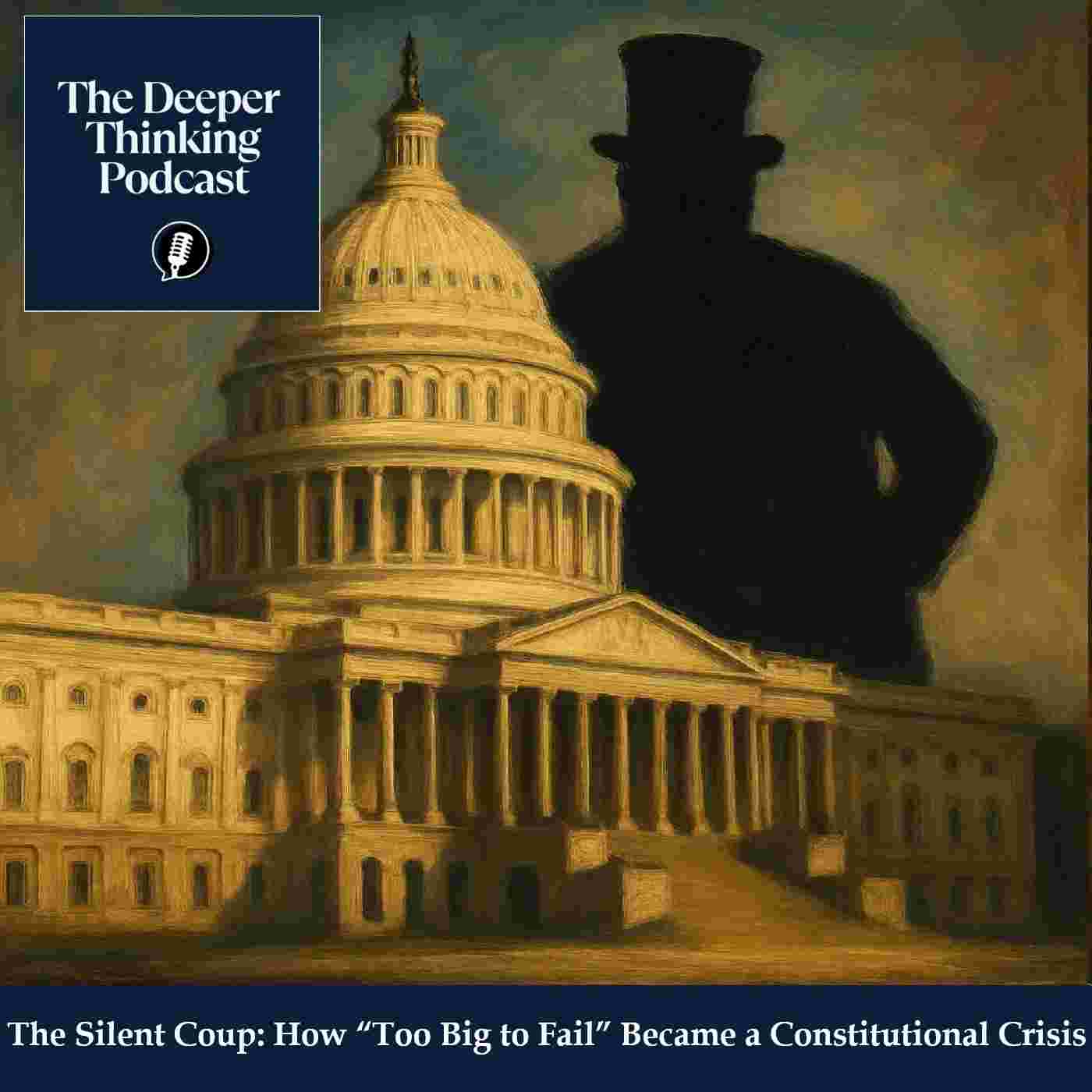
What happens when a democracy discovers that its sovereignty is conditional. In this episode, we follow the quiet trail of too big to fail, from a banking slogan to a deeper transformation of constitutional life. We trace how certain institutions grow so large and so entangled with everyday routines that their failure becomes unthinkable, and how that unthinkability slowly reorders who governments fear, who they answer to, and what they dare to change.
This is not only a story about finance. It is a story about sovereignty, consent, and the thin line between stability and capture. Drawing on Karl Polanyi and his account of market society, on Wolfgang Streeck on public debt and democratic constraint, and on Quinn Slobodian on the insulation of markets from popular will, we follow the long arc from Renaissance Florence and the Medici bank, through the East India Company, to the Greek government debt crisis.
Along the way, we sit with nurses, teachers, pensioners and policymakers as they encounter the same invisible boundary. A state that appears free to act finds that its most consequential decisions must pass through an informal veto held by institutions whose collapse would injure millions. We ask what it means to live in a democracy where losses are socialised, gains are privatised, and the real constitutional line runs not between branches of government, but between the public that votes and the balance sheets it cannot see.
Reflections
This episode traces how fragility becomes a form of power, and how a policy language of stability can conceal a slow transfer of sovereignty away from the people living under it.
Here are some other reflections that surfaced along the way:
Too big to fail is not just a financial category, it is a constitutional condition.
When one failure can injure a nation, fear begins to govern in place of law.
Dependency forms as efficiency first, necessity later, inevitability last.
Every bailout writes another unwritten rule about who may not be allowed to fall.
Democracy can keep its rituals while losing its room to decide.
Market reactions arrive in seconds, public reactions arrive in months.
Fragility at the top becomes discipline for everyone else.
Rescues that restore normality can also deepen the next crisis of consent.
Sovereignty thins not through coups, but through habits of caution that no one voted for.
Why Listen?
Reframe too big to fail as a problem of democracy, not only of finance.
Explore how Polanyi helps us see bailouts and austerity as part of a longer struggle over markets and society.
Follow Streeck on public debt, fiscal pressure, and the shrinking space of democratic choice.
Engage with Slobodian on how global economic orders can sideline domestic publics.
See the East India Company and Greece as part of the same long story about private power and public dependence.
Listen On:
YouTube
Spotify
Apple Podcasts
Support This Work
If this episode stayed with you and you would like to support the ongoing work, you can do so here: Buy Me a Coffee
Bibliography
Polanyi, Karl. The Great Transformation. Boston: Beacon Press, 2001.
Streeck, Wolfgang. Buying Time: The Delayed Crisis of Democratic Capitalism. London: Verso, 2014.
Slobodian, Quinn. Globalists: The End of Empire and the Birth of Neoliberalism. Cambridge, MA: Harvard University Press, 2018.
Robins, Nick. The Corporation that Changed the World: How the East India Company Shaped the Modern Multinational. London: Pluto Press, 2012.
Bibliography Relevance
Karl Polanyi: Shows how market society is created and maintained by states, not discovered, and how at
The Deeper Thinking Podcast
The Deeper Thinking Podcast
https://thedeeperthinkingpodcast.podbean.com/