
Check out the article Study Smarter, Not Harder: An Evidence-Based Guide to Effective Learning at SelfSensei.com
Stop passive consumption and start mastering your studies. This deep dive explores the neuroscience behind effective learning, challenging the "illusion of competence" that comes from re-reading and highlighting. We break down the concept of "Desirable Difficulty" and provide evidence-based strategies to overcome information overload and decision fatigue.
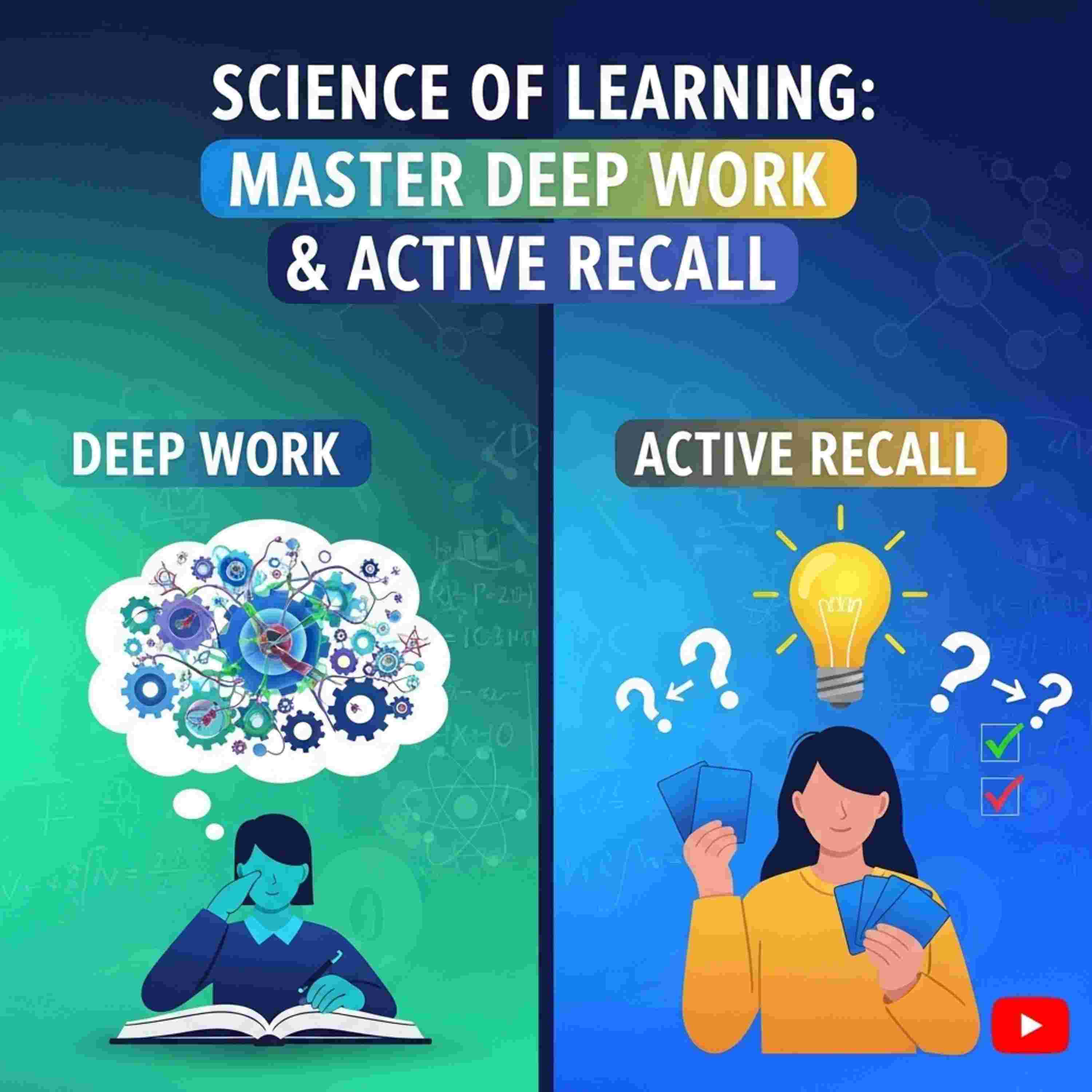
Discover how to utilize Retrieval Practice, Spaced Repetition, and the Feynman Technique to build durable knowledge. We also discuss Cal Newport’s "Deep Work" philosophy, explaining how to toggle your brain's Task Positive Network (TPN) for maximum focus. Finally, learn why sleep is non-negotiable for memory consolidation and how to manage technostress in a distracted world.
#DeepWork #LearningScience #StudyTips #ActiveRecall #Productivity #Neuroscience #FeynmanTechnique #SelfImprovement #Focus #CognitivePsychology #MemoryHacks #Education #BrainHealth #StudentSuccess #DesirableDifficulty
00:00 – Introduction to Information Overload The hosts introduce the concept of "drinking from a firehose" of information and the resulting cognitive overwhelm that defines the modern age.
01:05 – The Four Levels of Overload A breakdown of the four compounding levels of overwhelm: Sensory Overload, Cognitive Overload, Emotional Overload, and Decision Fatigue.
02:15 – The Illusion of Competence Discussion on why passive consumption (highlighting, re-reading) feels productive but fails to create durable knowledge, compared to the concept of "Desirable Difficulty".
03:40 – The Hierarchy of Understanding Using a "tiered cake" analogy to explain Bloom’s Taxonomy, moving from basic understanding to creation.
04:50 – Strategy 1: Retrieval Practice Explanation of the "Testing Effect" and the "Brain Dump" method to strengthen neural pathways through active recall rather than passive review.
05:45 – Strategy 2: Spaced Practice Why distributing study sessions over time (spacing) allows for beneficial forgetting, which strengthens memory retrieval upon review.
06:30 – Strategy 3: The Feynman Technique The importance of simplifying complex concepts into simple terms (explaining it to a 5-year-old) to identify gaps in knowledge.
07:15 – Deep Work and Neural Networks Introduction of Cal Newport’s "Deep Work" and the neuroscience behind the Task Positive Network (TPN) versus the Default Mode Network (DMN).
08:20 – Managing Technostress Practical advice on setting boundaries, such as digital detoxes and "quiet hours" to protect the brain's executive functions.
09:10 – The Critical Role of Sleep How sleep facilitates the consolidation phase of learning, flushing out metabolic waste (beta-amyloid) and moving data from the hippocampus to the neocortex.
10:15 – Conclusion: Metacognition Final thoughts on becoming an intentional learner by treating study sessions as measurable experiments rather than passive chores.