
The Uncertainty E.D.G.E. Podcast explores what judgment looks like in practice when certainty is impossible.
I am a judgment guide. I help people act when the stakes are real, tradeoffs are unavoidable, and certainty isn’t coming. My value is not tactical insights, prediction, or optimization. It is guiding people to build their capacity for judgment under uncertainty.
Each episode examines a real decision moment—where real outcomes, real people, and real tradeoffs were at stake. Rather than focusing on outcomes or hindsight explanations, the conversations stay close to the decision itself: what could not be known at the time, what pressures were present, and how judgment was exercised without guarantees.
This is not a podcast about best practices, leadership slogans, or forecasting the future. It is about how people responsible for consequential decisions actually decide when responsibility can’t be delegated and waiting for clarity is itself a risk.
The podcast is for people accountable for decisions that matter—often without full control or authority—who must act with clarity and judgment when certainty is impossible.
Listeners might be interested in The Uncertainty E.D.G.E. newsletter as well. Check out at www.theuncertaintyedge.com. Hosted by Sam Sivarajan.
The Uncertainty E.D.G.E. Podcast explores what judgment looks like in practice when certainty is impossible.
I am a judgment guide. I help people act when the stakes are real, tradeoffs are unavoidable, and certainty isn’t coming. My value is not tactical insights, prediction, or optimization. It is guiding people to build their capacity for judgment under uncertainty.
Each episode examines a real decision moment—where real outcomes, real people, and real tradeoffs were at stake. Rather than focusing on outcomes or hindsight explanations, the conversations stay close to the decision itself: what could not be known at the time, what pressures were present, and how judgment was exercised without guarantees.
This is not a podcast about best practices, leadership slogans, or forecasting the future. It is about how people responsible for consequential decisions actually decide when responsibility can’t be delegated and waiting for clarity is itself a risk.
The podcast is for people accountable for decisions that matter—often without full control or authority—who must act with clarity and judgment when certainty is impossible.
Listeners might be interested in The Uncertainty E.D.G.E. newsletter as well. Check out at www.theuncertaintyedge.com. Hosted by Sam Sivarajan.
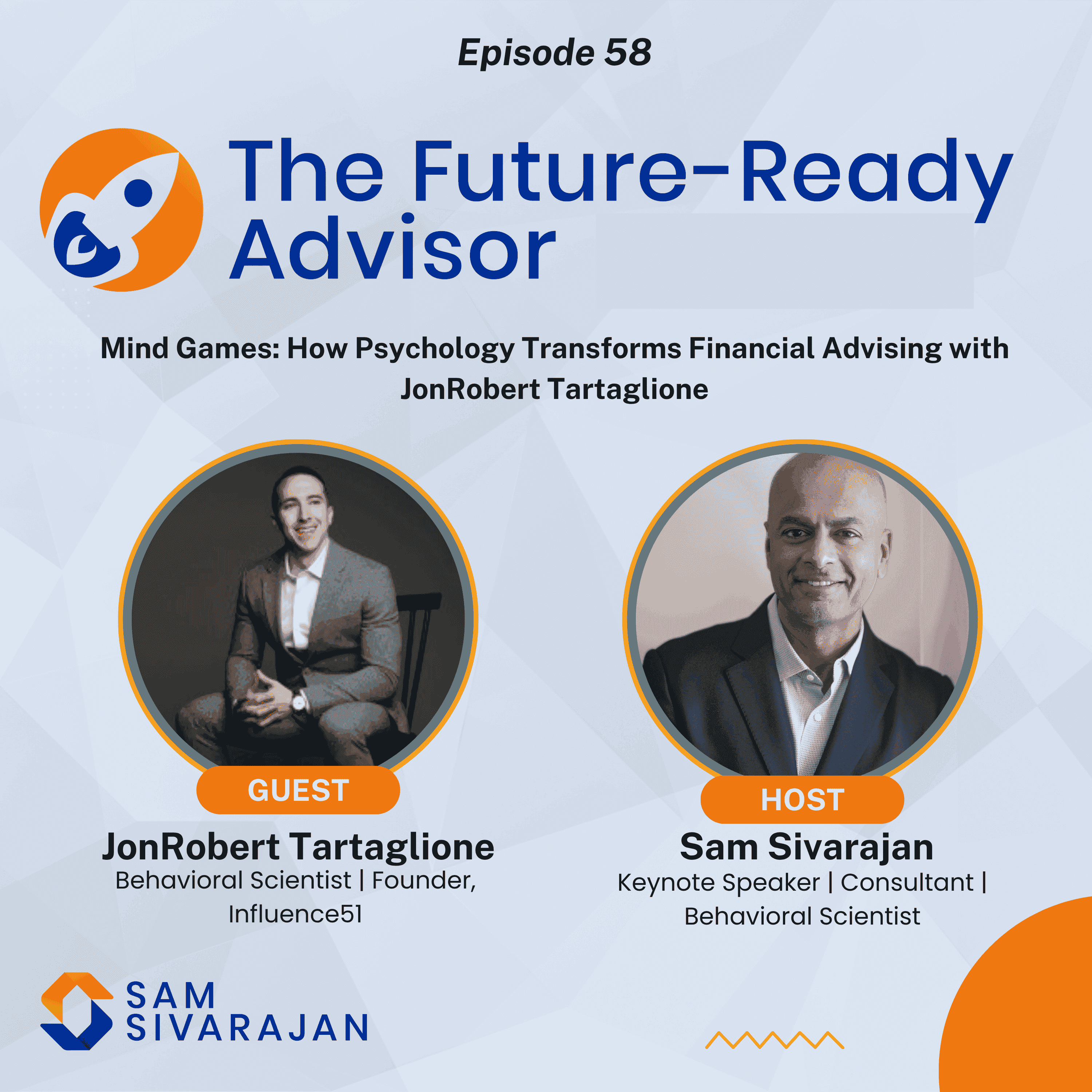
In this episode of The Future-Ready Advisor, host Sam Sivarajan sits down with JonRobert 'Tat' Tartaglione, a behavioral scientist and founder of Influence 51, to explore the fascinating intersection of psychology and financial advising. With a doctorate in psychology from Cambridge, Tat specializes in translating complex behavioral science insights into practical tools that financial professionals can implement immediately.
They discuss how small changes in language and framing can dramatically influence client decisions, why choice architecture matters more than we realize, and how metaphors shape our perception of financial concepts. Tat shares practical examples of behavioral science principles in action, from commitment devices to loss aversion, all tailored specifically for financial advisors seeking to improve client outcomes.
Whether you're looking to enhance client communication, drive behavioral change, or simply understand the psychological forces behind financial decisions, this conversation offers actionable strategies that bridge the gap between academic research and real-world application.
'Language matters so, so much. There is a difference between saying \'80% fat free\' and \'20% fat\'. Even seemingly insignificant tweaks matter.' — JonRobert Tartaglione
Choice architecture dramatically influences decisions - how options are presented matters more than the options themselves.
Metaphors shape financial conversations - the language we use guides how clients conceptualize financial concepts.
Commitment devices drive action - creating accountability structures helps clients follow through on financial plans.
Loss aversion is a powerful motivator - framing choices to highlight what clients might lose creates stronger incentives.
Subtle language changes yield big results - even minor wording adjustments can significantly impact client decisions and behaviors.
'When it comes to choice architecture, the way you present options affects how people choose, even when the options themselves don't change.'
'Money doesn't influence decisions—the psychology around money influences decisions.'
'People will work harder to avoid losing $5 than they will to gain $5, even though mathematically it's the same amount.'
'Budgeting as 'paying your future self' reframes the experience from loss to investment.'
'Metaphors aren't just flowery language—they guide how people conceptualize problems and solutions.'
00:00 - Introduction to JonRobert Tartaglione and Influence 51
01:39 - The Gap Between Behavioral Science Research and Practical Application
06:37 - Understanding Choice Architecture in Financial Advising
15:06 - Loss Aversion and How to Frame Financial Decisions
22:04 - The Power of Commitment Devices to Change Client Behavior
31:24 - Metaphors and Language: How Words Shape Financial Perceptions
46:43 - Making Behavioral Science Concrete for Different Industries
48:15 - The Critical Importance of Language in Client Communications
Learn more about JonRobert Tartaglione and his work: https://www.influence51.com
Subscribe on your favorite podcast platform to never miss an episode.