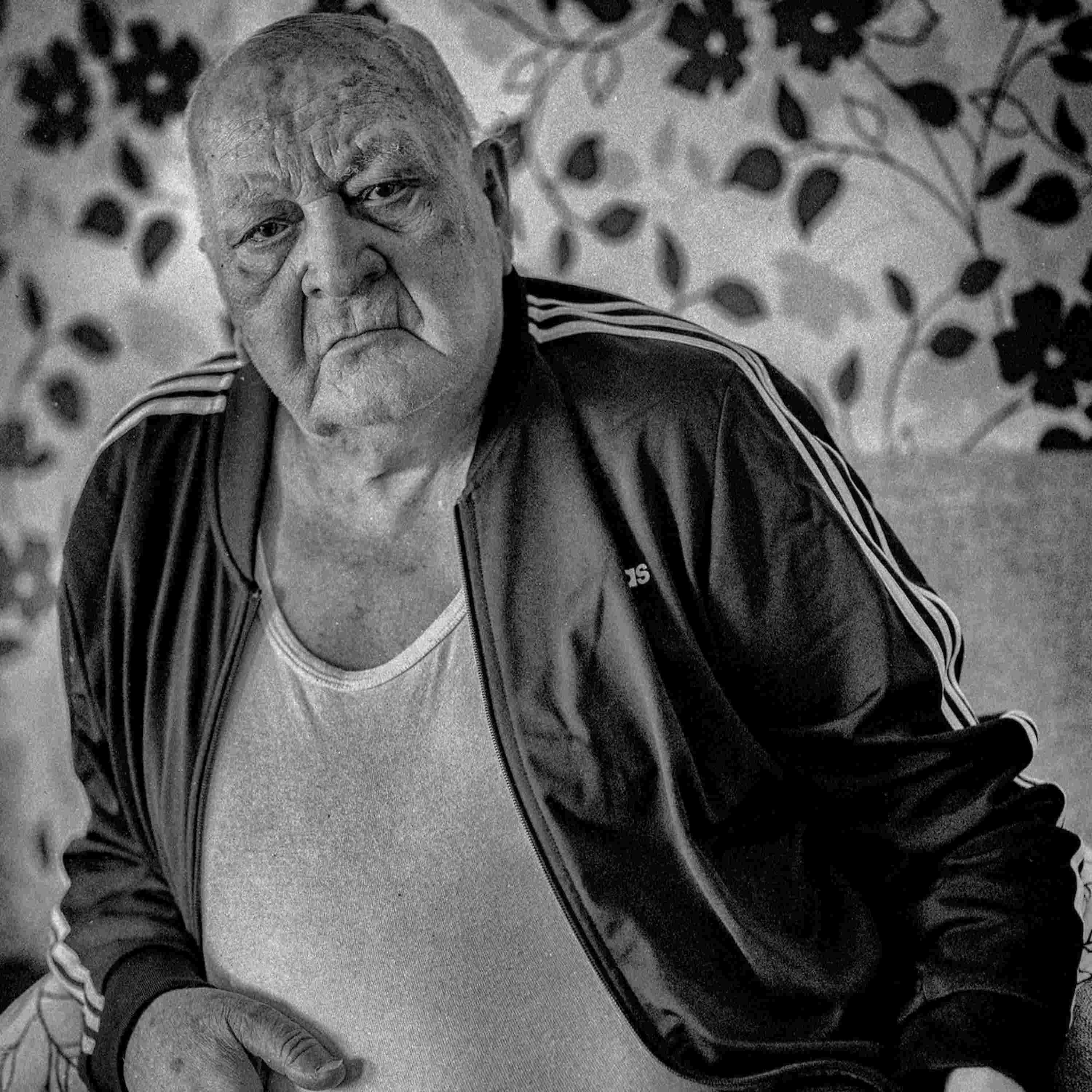
1946
“There were some Jews living in my village, and we were friends with them. In Akka there were more Jews. If I got sick, I used to go to a Jewish doctor in Akka named Nathan. As children, we did not distinguish between Christians, Muslims, and Jews—we were friends.”
1948
“The Jews began attacking us with heavy artillery, just to scare us. Then the aerial bombardments of our village began and people started to flee. Some families refused to leave Tarshiha; they hid with their neighbors, who were Palestinian Jews and Druze. Some of the children and grandchildren of those who hid are still living in Tarshiha today.
There were about twenty people in my family who fled toward Lebanon. We loaded as many mattresses as possible onto one of our horses. I was barefoot, and I was given a pair of shoes, size 42. I was a child. I rode the horse for a while, then I got down and started running barefoot. I remember it clearly. We walked ten kilometers. I was afraid. My parents tried to calm me, but deep down they were also afraid. We were running to escape death.”
– Who was it that drove you out?
“The Jews, but not the same Jews we knew before. These were Jews who came from outside. I saw dead bodies lying in the groves.
After crossing the border into Lebanon, we came to Ayta ash Shab. We ate the food we had brought with us. We continued on to Aleppo in Syria. There were seven of us in the family, and we lived in a barrack. The rooms were three by three meters and were divided with blankets. If someone had sex with his wife, everyone could hear it.
The Nakba took everything from us. The only thing we had left was to study at school. I was good at my studies, but in order to study I had to go outside—there was no space indoors. I remember once in winter, when it was cold and snowy. I had to go out into the cold and sit on the snow to study. I was in the fourth grade.”
2015
“The first exodus, from Palestine, was very hard, but it helped us survive the second exodus, from Syria to Sweden. When I was 74 years old, in 2015, we were forced to flee from Syria to Turkey, crossing the mountains on foot. From Turkey we took a rubber boat across the Aegean Sea to Greece. There were 44 people in the boat; it was approved for a maximum of ten. Then we continued through Macedonia, Yugoslavia, Hungary, Austria, Germany, Denmark, and finally to Sweden.
For the journey to Turkey, my wife and I paid 30,000 kronor, and from Turkey to Sweden the same amount.
I am glad that Sweden took us in, but this is not my father’s house.”
All content for Överlevarna is the property of Överlevarna and is served directly from their servers
with no modification, redirects, or rehosting. The podcast is not affiliated with or endorsed by Podjoint in any way.
1946
“There were some Jews living in my village, and we were friends with them. In Akka there were more Jews. If I got sick, I used to go to a Jewish doctor in Akka named Nathan. As children, we did not distinguish between Christians, Muslims, and Jews—we were friends.”
1948
“The Jews began attacking us with heavy artillery, just to scare us. Then the aerial bombardments of our village began and people started to flee. Some families refused to leave Tarshiha; they hid with their neighbors, who were Palestinian Jews and Druze. Some of the children and grandchildren of those who hid are still living in Tarshiha today.
There were about twenty people in my family who fled toward Lebanon. We loaded as many mattresses as possible onto one of our horses. I was barefoot, and I was given a pair of shoes, size 42. I was a child. I rode the horse for a while, then I got down and started running barefoot. I remember it clearly. We walked ten kilometers. I was afraid. My parents tried to calm me, but deep down they were also afraid. We were running to escape death.”
– Who was it that drove you out?
“The Jews, but not the same Jews we knew before. These were Jews who came from outside. I saw dead bodies lying in the groves.
After crossing the border into Lebanon, we came to Ayta ash Shab. We ate the food we had brought with us. We continued on to Aleppo in Syria. There were seven of us in the family, and we lived in a barrack. The rooms were three by three meters and were divided with blankets. If someone had sex with his wife, everyone could hear it.
The Nakba took everything from us. The only thing we had left was to study at school. I was good at my studies, but in order to study I had to go outside—there was no space indoors. I remember once in winter, when it was cold and snowy. I had to go out into the cold and sit on the snow to study. I was in the fourth grade.”
2015
“The first exodus, from Palestine, was very hard, but it helped us survive the second exodus, from Syria to Sweden. When I was 74 years old, in 2015, we were forced to flee from Syria to Turkey, crossing the mountains on foot. From Turkey we took a rubber boat across the Aegean Sea to Greece. There were 44 people in the boat; it was approved for a maximum of ten. Then we continued through Macedonia, Yugoslavia, Hungary, Austria, Germany, Denmark, and finally to Sweden.
For the journey to Turkey, my wife and I paid 30,000 kronor, and from Turkey to Sweden the same amount.
I am glad that Sweden took us in, but this is not my father’s house.”
“We lived in a small house on Mount Carmel. It was a mixed area with Muslims and Jews. My father worked at a cigarette factory and also sold olive oil. My brother started working at Spinneys supermarket, which was owned by a couple of Englishmen. I had seven Jewish friends in the neighborhood who sometimes came over to our home.
Cohen later became a police chief under the British. Another was named Shabbatai Levi, one was Spector, and a girl was named Sternheim.
My mother invited everyone to eat. She baked bread, boiled eggs with onion skins so they turned brown, and served cheese and yogurt. We spoke Hebrew with one another. My grandfather made Arabic coffee that lasted the whole day.
Cohen’s father used to come and drink coffee with my father.
The girl Sternheim worked in a flower shop. ‘I will protect you,’ she said. ‘I will come and get you wherever you are. Call me and I will come. Don’t be afraid.’
I still remember her phone number: 3917.” (begins to cry)
I had just turned 13 and worked at a café in central Haifa. The owner was named Siegel. He spoke only German. Jochanan also worked at the café, and we became friends. One day Jochanan was hit by a British military jeep. The driver was drunk. Jochanan was taken to the hospital but died four days later.
I wanted to attend his funeral but couldn’t because I had nothing to cover my head with. I stood at the entrance to the cemetery and cried.
‘Is he your brother?’ a man asked.
‘No, he’s my friend, but he was like a brother.’
The man gave me a kippah with a Star of David on it so that I could approach the grave.”
“The first time I noticed unrest was when the Stern Gang blew up a car outside the British police station in Haifa. That was in early 1947.
We moved to Kababir in Haifa, where only Muslims lived. My brother-in-law Ibrahim drove us in his car. We rented an apartment. But after a while it didn’t feel safe in Kababir either, so we moved on to al-Tira, south of Haifa, where we owned a house.
Al-Nakba began when the Haganah blew up 16 houses in al-Tira. Assad al-Bardan, one of our neighbors, went out at night with a lamp to see what was happening. He was shot. There were air raids at night.
People were afraid to sleep in their homes and sought refuge in olive groves and caves. On the last day, before we fled, the shooting was constant. Only my brother and I were at home. My parents were hiding in a cave, but we didn’t know where. We went outside to see what was happening.
‘What are you doing here?’ a man asked. ‘Everyone has already fled.’”
“We didn’t know where to go. We were from Mount Carmel and didn’t know the surroundings of al-Tira. We were afraid. We left our house when the moon had risen and saw about 50 Jewish soldiers entering al-Tira. We lay down on the mountain so as not to be discovered.
As we continued walking, we met Muhammad and Afu. They showed us the way to ‘Ain Hawd. It was dawn when we arrived, but bombs were falling, so we continued south. After three hours we reached Ijzim. There we met our oldest brother, who gave us each a cigarette.
Our brother paid a man to guide us out of Ijzim toward Nablus in the West Bank. There they gave us breakfast and water, and there we finally found our mother and one of her sisters.
Together we continued to Jordan. There was little water. After a couple of months, a truck took us to Duma, outside Damascus in Syria.
We and about ten other families were allowed to stay in a mosque. They divided a hall with blankets where we lived. We stayed there for four or five months. Then the whole family was reunited again—except for one of my brothers, Ahmed, who was imprisoned in Palestine.
I lived in Syria for 36 years. I came to Sweden in 1980.”
Överlevarna
1946
“There were some Jews living in my village, and we were friends with them. In Akka there were more Jews. If I got sick, I used to go to a Jewish doctor in Akka named Nathan. As children, we did not distinguish between Christians, Muslims, and Jews—we were friends.”
1948
“The Jews began attacking us with heavy artillery, just to scare us. Then the aerial bombardments of our village began and people started to flee. Some families refused to leave Tarshiha; they hid with their neighbors, who were Palestinian Jews and Druze. Some of the children and grandchildren of those who hid are still living in Tarshiha today.
There were about twenty people in my family who fled toward Lebanon. We loaded as many mattresses as possible onto one of our horses. I was barefoot, and I was given a pair of shoes, size 42. I was a child. I rode the horse for a while, then I got down and started running barefoot. I remember it clearly. We walked ten kilometers. I was afraid. My parents tried to calm me, but deep down they were also afraid. We were running to escape death.”
– Who was it that drove you out?
“The Jews, but not the same Jews we knew before. These were Jews who came from outside. I saw dead bodies lying in the groves.
After crossing the border into Lebanon, we came to Ayta ash Shab. We ate the food we had brought with us. We continued on to Aleppo in Syria. There were seven of us in the family, and we lived in a barrack. The rooms were three by three meters and were divided with blankets. If someone had sex with his wife, everyone could hear it.
The Nakba took everything from us. The only thing we had left was to study at school. I was good at my studies, but in order to study I had to go outside—there was no space indoors. I remember once in winter, when it was cold and snowy. I had to go out into the cold and sit on the snow to study. I was in the fourth grade.”
2015
“The first exodus, from Palestine, was very hard, but it helped us survive the second exodus, from Syria to Sweden. When I was 74 years old, in 2015, we were forced to flee from Syria to Turkey, crossing the mountains on foot. From Turkey we took a rubber boat across the Aegean Sea to Greece. There were 44 people in the boat; it was approved for a maximum of ten. Then we continued through Macedonia, Yugoslavia, Hungary, Austria, Germany, Denmark, and finally to Sweden.
For the journey to Turkey, my wife and I paid 30,000 kronor, and from Turkey to Sweden the same amount.
I am glad that Sweden took us in, but this is not my father’s house.”