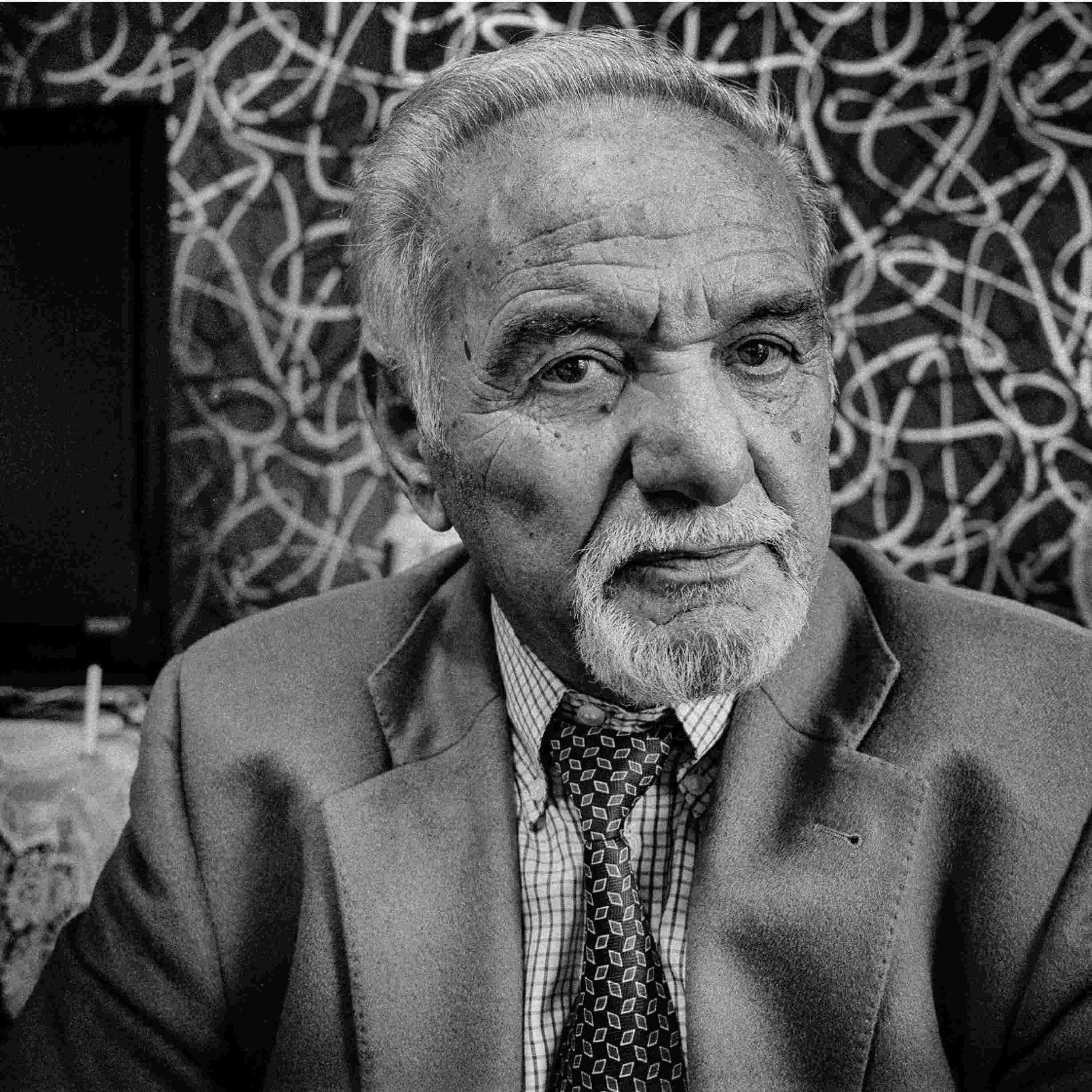
1946
“There were some Jews living in my village, and we were friends with them. In Akka there were more Jews. If I got sick, I used to go to a Jewish doctor in Akka named Nathan. As children, we did not distinguish between Christians, Muslims, and Jews—we were friends.”
1948
“The Jews began attacking us with heavy artillery, just to scare us. Then the aerial bombardments of our village began and people started to flee. Some families refused to leave Tarshiha; they hid with their neighbors, who were Palestinian Jews and Druze. Some of the children and grandchildren of those who hid are still living in Tarshiha today.
There were about twenty people in my family who fled toward Lebanon. We loaded as many mattresses as possible onto one of our horses. I was barefoot, and I was given a pair of shoes, size 42. I was a child. I rode the horse for a while, then I got down and started running barefoot. I remember it clearly. We walked ten kilometers. I was afraid. My parents tried to calm me, but deep down they were also afraid. We were running to escape death.”
– Who was it that drove you out?
“The Jews, but not the same Jews we knew before. These were Jews who came from outside. I saw dead bodies lying in the groves.
After crossing the border into Lebanon, we came to Ayta ash Shab. We ate the food we had brought with us. We continued on to Aleppo in Syria. There were seven of us in the family, and we lived in a barrack. The rooms were three by three meters and were divided with blankets. If someone had sex with his wife, everyone could hear it.
The Nakba took everything from us. The only thing we had left was to study at school. I was good at my studies, but in order to study I had to go outside—there was no space indoors. I remember once in winter, when it was cold and snowy. I had to go out into the cold and sit on the snow to study. I was in the fourth grade.”
2015
“The first exodus, from Palestine, was very hard, but it helped us survive the second exodus, from Syria to Sweden. When I was 74 years old, in 2015, we were forced to flee from Syria to Turkey, crossing the mountains on foot. From Turkey we took a rubber boat across the Aegean Sea to Greece. There were 44 people in the boat; it was approved for a maximum of ten. Then we continued through Macedonia, Yugoslavia, Hungary, Austria, Germany, Denmark, and finally to Sweden.
For the journey to Turkey, my wife and I paid 30,000 kronor, and from Turkey to Sweden the same amount.
I am glad that Sweden took us in, but this is not my father’s house.”
All content for Överlevarna is the property of Överlevarna and is served directly from their servers
with no modification, redirects, or rehosting. The podcast is not affiliated with or endorsed by Podjoint in any way.
1946
“There were some Jews living in my village, and we were friends with them. In Akka there were more Jews. If I got sick, I used to go to a Jewish doctor in Akka named Nathan. As children, we did not distinguish between Christians, Muslims, and Jews—we were friends.”
1948
“The Jews began attacking us with heavy artillery, just to scare us. Then the aerial bombardments of our village began and people started to flee. Some families refused to leave Tarshiha; they hid with their neighbors, who were Palestinian Jews and Druze. Some of the children and grandchildren of those who hid are still living in Tarshiha today.
There were about twenty people in my family who fled toward Lebanon. We loaded as many mattresses as possible onto one of our horses. I was barefoot, and I was given a pair of shoes, size 42. I was a child. I rode the horse for a while, then I got down and started running barefoot. I remember it clearly. We walked ten kilometers. I was afraid. My parents tried to calm me, but deep down they were also afraid. We were running to escape death.”
– Who was it that drove you out?
“The Jews, but not the same Jews we knew before. These were Jews who came from outside. I saw dead bodies lying in the groves.
After crossing the border into Lebanon, we came to Ayta ash Shab. We ate the food we had brought with us. We continued on to Aleppo in Syria. There were seven of us in the family, and we lived in a barrack. The rooms were three by three meters and were divided with blankets. If someone had sex with his wife, everyone could hear it.
The Nakba took everything from us. The only thing we had left was to study at school. I was good at my studies, but in order to study I had to go outside—there was no space indoors. I remember once in winter, when it was cold and snowy. I had to go out into the cold and sit on the snow to study. I was in the fourth grade.”
2015
“The first exodus, from Palestine, was very hard, but it helped us survive the second exodus, from Syria to Sweden. When I was 74 years old, in 2015, we were forced to flee from Syria to Turkey, crossing the mountains on foot. From Turkey we took a rubber boat across the Aegean Sea to Greece. There were 44 people in the boat; it was approved for a maximum of ten. Then we continued through Macedonia, Yugoslavia, Hungary, Austria, Germany, Denmark, and finally to Sweden.
For the journey to Turkey, my wife and I paid 30,000 kronor, and from Turkey to Sweden the same amount.
I am glad that Sweden took us in, but this is not my father’s house.”
1946
”My father owned a lot of land where he grew wheat and tobacco. He sold the tobacco to a company in ‘Akka. We had sheep, goats, camels, and cows. My father bought donkeys from Cyprus; they were strong.
I used to help with the milking. I would scoop the top layer of milk from the bucket with my hand and drink it.
I ran around on our land. When I think about it now, it feels as if I was flying above ground covered with flowers. I was free.
In winter we gathered firewood and loaded it onto camels.
Deir al-Qasi lay high up on a mountain with a beautiful view and fresh air. People from ‘Akka and Haifa often came on weekend outings to our village.
There were no Jews living in Deir al-Qasi. But Nahariya, which was nearby, was a Jewish village. We had good relations with them. They came to shop in our village, and we went to a doctor in theirs.
Before the Nakba, I did not notice any tension between us and the Jews. However, there were strong tensions between the British and the Palestinian resistance fighters. We were constantly afraid of the British soldiers.”
1948
”I had turned eight years old and noticed nothing about the war approaching. Suddenly people fled from al-Quds to our village.
One day I was going to milk the goat. I was standing in the shade of a tree. Suddenly I heard a loud explosion. When I looked up, I saw three airplanes dropping bombs. I got scared and ran back to our house. I saw black smoke rising.
By a well stood a man. His leg had been torn off. I felt pain and saw blood coming from my shoulder. My father, who was ill, was lying down resting. I tried to lift him up, but I did not have the strength.
“The Zionists are coming!” my cousin shouted as he came running.
My father slowly rose from the bed and we left the house.
Outside, all the animals had been killed in the bombing. Even the dog was dead. The camels survived because they were with my grandfather.
Everyone fled—men, women, children, and the elderly. We went to seek shelter in a nearby forest. My father leaned on my cousin for support. In the darkness I saw dead bodies on the ground. We continued walking toward the Lebanese border.
We had no food and no water. At the border stood Israeli soldiers. They shot a young man before our eyes.
“Dear ones, go to your leader, he will give you food,” one of the soldiers shouted to us.
We crossed the border and arrived in the village of Ayta ash-Shab, where my father had a cousin. We were able to stay there.
After a while, when things had calmed down, my mother and I returned to our farm. I brought some chickens with me from there. My mother also took some things from inside the house—I don’t know what. That was the only time we returned. Later, the house was demolished.
We stayed with my father’s cousin for three days. So many refugees had gathered in Ayta ash-Shab that we decided to go north to a refugee camp in the city of Sur. There we hired a truck and everyone was driven eastward, toward the Syrian border, to the Baalbek refugee camp.
Our family and five other families had to share one barrack. We remained there for twelve years, until the early 1960s.”
Afterthought
I make a distinction between Jews and Israelis. Jews and Arabs lived in peace in Palestine. But the Zionists who came from Europe destroyed my life. I hate Zionists, but not Jews.
Every day I dream of returning to Deir al-Qasi, the most beautiful village in the world. But I have no passport."
Överlevarna
1946
“There were some Jews living in my village, and we were friends with them. In Akka there were more Jews. If I got sick, I used to go to a Jewish doctor in Akka named Nathan. As children, we did not distinguish between Christians, Muslims, and Jews—we were friends.”
1948
“The Jews began attacking us with heavy artillery, just to scare us. Then the aerial bombardments of our village began and people started to flee. Some families refused to leave Tarshiha; they hid with their neighbors, who were Palestinian Jews and Druze. Some of the children and grandchildren of those who hid are still living in Tarshiha today.
There were about twenty people in my family who fled toward Lebanon. We loaded as many mattresses as possible onto one of our horses. I was barefoot, and I was given a pair of shoes, size 42. I was a child. I rode the horse for a while, then I got down and started running barefoot. I remember it clearly. We walked ten kilometers. I was afraid. My parents tried to calm me, but deep down they were also afraid. We were running to escape death.”
– Who was it that drove you out?
“The Jews, but not the same Jews we knew before. These were Jews who came from outside. I saw dead bodies lying in the groves.
After crossing the border into Lebanon, we came to Ayta ash Shab. We ate the food we had brought with us. We continued on to Aleppo in Syria. There were seven of us in the family, and we lived in a barrack. The rooms were three by three meters and were divided with blankets. If someone had sex with his wife, everyone could hear it.
The Nakba took everything from us. The only thing we had left was to study at school. I was good at my studies, but in order to study I had to go outside—there was no space indoors. I remember once in winter, when it was cold and snowy. I had to go out into the cold and sit on the snow to study. I was in the fourth grade.”
2015
“The first exodus, from Palestine, was very hard, but it helped us survive the second exodus, from Syria to Sweden. When I was 74 years old, in 2015, we were forced to flee from Syria to Turkey, crossing the mountains on foot. From Turkey we took a rubber boat across the Aegean Sea to Greece. There were 44 people in the boat; it was approved for a maximum of ten. Then we continued through Macedonia, Yugoslavia, Hungary, Austria, Germany, Denmark, and finally to Sweden.
For the journey to Turkey, my wife and I paid 30,000 kronor, and from Turkey to Sweden the same amount.
I am glad that Sweden took us in, but this is not my father’s house.”