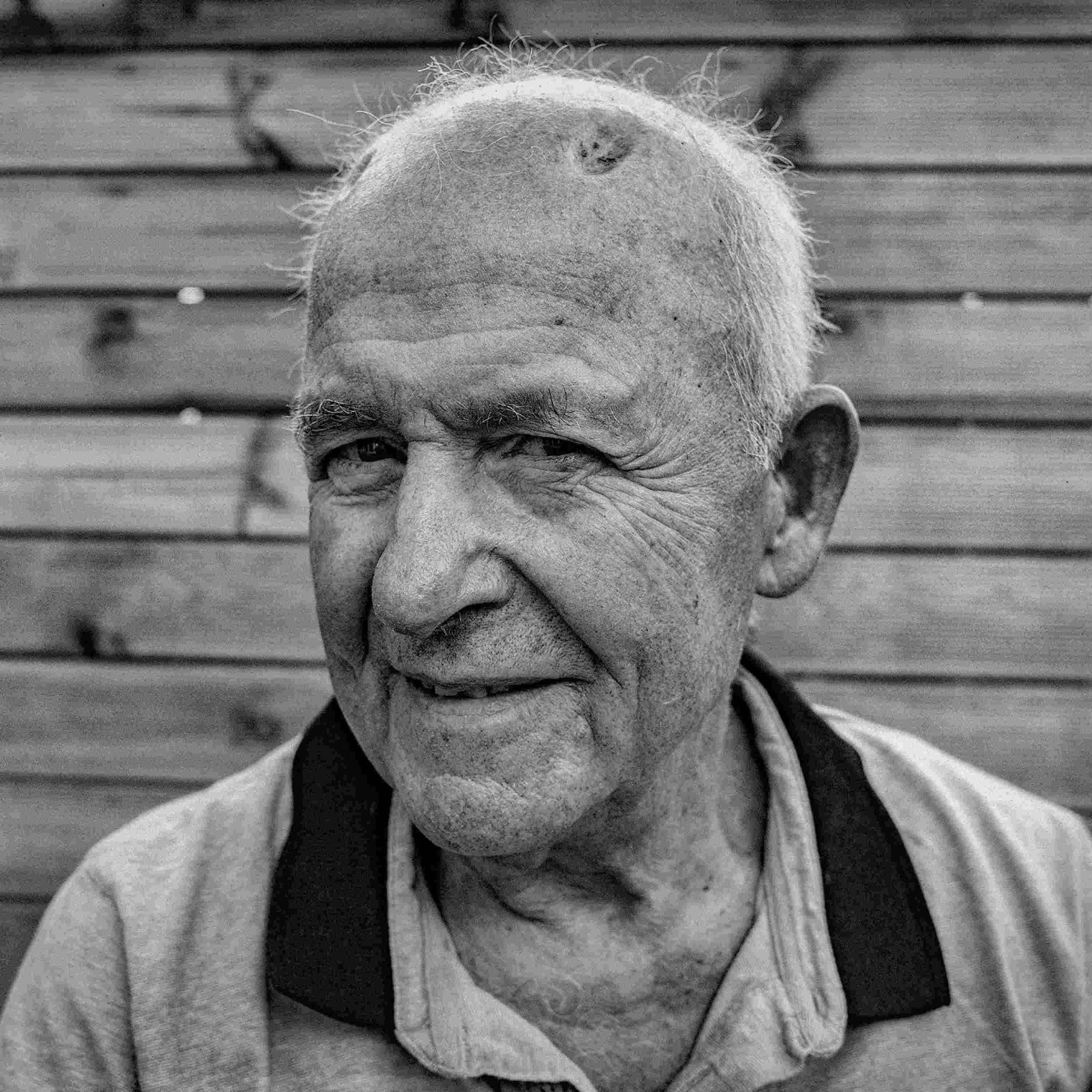
1946
“There were some Jews living in my village, and we were friends with them. In Akka there were more Jews. If I got sick, I used to go to a Jewish doctor in Akka named Nathan. As children, we did not distinguish between Christians, Muslims, and Jews—we were friends.”
1948
“The Jews began attacking us with heavy artillery, just to scare us. Then the aerial bombardments of our village began and people started to flee. Some families refused to leave Tarshiha; they hid with their neighbors, who were Palestinian Jews and Druze. Some of the children and grandchildren of those who hid are still living in Tarshiha today.
There were about twenty people in my family who fled toward Lebanon. We loaded as many mattresses as possible onto one of our horses. I was barefoot, and I was given a pair of shoes, size 42. I was a child. I rode the horse for a while, then I got down and started running barefoot. I remember it clearly. We walked ten kilometers. I was afraid. My parents tried to calm me, but deep down they were also afraid. We were running to escape death.”
– Who was it that drove you out?
“The Jews, but not the same Jews we knew before. These were Jews who came from outside. I saw dead bodies lying in the groves.
After crossing the border into Lebanon, we came to Ayta ash Shab. We ate the food we had brought with us. We continued on to Aleppo in Syria. There were seven of us in the family, and we lived in a barrack. The rooms were three by three meters and were divided with blankets. If someone had sex with his wife, everyone could hear it.
The Nakba took everything from us. The only thing we had left was to study at school. I was good at my studies, but in order to study I had to go outside—there was no space indoors. I remember once in winter, when it was cold and snowy. I had to go out into the cold and sit on the snow to study. I was in the fourth grade.”
2015
“The first exodus, from Palestine, was very hard, but it helped us survive the second exodus, from Syria to Sweden. When I was 74 years old, in 2015, we were forced to flee from Syria to Turkey, crossing the mountains on foot. From Turkey we took a rubber boat across the Aegean Sea to Greece. There were 44 people in the boat; it was approved for a maximum of ten. Then we continued through Macedonia, Yugoslavia, Hungary, Austria, Germany, Denmark, and finally to Sweden.
For the journey to Turkey, my wife and I paid 30,000 kronor, and from Turkey to Sweden the same amount.
I am glad that Sweden took us in, but this is not my father’s house.”
All content for Överlevarna is the property of Överlevarna and is served directly from their servers
with no modification, redirects, or rehosting. The podcast is not affiliated with or endorsed by Podjoint in any way.
1946
“There were some Jews living in my village, and we were friends with them. In Akka there were more Jews. If I got sick, I used to go to a Jewish doctor in Akka named Nathan. As children, we did not distinguish between Christians, Muslims, and Jews—we were friends.”
1948
“The Jews began attacking us with heavy artillery, just to scare us. Then the aerial bombardments of our village began and people started to flee. Some families refused to leave Tarshiha; they hid with their neighbors, who were Palestinian Jews and Druze. Some of the children and grandchildren of those who hid are still living in Tarshiha today.
There were about twenty people in my family who fled toward Lebanon. We loaded as many mattresses as possible onto one of our horses. I was barefoot, and I was given a pair of shoes, size 42. I was a child. I rode the horse for a while, then I got down and started running barefoot. I remember it clearly. We walked ten kilometers. I was afraid. My parents tried to calm me, but deep down they were also afraid. We were running to escape death.”
– Who was it that drove you out?
“The Jews, but not the same Jews we knew before. These were Jews who came from outside. I saw dead bodies lying in the groves.
After crossing the border into Lebanon, we came to Ayta ash Shab. We ate the food we had brought with us. We continued on to Aleppo in Syria. There were seven of us in the family, and we lived in a barrack. The rooms were three by three meters and were divided with blankets. If someone had sex with his wife, everyone could hear it.
The Nakba took everything from us. The only thing we had left was to study at school. I was good at my studies, but in order to study I had to go outside—there was no space indoors. I remember once in winter, when it was cold and snowy. I had to go out into the cold and sit on the snow to study. I was in the fourth grade.”
2015
“The first exodus, from Palestine, was very hard, but it helped us survive the second exodus, from Syria to Sweden. When I was 74 years old, in 2015, we were forced to flee from Syria to Turkey, crossing the mountains on foot. From Turkey we took a rubber boat across the Aegean Sea to Greece. There were 44 people in the boat; it was approved for a maximum of ten. Then we continued through Macedonia, Yugoslavia, Hungary, Austria, Germany, Denmark, and finally to Sweden.
For the journey to Turkey, my wife and I paid 30,000 kronor, and from Turkey to Sweden the same amount.
I am glad that Sweden took us in, but this is not my father’s house.”
1948
"The Zionists killed my maternal uncle, Ahmed Shaban, and three others. They were shot in front of all the villagers. My uncle, who was perhaps 30 years old, was in the resistance movement, first against the British occupation, then against the Zionists'. After the executions, people got scared.
Half of my relatives fled to Syria, my paternal uncle fled to Jordan and we to Lebanon, on foot. The only thing we brought with us were the clothes we were wearing. I was four years old. During the flight, I heard gunfire and got scared. I wanted mum to carry me. My little sister started screaming too and wanted to be carried too. After al-Nakba my parents were sad."
1955
"In the Ain al-Hilweh refugee camp in Lebanon I went to school. The teachers were very harsh. They hit us. Once I got a beating when I was standing outside the school smoking. I was eleven years old then. I was more scared of my teachers than of my parents. In the beginning I hated them, but then I understood that they wanted to take care of us. After school we used to go into Saida, a 20-minute walk. We pinched oranges from the plantations along the way. In Saida we went to the cinema. I liked everything with Omar Sharif and Faten Hamama. We were home again for dinner, at eight, nine.
My parents were offered to become Lebanese citizens, but they declined. They expected to be able to return to Palestine. Nasser and the Arab world promised that they would be allowed to return. They promised and promised. The Arab world is the Palestinians' worst enemy. It was a mistake to refuse to become Lebanese."
1961
"Me and my friends were politically active and organized demonstrations in the camp. We got in trouble with the Lebanese security police. Once a friend told a funny story that I laughed at. Then some Lebanese security police showed up and wanted to know what was so funny. We had to spend the night at their place. We were oppressed by the Lebanese security police. I left the refugee camp in 1964 and started at a UN school in Siblin, outside Saida. There, the Lebanese security police tried to recruit me as an agent. I would get 150 lira a month. That was a lot of money at the time. They would give me a pistol and promised to pay for my parties. All I had to do was snitch on my friends..
1967
"I was bullied by my Swedish colleagues. They imitated the defeated Egyptian soldiers who had fled barefoot through the desert.
One of them kept calling me a "fucking Arab". I took a stranglehold on my honor as a slut. To defend myself against the bullies, I joined the KPML(r)."
1995
"When I became a Swedish citizen, my family and I were able to go back to my home village. The only thing left was the mosque and the cemetery. The mosque was full of cow dung, so we started cleaning it. After that, six Israeli soldiers showed up and explained that there were too many of us in there.
"This counts as a demonstration," said one of the soldiers.
"It's not a demonstration, we're just cleaning the mosque. I'm a Swedish citizen and I was born in this village."
"Okay, don't let me go, don't let me go, let's say he left us alone."
Reflection
"At night I dream that I kill all the Arab leaders. I fly in a helicopter and shoot them. I hate them more than I hate Zionism. I respect the Israeli leaders because they take care of their own people."
Överlevarna
1946
“There were some Jews living in my village, and we were friends with them. In Akka there were more Jews. If I got sick, I used to go to a Jewish doctor in Akka named Nathan. As children, we did not distinguish between Christians, Muslims, and Jews—we were friends.”
1948
“The Jews began attacking us with heavy artillery, just to scare us. Then the aerial bombardments of our village began and people started to flee. Some families refused to leave Tarshiha; they hid with their neighbors, who were Palestinian Jews and Druze. Some of the children and grandchildren of those who hid are still living in Tarshiha today.
There were about twenty people in my family who fled toward Lebanon. We loaded as many mattresses as possible onto one of our horses. I was barefoot, and I was given a pair of shoes, size 42. I was a child. I rode the horse for a while, then I got down and started running barefoot. I remember it clearly. We walked ten kilometers. I was afraid. My parents tried to calm me, but deep down they were also afraid. We were running to escape death.”
– Who was it that drove you out?
“The Jews, but not the same Jews we knew before. These were Jews who came from outside. I saw dead bodies lying in the groves.
After crossing the border into Lebanon, we came to Ayta ash Shab. We ate the food we had brought with us. We continued on to Aleppo in Syria. There were seven of us in the family, and we lived in a barrack. The rooms were three by three meters and were divided with blankets. If someone had sex with his wife, everyone could hear it.
The Nakba took everything from us. The only thing we had left was to study at school. I was good at my studies, but in order to study I had to go outside—there was no space indoors. I remember once in winter, when it was cold and snowy. I had to go out into the cold and sit on the snow to study. I was in the fourth grade.”
2015
“The first exodus, from Palestine, was very hard, but it helped us survive the second exodus, from Syria to Sweden. When I was 74 years old, in 2015, we were forced to flee from Syria to Turkey, crossing the mountains on foot. From Turkey we took a rubber boat across the Aegean Sea to Greece. There were 44 people in the boat; it was approved for a maximum of ten. Then we continued through Macedonia, Yugoslavia, Hungary, Austria, Germany, Denmark, and finally to Sweden.
For the journey to Turkey, my wife and I paid 30,000 kronor, and from Turkey to Sweden the same amount.
I am glad that Sweden took us in, but this is not my father’s house.”