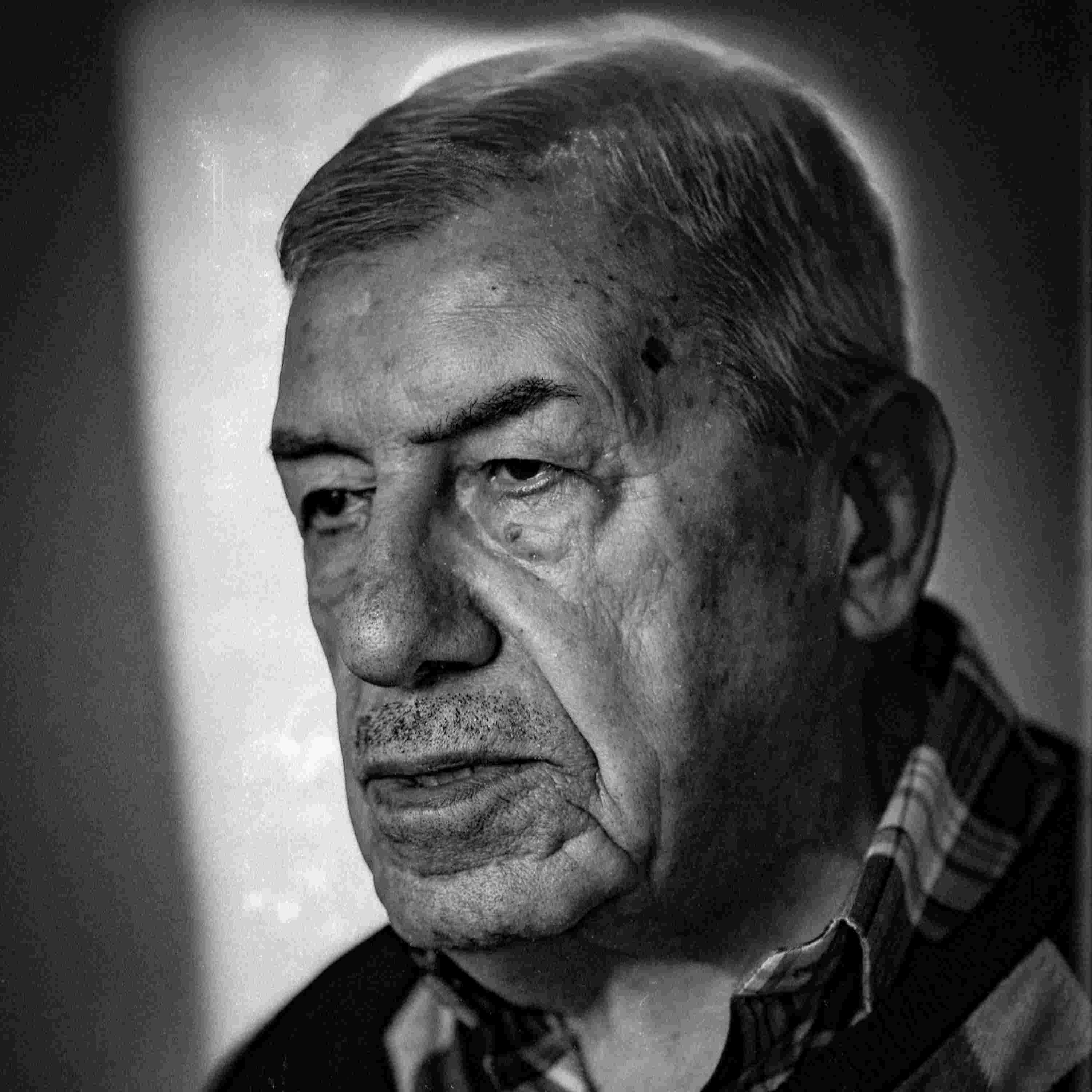
1946
“There were some Jews living in my village, and we were friends with them. In Akka there were more Jews. If I got sick, I used to go to a Jewish doctor in Akka named Nathan. As children, we did not distinguish between Christians, Muslims, and Jews—we were friends.”
1948
“The Jews began attacking us with heavy artillery, just to scare us. Then the aerial bombardments of our village began and people started to flee. Some families refused to leave Tarshiha; they hid with their neighbors, who were Palestinian Jews and Druze. Some of the children and grandchildren of those who hid are still living in Tarshiha today.
There were about twenty people in my family who fled toward Lebanon. We loaded as many mattresses as possible onto one of our horses. I was barefoot, and I was given a pair of shoes, size 42. I was a child. I rode the horse for a while, then I got down and started running barefoot. I remember it clearly. We walked ten kilometers. I was afraid. My parents tried to calm me, but deep down they were also afraid. We were running to escape death.”
– Who was it that drove you out?
“The Jews, but not the same Jews we knew before. These were Jews who came from outside. I saw dead bodies lying in the groves.
After crossing the border into Lebanon, we came to Ayta ash Shab. We ate the food we had brought with us. We continued on to Aleppo in Syria. There were seven of us in the family, and we lived in a barrack. The rooms were three by three meters and were divided with blankets. If someone had sex with his wife, everyone could hear it.
The Nakba took everything from us. The only thing we had left was to study at school. I was good at my studies, but in order to study I had to go outside—there was no space indoors. I remember once in winter, when it was cold and snowy. I had to go out into the cold and sit on the snow to study. I was in the fourth grade.”
2015
“The first exodus, from Palestine, was very hard, but it helped us survive the second exodus, from Syria to Sweden. When I was 74 years old, in 2015, we were forced to flee from Syria to Turkey, crossing the mountains on foot. From Turkey we took a rubber boat across the Aegean Sea to Greece. There were 44 people in the boat; it was approved for a maximum of ten. Then we continued through Macedonia, Yugoslavia, Hungary, Austria, Germany, Denmark, and finally to Sweden.
For the journey to Turkey, my wife and I paid 30,000 kronor, and from Turkey to Sweden the same amount.
I am glad that Sweden took us in, but this is not my father’s house.”
All content for Överlevarna is the property of Överlevarna and is served directly from their servers
with no modification, redirects, or rehosting. The podcast is not affiliated with or endorsed by Podjoint in any way.
1946
“There were some Jews living in my village, and we were friends with them. In Akka there were more Jews. If I got sick, I used to go to a Jewish doctor in Akka named Nathan. As children, we did not distinguish between Christians, Muslims, and Jews—we were friends.”
1948
“The Jews began attacking us with heavy artillery, just to scare us. Then the aerial bombardments of our village began and people started to flee. Some families refused to leave Tarshiha; they hid with their neighbors, who were Palestinian Jews and Druze. Some of the children and grandchildren of those who hid are still living in Tarshiha today.
There were about twenty people in my family who fled toward Lebanon. We loaded as many mattresses as possible onto one of our horses. I was barefoot, and I was given a pair of shoes, size 42. I was a child. I rode the horse for a while, then I got down and started running barefoot. I remember it clearly. We walked ten kilometers. I was afraid. My parents tried to calm me, but deep down they were also afraid. We were running to escape death.”
– Who was it that drove you out?
“The Jews, but not the same Jews we knew before. These were Jews who came from outside. I saw dead bodies lying in the groves.
After crossing the border into Lebanon, we came to Ayta ash Shab. We ate the food we had brought with us. We continued on to Aleppo in Syria. There were seven of us in the family, and we lived in a barrack. The rooms were three by three meters and were divided with blankets. If someone had sex with his wife, everyone could hear it.
The Nakba took everything from us. The only thing we had left was to study at school. I was good at my studies, but in order to study I had to go outside—there was no space indoors. I remember once in winter, when it was cold and snowy. I had to go out into the cold and sit on the snow to study. I was in the fourth grade.”
2015
“The first exodus, from Palestine, was very hard, but it helped us survive the second exodus, from Syria to Sweden. When I was 74 years old, in 2015, we were forced to flee from Syria to Turkey, crossing the mountains on foot. From Turkey we took a rubber boat across the Aegean Sea to Greece. There were 44 people in the boat; it was approved for a maximum of ten. Then we continued through Macedonia, Yugoslavia, Hungary, Austria, Germany, Denmark, and finally to Sweden.
For the journey to Turkey, my wife and I paid 30,000 kronor, and from Turkey to Sweden the same amount.
I am glad that Sweden took us in, but this is not my father’s house.”
1946
"We were farmers and grew wheat, olives, fruit and tobacco. Our tobacco was well-known, it was on a level with the Greek. We had different names for each area of land, depending on what we grew on it. Sometimes we slept in the fields. The land is our life, it is more important than the houses, better than working in a factory."
1948
"I was in fourth grade. We were used to the Zionists attacking us. We used to flee a bit away from the village and stay in an olive grove. When things calmed down, we returned to our house. We had received reinforcement from a volunteer Arab force from Syria. But after a while it got worse and the Arab force left us to our fate. We heard stories of how Jewish soldiers killed women and children in other villages.
I remember the planes that attacked the village. One of the pilots shot at a woman in a wheelchair. At the same time we were attacked on the ground by Jewish soldiers. Chaos and panic broke out among thousands of villagers. We fled on foot to Lebanon. We brought one of our horses and loaded some mattresses. I myself was wearing shorts. When we passed Safad we heard that the city had been occupied by the Zionists. Then we started running. We were attacked from the air and by Jewish soldiers on the ground. Even when we sat under the olive trees they came and shot at us. Some who returned to the village were killed. That's what we heard.
In Lebanon we sold the horse. We needed the money. We took a freight train from Tyre to Aleppo in Syria. At each station along the way, they emptied one or two wagons of refugees, so that not all refugees ended up in the same place. In Aleppo we were first placed in al-Nayrab, an old French military camp, which was next to the airport. Then we had to move into Aleppo. There we got to live in a building that had previously been a hospital."
Afterthought
- Doesn’t the feeling for your lost land disappear with the years?
“On the contrary, it remains, and we inherit that feeling from parents to children and grandchildren.”
- As a lawyer, do you want compensation for your lost land, or do you want the land back?
"I want the land (laughs). The land is a person's life. We don't sell any land, no houses. I am not a seller. I sell nothing. We inherit the land from generation to generation. I am still a refugee. I have no country, no passport, no rights. I don't know what happened to my schoolmates. I never got to finish fourth grade."
Överlevarna
1946
“There were some Jews living in my village, and we were friends with them. In Akka there were more Jews. If I got sick, I used to go to a Jewish doctor in Akka named Nathan. As children, we did not distinguish between Christians, Muslims, and Jews—we were friends.”
1948
“The Jews began attacking us with heavy artillery, just to scare us. Then the aerial bombardments of our village began and people started to flee. Some families refused to leave Tarshiha; they hid with their neighbors, who were Palestinian Jews and Druze. Some of the children and grandchildren of those who hid are still living in Tarshiha today.
There were about twenty people in my family who fled toward Lebanon. We loaded as many mattresses as possible onto one of our horses. I was barefoot, and I was given a pair of shoes, size 42. I was a child. I rode the horse for a while, then I got down and started running barefoot. I remember it clearly. We walked ten kilometers. I was afraid. My parents tried to calm me, but deep down they were also afraid. We were running to escape death.”
– Who was it that drove you out?
“The Jews, but not the same Jews we knew before. These were Jews who came from outside. I saw dead bodies lying in the groves.
After crossing the border into Lebanon, we came to Ayta ash Shab. We ate the food we had brought with us. We continued on to Aleppo in Syria. There were seven of us in the family, and we lived in a barrack. The rooms were three by three meters and were divided with blankets. If someone had sex with his wife, everyone could hear it.
The Nakba took everything from us. The only thing we had left was to study at school. I was good at my studies, but in order to study I had to go outside—there was no space indoors. I remember once in winter, when it was cold and snowy. I had to go out into the cold and sit on the snow to study. I was in the fourth grade.”
2015
“The first exodus, from Palestine, was very hard, but it helped us survive the second exodus, from Syria to Sweden. When I was 74 years old, in 2015, we were forced to flee from Syria to Turkey, crossing the mountains on foot. From Turkey we took a rubber boat across the Aegean Sea to Greece. There were 44 people in the boat; it was approved for a maximum of ten. Then we continued through Macedonia, Yugoslavia, Hungary, Austria, Germany, Denmark, and finally to Sweden.
For the journey to Turkey, my wife and I paid 30,000 kronor, and from Turkey to Sweden the same amount.
I am glad that Sweden took us in, but this is not my father’s house.”